Part 1
Sacred geography, devotion, and the quiet endurance of olive wood
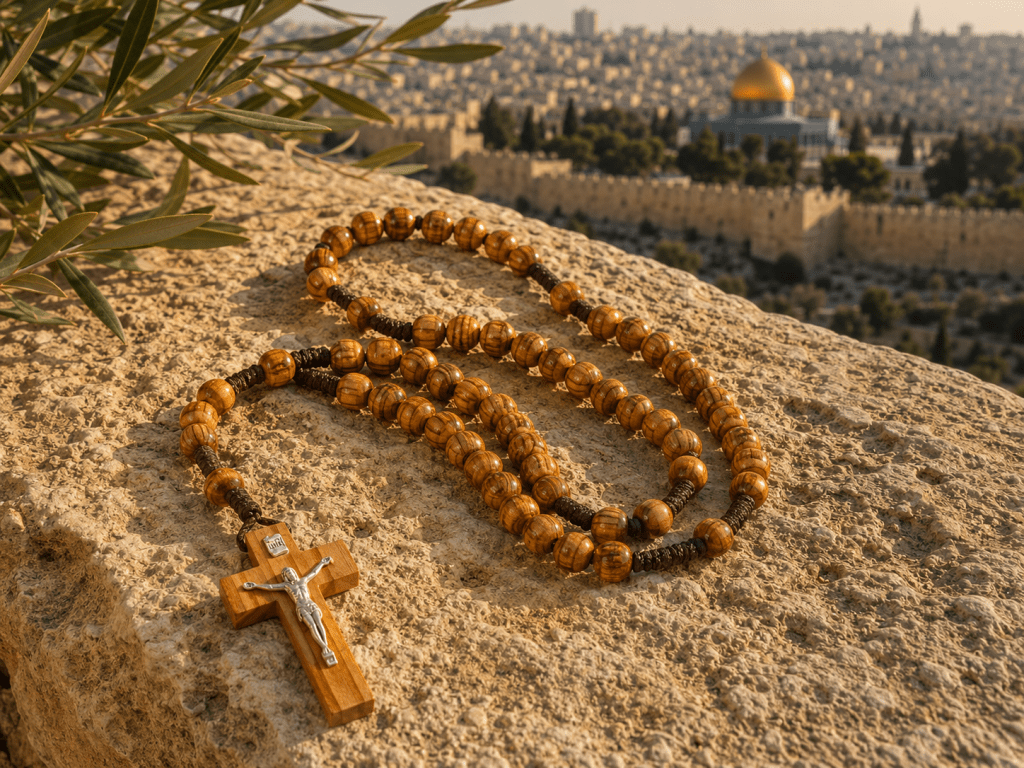
Walk into almost any Catholic gift shop, monastery bookstore, pilgrimage site, parish library, or family collection, and one rosary material appears again and again:
olive wood.
Pale honey-colored beads.
Swirling grain.
A warmth that seems to settle naturally into the hand.
Even before prayer begins, olive wood often feels different from other rosary materials.
Not grand.
Not ornate.
Not especially rare.
And yet it possesses a quiet familiarity that many people immediately recognize.
Perhaps because olive wood rarely feels like decoration alone.
It feels connected.
Connected to stories.
To landscapes.
To places whose names have echoed through Christian memory for centuries.
Bethlehem.
Jerusalem.
The Mount of Olives.
Gethsemane.
For many Catholics, an olive wood rosary feels less like an object and more like a reminder.
A reminder that faith unfolded in real places.
Among real trees.
Along dusty roads and stone pathways where ordinary people lived, worked, prayed, worried, hoped, and endured.
This association has made olive wood one of the most beloved materials in rosary making. Pilgrims carry it home from the Holy Land. Families pass it down through generations. Artisans continue to shape it into beads, crucifixes, and devotional objects that find their way into pockets, prayer corners, and bedside drawers around the world.
Yet olive wood did not become important simply because it came from somewhere holy.
Its story begins much earlier.
Before rosaries.
Before pilgrimage souvenirs.
Before Christian devotion.
It begins with a tree that fed communities, illuminated homes, provided oil for daily life, and became woven so deeply into Mediterranean culture that its branches, fruit, and oil eventually gathered layers of meaning far beyond their practical use.
Why olive wood?
Why did this material become so enduring in Catholic devotion?
And what story might an olive wood rosary quietly carry in the hand?
To answer that, we must begin with the tree itself.

 The Living Rosary Archives