Purpose of This Appendix
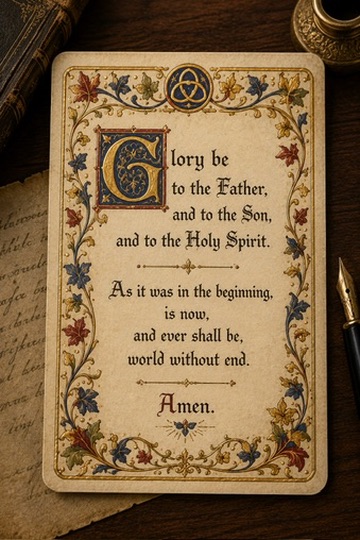
The Glory Be (also known as the Lesser Doxology) is among the oldest and most widely used prayers in Christianity.
Because of its ancient origins, numerous claims exist concerning its authorship, development, purpose, and theological significance.
Some of these claims are strongly supported by historical evidence.
Others belong to a later tradition or popular assumption.
This appendix evaluates common claims associated with the Glory Be and identifies the historical basis for each.
Evidence Categories
A — Official Church Teaching
Supported by:
- Sacred Scripture
- Ecumenical Councils
- Catechisms
- Liturgical Books
- Official Church Documents
B — Strong Historical Evidence
Supported by:
- Early Christian writings
- Liturgical texts
- Historical documentation
Widely accepted by historians.
C — Later Historical Tradition
Supported by later historical witnesses but lacking direct contemporary evidence.
D — Pious Tradition
Spiritually meaningful tradition that cannot be historically verified.
E — Popular Misconception
A claim that oversimplifies or contradicts available evidence.
Origins of the Prayer
Claim: The Glory Be is one of Christianity’s oldest surviving prayers.
Assessment: Historically Supported.
Evidence Category: B
Sources
- Early Christian liturgies
- Patristic writings
- Ancient doxological formulas
Notes
The prayer’s roots reach into the first centuries of Christianity.
Claim: The Apostles personally composed the Glory Be.
Assessment: Historically Uncertain.
Evidence Category: C
Notes
No historical source identifies a specific apostolic author.
The prayer reflects early Christian worship but cannot be directly attributed to the Apostles.
Claim: The Glory Be developed from early Christian praise formulas.
Assessment: Historically Supported.
Evidence Category: B
Sources
- New Testament doxologies
- Early liturgical traditions
Notes
The prayer emerged from a broader tradition of Trinitarian praise.
Scripture and the Glory Be
Claim: The Glory Be comes directly from a single biblical passage.
Assessment: Historically Incorrect.
Evidence Category: E
Notes
The prayer is inspired by biblical themes but is not a direct quotation of any single verse.
Claim: The Glory Be reflects biblical worship language.
Assessment: Historically Supported.
Evidence Category: A
Sources
- Romans 11:36
- Ephesians 3:21
- Revelation doxologies
- Other New Testament praise formulas
Notes
The prayer summarizes themes frequently found throughout Scripture.
Trinitarian Theology
Claim: The Glory Be is a Trinitarian prayer.
Assessment: Historically Supported.
Evidence Category: A
Notes
The prayer explicitly glorifies:
The Father
The Son
The Holy Spirit
Claim: The prayer helped reinforce orthodox Trinitarian belief.
Assessment: Historically Supported.
Evidence Category: B
Sources
- Patristic writings
- Post-Nicene liturgical traditions
Notes
The prayer became increasingly important during periods of doctrinal controversy.
Claim: The Glory Be was created specifically to combat Arianism.
Assessment: Historically Plausible but Uncertain.
Evidence Category: C
Notes
The prayer predates the formal Arian controversy, though its widespread use certainly reinforced orthodox Trinitarian theology.
East and West
Claim: Eastern and Western Christians use identical versions of the Glory Be.
Assessment: Historically Incorrect.
Evidence Category: E
Notes
Both traditions share the same theological purpose but employ different wording and liturgical forms.
Claim
The Glory Be exists in both Eastern and Western Christianity.
Assessment: Historically Supported.
Evidence Category: B
Sources
- Eastern liturgies
- Western liturgies
Notes
The prayer belongs to the shared heritage of ancient Christianity.
Translation Questions
Claim: “World without end” is a literal translation of the original wording.
Assessment: Partially Misleading.
Evidence Category: B
Notes
The phrase reflects an older English rendering intended to express eternal duration.
Modern translations often prefer “forever and ever.”
Claim: Modern translations changed the theology of the prayer.
Assessment: Historically Unsupported.
Evidence Category: E
Notes
Translation updates generally clarify language without altering doctrine.
Liturgical Use
Claim: The Glory Be has been used in Christian worship for many centuries.
Assessment: Historically Supported.
Evidence Category: B
Sources
- Ancient liturgies
- Monastic prayer traditions
- Breviaries
Notes
The prayer became a standard conclusion to psalms and devotional prayers.
Claim: The Glory Be is primarily associated with the Rosary.
Assessment: Historically Misleading.
Evidence Category: E
Notes
While closely associated with the Rosary today, the prayer predates the Rosary and appears throughout Christian worship.
Catholic Teaching
Claim: The Glory Be is a prayer of praise rather than petition.
Assessment: Official Catholic Teaching.
Evidence Category: A
Notes
Unlike the Hail Mary or Our Father, the Glory Be contains no request.
It is an act of worship and glorification.
Claim: The Glory Be summarizes essential Christian beliefs about God.
Assessment: Official Catholic Teaching.
Evidence Category: A
Notes
The prayer expresses belief in the Trinity and the eternal nature of God.
The Rosary
Claim: The Glory Be was always part of the Rosary.
Assessment: Historically Uncertain.
Evidence Category: C
Notes
Various forms of Marian Psalters and early Rosary traditions existed before the prayer became consistently attached to each decade.
Claim: The Glory Be became the customary conclusion of each decade.
Assessment: Historically Supported.
Evidence Category: B
Notes
By the standardized Rosary tradition, the Glory Be had become firmly established at the conclusion of each decade.
Summary of Major Conclusions
Historically Certain
- The Glory Be is an ancient Christian prayer.
- It is Trinitarian in structure.
- It reflects biblical themes of praise and worship.
- It has been used in both Eastern and Western Christianity.
- It functions primarily as a prayer of glorification.
Historically Probable
- The prayer emerged from early Christian doxological traditions.
- It helped reinforce orthodox Trinitarian theology.
- Its use expanded through liturgical and monastic practice.
Historically Uncertain
- Whether a specific individual first composed it.
- The precise form of the earliest version.
- The extent to which anti-Arian concerns shaped its development.
Frequently Misunderstood
- The prayer is not a direct biblical quotation.
- It was not invented for the Rosary.
- Eastern and Western versions are not identical.
- “World without end” is a translation choice, not a separate doctrine.
Final Assessment
The Glory Be stands among the oldest surviving prayers in Christian worship.
Rooted in biblical themes and shaped by the Church’s Trinitarian faith, it developed as an expression of praise directed toward the Father, Son, and Holy Spirit.
Unlike prayers of petition, it asks for nothing.
Its purpose is simply to glorify God.
For historians, it provides a window into the worship of the early Church.
For Christians, it remains one of the simplest and most enduring acts of praise ever committed to prayer.


