©MS 2026
The Scapular of St. Michael the Archangel
A Shield-Shaped Sign of Humility, Vigilance, and Trust in God
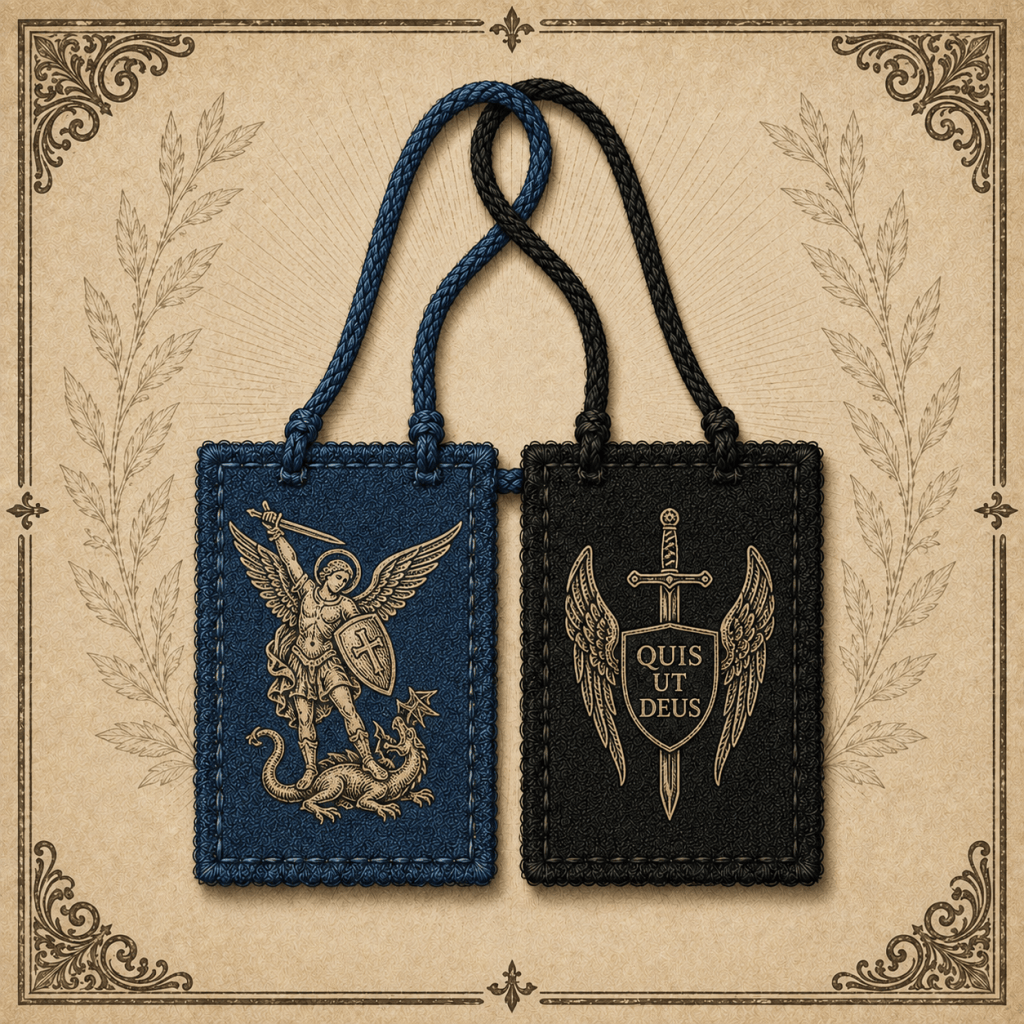
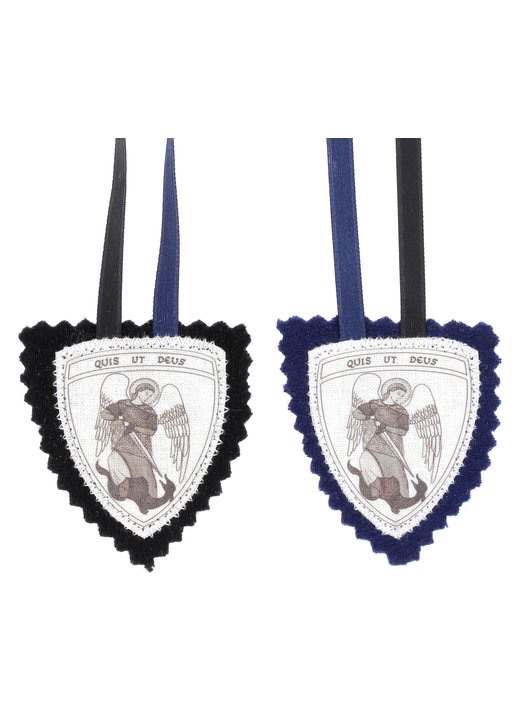
The Scapular of St. Michael the Archangel looks different from almost every other scapular we’ve seen so far. For starters, its panels are shaped like shields instead of rectangles. One is blue. One is black. Its cords are those two colors again. And its main picture depicts St. Michael standing triumphantly over the dragon, under the inscription:
Quis ut Deus?
Who is like God?
The scapular was not the simplified habit worn by members of some ancient religious order. Rather, it originated in nineteenth-century Rome as the badge of a confraternity devoted to St. Michael the Archangel. There is no history of reported apparition, visionary, or individual founder for the scapular. Instead we see its evolution through pious Catholic associations, promotion and approval under Popes Pius IX and Leo XIII, and its eventual attachment to the Archconfraternity of the Scapular of St. Michael. Devotion to Our Lord through St. Michael under the Brown Scapular is currently promoted by the Congregation of St. Michael the Archangel, more commonly known as the Michaelite Fathers. Their current Confraternity regards wearing the scapular as a sign of consecration to St. Michael, a reminder of the duties of fidelity to Baptism and Confirmation, resistance to sin and servitude to Christ and his Church.
Its imagery may appear dramatic:
A warrior.
A dragon.
A shield.
A battle.
But the scapular’s deepest statement is not about the wearer possessing extraordinary spiritual power.
It is the question contained in Michael’s own name:
Who is like God?
And the answer is:
No one.
⸻
At a Glance
| Full Name | Scapular of St. Michael the Archangel |
| Traditional Colors | Blue and black |
| Traditional Shape | Two small shield-shaped pieces of cloth |
| Traditional Image | St. Michael defeating the dragon |
| Inscription | Quis ut Deus?—“Who is like God?” |
| Original Association | A Roman confraternity dedicated to St. Michael |
| First Roman Confraternity | Church of Sant’Eustachio, Rome, in 1878 |
| Later Roman Location | Sant’Angelo in Pescheria, beginning in 1879 |
| Raised to an Archconfraternity | Pope Leo XIII, 1880 |
| Approved Rite of Investiture | Congregation of Rites, August 23, 1883 |
| Single Founder or Visionary | None clearly documented |
| Religious-Order Habit Made Small? | No |
| Modern Promoters | The Michaelite Fathers and their associated confraternity |
| Devotional Focus | The primacy of God, resistance to sin and temptation, humility, perseverance, and St. Michael’s intercession |
| Formal Reception Available? | Yes, within the current Michaelite confraternity |
| Primary Feast | Saints Michael, Gabriel, and Raphael, September 29 |
| Does It Guarantee Physical or Spiritual Protection? | No |
| Central Meaning | To stand under God’s authority and seek St. Michael’s aid in living faithfully |
The historical dates, form, colors, inscription, and relationship with the Roman archconfraternity are recorded in the early twentieth-century Catholic Encyclopedia.
⸻
Who Is St. Michael the Archangel?
Catholic teaching describes angels as created, spiritual beings who possess intelligence and will. They are servants and messengers of God, and the entire angelic world exists through Christ and for Christ. The Church invokes the angels’ assistance but understands their ministry as entirely subordinate to God.
Michael is one of three angels named in the canonical Scriptures:
- Michael
- Gabriel
- Raphael
He is called an archangel specifically in the Letter of Jude. Michael is shown in Scripture defending and fighting against evil — never acting on his own authority. He is a creature. He acts for God. His power is God’s power wielded by him. Pope Francis has called Michael the angel who battles for God’s primacy and reminds us that “the archangel triumphs because God is acting within him.” Ultimately, victory belongs to Christ. His work of salvation has overcome the power of evil. All of that — that distinction — governs our devotion to him. We do not worship Michael. We venerate him. We ask for his intercession as one of God’s devout soldiers.
⸻
Michael in the Book of Daniel
Michael first appears by name in the Book of Daniel.
In Daniel 10, he is described as one of the chief princes who comes to assist another heavenly messenger. He is later called the prince or protector associated with Daniel’s people.
Daniel 12 describes him as:
- A great prince
- Guardian of the people
- One who arises during a time of extraordinary distress
These passages helped shape the Christian understanding of Michael as a heavenly defender of God’s people.
But even here, Michael is not the source of salvation.
He serves within God’s providential plan.
⸻
Michael in the Letter of Jude
The Letter of Jude gives Michael the title archangel.
It describes a dispute between Michael and the devil over the body of Moses. Michael does not rely upon his own status or pronounce judgment through personal power. Instead, he says:
May the Lord rebuke you.
The passage emphasizes restraint and divine authority. Even the archangel does not behave as though he possesses power apart from God.
This may be one of the most important scriptural details for understanding the scapular.
Michael’s strength is not arrogance.
It is obedience.
His spiritual combat is not self-exaltation.
It is submission to God.
⸻
Michael in the Book of Revelation
The scene typically depicted on the scapular is found in Revelation 12. Michael and his angels fight against the dragon (who is called the Devil and Satan). The dragon is defeated and cast down. However, the passage does not state that Michael single-handedly brought about salvation.
The victory hymn declares that the faithful conquer through:
- The blood of the Lamb
- Their testimony
- Fidelity even in the face of death
Christ therefore is the center of the victory. Michael attends to the victory of the Lamb. This keeps the image on the scapular’ from becoming a narrative where the archangel supplants Jesus as Savior or stands as an opposing equal force to Satan. Christianity does not teach that good and evil are two equal powers battling for supremacy. God is Creator. Satan is a created being who fell. Michael is a created being who is faithful. Christ is Lord.
⸻
What Does “Quis ut Deus?” Mean?
The Latin phrase Quis ut Deus? means:
Who is like God?
It translates literally to Who is like God?. It is the traditional understanding of what the Hebrew name Michael means. The question is not asking who. It is stating that there is none. It doesn’t say: Michael is like God. It says: There is none like God. Michael’ himself rejects pride and idolatry and rebellion by his very name. Catholic tradition teaches that Michael’ was appointed champion of the heavenly hosts due to his humility which stood in stark contrast to Satan’s rebellion. While Satan exalts himself above God, Michael’s name cries out that God alone is God. Pope Francis has said that Michael’s name declares God to be first, above all else and all-powerful. When we shout Michael!, we are not just rallying for combat. We are examining our conscience.
Whenever the wearer is tempted to make an idol of:
- Personal power
- Control
- Wealth
- Political identity
- Reputation
- Pleasure
- Fear
- Anger
- Religious superiority
- Even the devotional object itself
the scapular asks:
Who is like God?
And the answer remains:
No one.
⸻
Where Did the Scapular Come From?
The origins of the Scapular of St. Michael are less colorful than those of many scapulars. There is no well-documented apparition where Michael disclosed the design. There is no identifiable visionary. There is no older religious habit that it was simplified from. The scapular is historically said to have come into existence during the papacy of Pius IX, who blessed it, but to have received its first approval under Leo XIII. In 1878, a confraternity dedicated to St. Michael was founded at the Church of Sant’Eustachio in Rome. The following year, 1879, an associated confraternity was founded at Sant’Angelo in Pescheria, an old Roman church which itself was dedicated to the archangel.
In 1880, Leo XIII promoted the association to the status of archconfraternity, bearing the official title Archconfraternity of the Scapular of St. Michael. The Congregation of Rites approved a ritual for blessing the scapular and investing the faithful with it on August 23, 1883. That ritual was inserted into the Rituale Romanum. An enumeration of indulgences attached to the historical association was approved by the Congregation of Indulgences in 1903.
⸻
Evidence Check
Claim: St. Michael personally revealed the scapular during an authenticated apparition.
Assessment: Not supported by the historical sources reviewed.
Evidence Category: No established apparition tradition is necessary to explain its origin.
Supported History: The scapular developed through a nineteenth-century Roman confraternity, received papal support, and acquired an approved blessing and investiture rite.
This makes the St. Michael scapular unusual within the series.
Its authority as a devotion did not depend upon verifying a private revelation.
It developed through the institutional devotional life of the Church.
⸻
The Roman Churches Behind the Devotion
Sant’Eustachio
The first known confraternity connected with the scapular was established at Sant’Eustachio in Rome in 1878.
Modern Michaelite materials give August 30, 1878, as the date of its establishment.
Sant’Angelo in Pescheria
The confraternity’s later Roman home was Sant’Angelo in Pescheria.
The church is dedicated to St. Michael and stands within the ancient Portico of Octavia in Rome’s historic center. The name in Pescheria refers to the fish market that once operated nearby.
The historical Catholic Encyclopedia says that the confraternity was attached more closely to its Roman church than to a religious order.
This is an important distinction.
The original scapular was not created by the modern Michaelite Fathers, who did not yet exist as a canonically established congregation.
Its first spiritual home was a Roman confraternity.
⸻
Why Is It Shaped Like a Shield?
Most devotion scapulars maintain the rectangular shape of the article of clothing. The Scapular of St. Michael does not. Instead of rectangles, the two panels are cut into the shape of small shields. Official sources from history mention the shape, but offer no extensive explanation of its symbolism. However, the shield is easily seen as a very fitting image for a devotion focusing on Michael as defender and protector.
It suggests:
- Vigilance
- Defense
- Readiness
- Fidelity in conflict
- Trust in God’s protection
- The responsibility to resist sin
The shield should not be interpreted as though the fabric creates a supernatural barrier around the wearer.
Its meaning is symbolic and devotional.
It reminds the Christian that faith requires perseverance and that prayer, sacramental life, virtue, and reliance upon God belong to spiritual defense.
⸻
Why Blue and Black?
The historical regulations are clear about the colors:
- One shield-shaped panel was blue.
- The other was black.
- One connecting band was blue.
- The other was black.
What is less clear is why those specific colors were selected.
I did not find an authoritative early source assigning one fixed theological meaning to each color.
Later interpretations may associate:
Blue with:
- Heaven
- Fidelity
- The angelic realm
- Hope
- God’s transcendence
Black with:
- Spiritual conflict
- Renunciation of sin
- Penitence
- Death to selfishness
- The seriousness of evil
These are reasonable devotional reflections.
They should not be presented as though Leo XIII or the Roman confraternity formally defined a universal color code.
The historically secure statement is simpler:
Blue and black were the prescribed colors of this particular scapular.
⸻
The Traditional Images
The historical scapular displayed the same essential image on both shield-shaped panels:
- St. Michael the Archangel
- Defeating or standing over the dragon
- Accompanied by the inscription Quis ut Deus?
Modern artists may show Michael:
- Holding a sword
- Carrying a spear
- Bearing a shield
- Wearing armor
- Standing upon a serpent or dragon
- Holding scales associated with judgment
- Carrying a banner marked with a cross
Not all of these details are required by the historical scapular design.
The central image is Michael’s victory over the dragon beneath the proclamation that no one is like God.
⸻
Does Michael Personally Defeat Satan?
Christian artwork sometimes depicts Michael as if he defeated Satan single-handedly. Revelation does speak of Michael and his angels fighting the dragon. However, the ultimate victory for Christians is still Christ-focused. The dragon is defeated by the blood of the Lamb. Michael is only able to defeat evil because he submits to God’s authority and saving work. That is why Quis ut Deus? matters so much. Michael’s victory over evil is an act of humility itself.
⸻
What Does the Scapular Symbolize?
The Primacy of God
Michael’s name has the most explicit meaning. God is first. The wearer isn’t encouraged to obsess over the devil, angels, specters, or spiritual curiosities. The wearer is encouraged to put God before all else. If Michael becomes the focus rather than the servant who points toward God, the scapular no longer matters.
⸻
Fidelity to Baptism
The present-day Michaelite confraternity makes clear this connection between receiving the scapular and living the duties of Baptism. Baptism is our entry into Christian life. The wearer is called to reject sin, profess belief, and live as Christ’s child – not just own a magic charm for protection. The scapular does not confer a second religious identity above Baptism. It remembers and reinforces a status we already have from Baptism.
⸻
Fidelity to Confirmation
The modern confraternity also connects the scapular with the responsibilities arising from Confirmation.
Confirmation strengthens the baptized Christian for witness, mission, and fidelity.
The language of spiritual battle is therefore applied first to ordinary Christian responsibilities:
- Resisting temptation
- Practicing virtue
- Defending truth without cruelty
- Remaining faithful under pressure
- Building the Kingdom of God
- Bearing witness to Christ
The scapular does not assign the wearer a secret or elite spiritual rank.
It reminds the wearer to live the sacraments already received.
⸻
Humility
The point of Michael’ name contradicts pride. Pride says: I must have my way. Michael’ name asks: Who is like God? Pride says: I am my own judge of good and evil. Michael’ name replies: God is God, and I am not. Pride says: I have power. Michael demonstrates that real spiritual power stems from obedience to God. That might be the enduring lesson of the scapular.
⸻
Vigilance Against Sin
The Christian tradition speaks of spiritual battle, but that battle should not be reduced to dramatic accounts of demons.
The Catechism describes prayer itself as a battle against both personal weakness and the temptations that draw a person away from union with God.
For most Christians, spiritual combat appears in ordinary forms:
- Choosing honesty when deception would be easier
- Controlling anger
- Resisting addiction
- Refusing cruelty
- Forgiving without denying harm
- Rejecting despair
- Remaining faithful in prayer
- Seeking reconciliation
- Telling the truth
- Asking for help
- Turning away from habits that damage oneself or others
The scapular does not ask the wearer to search constantly for demons.
It asks the wearer to recognize and resist what leads away from God.
⸻
Protection
Catholic tradition invokes St. Michael as a protector against evil.
The Church’s liturgy and popular piety recognize the ministry and intercession of the angels, including their assistance and protection of the faithful.
Protection, however, must not be interpreted as a guarantee that the wearer will never experience:
- Illness
- Violence
- Accidents
- Temptation
- Grief
- Persecution
- Mental distress
- Spiritual dryness
- Death
Christian protection ultimately means being assisted toward fidelity and salvation—not being promised immunity from every form of earthly suffering.
⸻
Service to the Church
The modern Michaelite confraternity describes the scapular as a sign of service to Christ and his Church.
Its members are encouraged to build the Kingdom of God through sacramental life, moral conversion, prayer, and service rather than through fear or obsession with spiritual enemies.
The image of Michael should therefore inspire:
- Courage without aggression
- Conviction without contempt
- Strength without domination
- Vigilance without paranoia
- Humility without passivity
⸻
Spiritual Warfare: What Does the Church Mean?
The phrase spiritual warfare can be helpful.
It can also be misused.
Catholic teaching recognizes the reality of evil, temptation, sin, fallen angels, and the need for spiritual vigilance. It also teaches that Christ has already achieved the decisive victory through his death and Resurrection.
Spiritual warfare does not mean:
- Every inconvenience is caused by a demon.
- Every illness is demonic.
- Mental-health symptoms should be treated only through prayer.
- Ordinary people should attempt solemn exorcisms.
- Religious fear should replace medical, psychological, or pastoral care.
- A devotional object allows someone to command spirits through personal authority.
- Catholics should become preoccupied with identifying hidden supernatural enemies.
The Catechism distinguishes ordinary Christian prayer from a solemn or major exorcism. A major exorcism may be performed only by a priest who has received the bishop’s authorization.
The scapular gives no one authority to conduct an exorcism.
Its warfare begins with repentance, prayer, virtue, and trust in Christ.
⸻
The Prayer to St. Michael
The modern Michaelite confraternity asks those formally receiving its scapular to pray daily the familiar invocation associated with Pope Leo XIII:
St. Michael the Archangel, defend us in battle.
Be our protection against the wickedness and snares of the devil…
The Holy See has continued to recommend this prayer in modern times; Pope Francis asked that it be recited at the conclusion of the Rosary during October 2018.
The Michaelite sources sometimes call it the simple exorcism of Leo XIII.
That language requires clarification.
The short prayer may be prayed by ordinary Catholics.
It is not the Church’s solemn rite of major exorcism.
A layperson praying:
May God rebuke him, we humbly pray
is asking God for protection.
The person is not claiming personal jurisdiction over demons.
⸻
The Historical Archconfraternity and the Modern Michaelite Confraternity
This part of the history requires careful distinction.
The Historical Roman Archconfraternity
The original nineteenth-century scapular belonged to a Roman confraternity associated first with Sant’Eustachio and then with Sant’Angelo in Pescheria.
It became an archconfraternity under Leo XIII in 1880.
The sources reviewed for this article did not provide clear documentation of the historical Roman archconfraternity’s current canonical activity, membership structure, or surviving statutes.
We should therefore avoid assuming that every modern group using the scapular is juridically identical to the original Roman archconfraternity.
The Michaelite Fathers
The Congregation of St. Michael the Archangel was founded through the work of Blessed Bronisław Markiewicz in Poland around the beginning of the twentieth century.
The congregation received canonical establishment in 1921, fourteen years after Markiewicz’s death. Its charism developed from service to poor and abandoned youth, trust in divine providence, and the spirituality summarized by the words
Temperance and Work.
Because the Michaelite congregation was established after the Roman scapular confraternity, it did not create the original devotion.
Instead, it became a major modern promoter and custodian of it.
That is the most historically accurate relationship:
The scapular originated in nineteenth-century Rome.
The Michaelite Fathers later adopted, organized, and renewed its contemporary practice.
⸻
The Modern Michaelite Scapular
The scapular currently distributed by the Michaelite Fathers retains the traditional:
- Shield shape
- Blue or navy cloth
- Black cloth
- Connection with St. Michael
But its imagery differs from the original Roman form.
The current Michaelite version described on the congregation’s devotional site has:
Black Side
An image of St. Michael associated with the sanctuary of Monte Sant’Angelo on Mount Gargano.
Navy-Blue Side
An image of Our Lady associated with Miejsce Piastowe, the Polish motherhouse of the Michaelite Fathers.
The historical Roman scapular, by contrast, placed St. Michael defeating the dragon and the words Quis ut Deus? on both portions.
These are therefore related but not visually identical forms.
The modern version expresses the spirituality of the Michaelite congregation in addition to the older Roman devotion.
⸻
Blessing, Investiture, and Enrollment
Historical Practice
Historically, reception into the Archconfraternity of the Scapular of St. Michael involved formal investiture with the scapular.
The Congregation of Rites approved a blessing and investiture formula in 1883.
Current Michaelite Practice
According to the current Michaelite confraternity, the scapular is received from an authorized priest or deacon through a rite of imposition.
The recipient then becomes a member of the confraternity associated with the Michaelite Fathers and shares in the congregation’s spiritual goods.
The current expectations are:
- Receive the scapular from an authorized priest or deacon.
- Wear it faithfully.
- Pray the short Prayer to St. Michael daily.
- Live the obligations of Baptism and Confirmation.
- Participate regularly in Reconciliation.
- Work for the Kingdom of God.
A person merely purchasing the scapular has not necessarily completed this formal reception.
⸻
Must the Scapular Be Worn Constantly?
The current Michaelite confraternity asks members to wear it continually.
That ideal expresses the scapular’s role as a persistent reminder of commitment.
It should not be interpreted superstitiously.
Temporary removal for:
- Bathing
- Surgery
- Medical imaging
- Skin irritation
- Work safety
- Repair
- Sleep difficulties
- Other practical reasons
does not mean that St. Michael has abandoned the wearer or that spiritual protection has suddenly vanished.
The relationship is not controlled by whether the cord remains physically unbroken every second of the day.
⸻
The Scapular Medal
According to the Michaelite Fathers, this medal was approved as a substitute to the cloth scapular by their own rector major on March 1, 2013. When received according to current Michaelite practice, the first reception is of the cloth scapular. The individual may replace the cloth scapular with the blessed medal at a later time while remaining in union with the spiritual benefits of the confraternity. That is how it should be stated. It is a permission given in the modern form of Michaelites. It should not automatically be assumed to be a papal decree that applies to every historical version of the St. Michael scapular. The cloth is closest in appearance to the original shield shape.
⸻
What Graces Are Associated with the Scapular?
The modern Michaelite materials describe spiritual intentions including:
- Protection and freedom for the Church
- Grace to make a good confession
- Strength against addiction and vice
- Resistance to error and false teaching
- Conversion of sinners
- Growth in humility
- Increase in faith, hope, and charity
- Prayer for the dead
- Grace for a holy death
These should be understood as the spiritual goods for which members pray.
They are not automatic guarantees.
The scapular is a sacramental. The Catechism teaches that sacramentals do not confer grace in the same way as the sacraments. Through the prayer of the Church, they prepare believers to receive grace and dispose them to cooperate with it.
The scapular may help the wearer:
- Remember God during temptation
- Turn toward prayer
- Seek confession
- Resist destructive habits
- Practice humility
- Ask for angelic intercession
- Persevere in faith
- Grow in courage
The cloth does not make those choices on the wearer’s behalf.
⸻
Does It Guarantee Protection from Demons?
No.
It is reasonable within Catholic devotion to ask St. Michael’s intercession against evil.
It is not reasonable to claim that wearing the scapular makes a person spiritually untouchable.
The wearer may still:
- Experience temptation
- Commit sin
- Become frightened
- Require confession
- Need pastoral guidance
- Need medical or mental-health treatment
- Suffer ordinary and extraordinary trials
- Die
The scapular does not replace:
- Christ
- The sacraments
- Prayer
- Moral responsibility
- Appropriate professional care
- The authority of the Church
- Personal conversion
The proper response to spiritual fear is not collecting ever more powerful objects.
It is deeper trust in God.
⸻
Does It Protect Against Physical Danger?
The Church invokes the angels’ protection and recognizes their ministry within God’s providence.
But the scapular contains no documented universal promise that its wearer will never be:
- Injured
- Attacked
- In an accident
- Persecuted
- Sick
- Killed
St. Michael’s intercession may be sought in danger.
The outcome remains within God’s providence.
Christian protection is ultimately ordered toward salvation and fidelity, not the guarantee of an uninterrupted or painless earthly life.
⸻
What About Addiction?
The current confraternity specifically includes prayer for strength against addictions and destructive habits.
That can make the scapular meaningful for someone in recovery.
But it should accompany—not replace—appropriate help, which may include:
- Medical treatment
- Counseling
- Recovery programs
- Accountability
- Medication
- Spiritual direction
- Confession
- Community support
- Changes in environment
Prayer and treatment are not enemies.
A person struggling with addiction does not lack faith merely because professional intervention is needed.
The scapular may represent the decision to keep fighting.
It is not a substitute for the work of recovery.
⸻
Feast Days Connected with the Devotion
The universal Church celebrates Saints Michael, Gabriel, and Raphael on September 29.
The current Michaelite confraternity also gives particular attention to:
- Blessed Bronisław Markiewicz — January 30
- The apparition tradition of St. Michael at Mount Gargano — May 8
- Saints Michael, Gabriel, and Raphael — September 29
- The Guardian Angels — October 2
These observances reflect the modern Michaelite spirituality surrounding the scapular.
September 29 remains the primary universal liturgical feast of the archangels.
⸻
St. Michael and Mount Gargano
Southern Italy’s Sanctuary of St. Michael on Mount Gargano is another of the historic centers of devotion to that archangel. Vatican’ Directory on Popular Piety names San Michele Gargano as one of the major shrines formed by centuries of angelic devotion. Traditional histories link apparitions of Michael on the mount beginning in the late fifth century. Those stories play a role in the development of Western devotion to Michael, but they don’t originate the nineteenth-century scapular. The invocation of the modern Michaelite version’ clearly identifies its use of the Gargano image with this much older tradition.
⸻
Common Misunderstandings
“St. Michael is a kind of lesser god who fights Satan.”
He is not.
Michael is a created angel who serves God. God and Satan are not equal powers.
“Who is like God?” means Michael is like God.
It means the opposite.
The phrase proclaims that no creature is equal to God.
“The scapular came directly from an apparition of St. Michael.”
No historically verified apparition is needed to explain its origin. It developed through a Roman confraternity.
“The Michaelite Fathers created the scapular.”
They did not.
The scapular predates the canonical establishment of their congregation. They are major modern promoters of the devotion.
“The historical Roman and current Michaelite confraternities are obviously the same legal body.”
That cannot be established from the public sources reviewed.
Their devotions are historically connected, but current canonical continuity should not be assumed without documentation.
“The traditional and modern scapulars have exactly the same images.”
They do not.
The historical form showed Michael and the dragon on both panels. The contemporary Michaelite form uses an image of Michael on one side and an image of Our Lady on the other.
“The blue and black colors have one officially defined meaning.”
No authoritative early color code was located. Later symbolic interpretations may be helpful, but the historical sources primarily identify the colors as prescribed features.
“Wearing it prevents all demonic influence.”
No sacramental creates automatic immunity from temptation or sin.
“It authorizes me to conduct exorcisms.”
It does not.
A major exorcism may be performed only by a priest authorized by the bishop.
“The short Prayer to St. Michael is the same as the solemn rite of exorcism.”
It is not.
It is an invocation that ordinary Catholics may pray.
“Mental illness is evidence of demonic activity.”
The scapular provides no basis for that conclusion. Spiritual care should never be used to deny appropriate medical or psychological care.
“If the scapular breaks or is removed, St. Michael’s protection ends.”
That is a superstitious interpretation.
“Buying one automatically enrolls me.”
Formal reception under the current Michaelite confraternity involves investiture by an authorized priest or deacon.
“The scapular guarantees a holy death.”
It expresses prayer for perseverance and a holy death. It does not bypass the need for faith, repentance, and grace.
⸻
The Scapular Today
The St. Michael scapular remains far less common than the Brown Scapular, but the devotion is active internationally through the Michaelite Fathers.
Their current apostolate promotes:
- Formal investiture
- The Confraternity of the Scapular
- Daily prayer to St. Michael
- Devotion connected with the sacraments
- Spiritual association with the Michaelite congregations
- Pilgrimages and visits of the St. Michael statue
- Formation in the congregation’s spirituality of temperance and work
The historical Roman confraternity is more difficult to trace in current public documentation.
That leaves the devotion with two distinguishable historical layers:
The Roman Layer
The nineteenth-century scapular, confraternity, archconfraternity, and approved investiture rite.
The Michaelite Layer
The modern religious congregation that has adopted the scapular, adapted its images, organized a contemporary confraternity, and given the devotion a living spiritual home.
Both matter.
They should not be collapsed into one origin story.
⸻
A Student’s Reflection
Before researching this scapular, I expected the article to be about protection.
St. Michael.
The dragon.
A shield.
Spiritual warfare.
Those are all present.
But they are not what remained with me.
What remained was the question:
Who is like God?
I had always understood that phrase as something Michael might shout at the enemy.
A declaration of battle.
A challenge.
But now I think it may be directed just as much toward the wearer.
Who is like God?
Not my fear.
Not my certainty.
Not my desire to control what happens next.
Not my anger.
Not my religious identity.
Not the powerful people I admire.
Not the people I fear.
Not even St. Michael.
And certainly not a scapular.
The shield does not say that I possess divine protection as though it were armor I control.
It says that I stand beneath an authority greater than myself.
The image of Michael is dramatic, but his posture is fundamentally humble.
He does not defeat evil by declaring himself powerful.
His very name declares that God alone is God.
That changes the meaning of spiritual warfare.
It is easy to imagine spiritual warfare as something heroic and external:
Demons.
Battles.
Enemies.
Victory.
It is more difficult to recognize the quieter battlegrounds:
The moment I want to be cruel.
The moment fear becomes obsession.
The moment I would rather control someone than love them.
The moment pride convinces me that my judgment cannot be wrong.
The moment I use religion to make myself feel superior.
The moment I trust an object more than I trust God.
Perhaps the scapular’s two shields are not asking me to become fascinated with darkness.
Perhaps they are asking me to guard two things:
My heart from pride.
And my life for God.
The blue and black cloth carries the image of conflict.
But the words carry the answer.
No one is like God.
And if I truly believe that, then I do not have to become God.
I do not have to control every outcome.
I do not have to defeat every enemy through my own strength.
I can pray.
I can repent.
I can seek help.
I can remain vigilant.
I can do the next faithful thing.
And I can ask St. Michael—not to make me powerful—but to help me remain under the authority of the One he serves.
That may be the most meaningful protection this scapular offers:
Not freedom from every battle.
But the humility to remember whose victory it is.
⸻
Primary and Historical Sources
Holy See Press Office, 2018 communiqué containing the short Prayer to St. Michael traditionally associated with Leo XIII.
Catholic Encyclopedia, “Scapular,” on the nineteenth-century Roman confraternity, Leo XIII’s approval, the 1883 investiture rite, the shield shape, blue-and-black cloth, and the inscription Quis ut Deus?
Acta Sanctae Sedis archive, the Holy See’s official historical collection in which the relevant nineteenth-century Roman decrees were published.
Congregation of St. Michael the Archangel, current history, symbolism, design, requirements, confraternity statutes, and investiture guidance for the scapular.
Michaelite Fathers, history of Blessed Bronisław Markiewicz and the congregation’s canonical establishment in 1921.
Catechism of the Catholic Church, paragraphs 325–336, on angels as created spiritual beings and servants of God.
Catechism of the Catholic Church, paragraphs 1667–1673, on sacramentals and the distinction between ordinary prayer and major exorcism.
Daniel 10 and 12, Jude 9, and Revelation 12, on Michael’s biblical role as prince, guardian, archangel, and combatant against the dragon.
Pope Francis, remarks at the inauguration of the statue of St. Michael in the Vatican Gardens, on Michael as defender of God’s primacy and servant of Christ’s victory.
Congregation for Divine Worship, Directory on Popular Piety and the Liturgy, paragraphs 215–217, on Catholic veneration of the angels, their intercession, and the feast of the archangels.


