Purpose of This Appendix
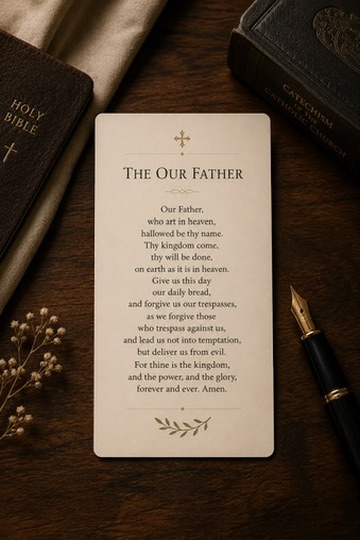
The Our Father occupies a unique place in Christian history because it is the only major prayer commonly attributed directly to the teaching of Jesus Christ.
Because of its importance, numerous claims have arisen concerning its origin, wording, translation, and use. Some are supported by Scripture and historical evidence. Others are matters of interpretation. Still others result from misunderstandings that have circulated over time.
This appendix evaluates common claims associated with the Lord’s Prayer and identifies the historical basis for each.
Evidence Categories
A — Official Church Teaching
Supported by:
- Sacred Scripture
- Ecumenical Councils
- Catechisms
- Liturgical Books
- Official Church Documents
B — Strong Historical Evidence
Supported by:
- Contemporary sources
- Early manuscripts
- Reliable historical documentation
Widely accepted by historians.
C — Later Historical Tradition
Supported by later witnesses but lacking contemporary evidence.
Plausible, but not certain.
D — Pious Tradition
Spiritually meaningful tradition that cannot be historically verified.
E — Popular Misconception
A claim that contradicts or oversimplifies the available evidence.
Origins of the Prayer
Claim: Jesus taught the Our Father to His disciples.
Assessment: Historically Supported.
Evidence Category: A
Primary Sources
- Matthew 6:9–13
- Luke 11:2–4
Notes
The prayer appears in two independent Gospel traditions and is universally regarded as originating from the teaching of Jesus.
Claim: The Our Father is the only prayer taught directly by Christ in the Gospels.
Assessment: Generally Supported.
Evidence Category: A
Notes
Many of Jesus’ prayers are preserved in Scripture, but the Lord’s Prayer is unique in being explicitly presented as a model prayer taught to disciples.
Claim: The Lord’s Prayer was invented by the early Church after Jesus’ death.
Assessment: Historically Unsupported.
Evidence Category: E
Notes
The prayer appears in multiple Gospel traditions and is embedded within early Christian sources.
Matthew and Luke
Claim: Matthew and Luke preserve different versions of the prayer.
Assessment: Historically Supported.
Evidence Category: A
Sources
- Matthew 6:9–13
- Luke 11:2–4
Notes
The two versions differ in length and wording.
Claim: Matthew’s version is longer than Luke’s.
Assessment: Historically Supported.
Evidence Category: A
Notes
Several petitions and phrases found in Matthew are absent from Luke.
Claim: Historians know which version came first.
Assessment: Historically Uncertain.
Evidence Category: C
Notes
Scholars continue debating whether Matthew expanded an earlier form or Luke abbreviated a longer form. No consensus exists.
The Daily Bread Question
Claim: The phrase “daily bread” is a straightforward translation.
Assessment: Partially Misleading.
Evidence Category: B
Sources
- Greek New Testament
- Epiousios studies
Notes
The Greek word epiousios is extremely rare and difficult to translate.
Claim: Scholars know exactly what epiousios means.
Assessment: Historically Unsupported.
Evidence Category: E
Notes
Several interpretations remain possible.
The precise meaning remains debated.
Claim: “Daily bread” can refer to more than physical food.
Assessment: Historically Supported.
Evidence Category: B
Sources
- Early Church Fathers
- Catechism of the Catholic Church
Notes
Christian interpretation has long included spiritual and Eucharistic meanings.
The Doxology
Claim: The original Lord’s Prayer ended with: For thine is the kingdom, and the power, and the glory forever.
Assessment: Historically Uncertain.
Evidence Category: B
Sources
- New Testament manuscripts
- Didache
Notes
The doxology appears in some early traditions but is absent from several of the earliest biblical manuscripts.
Claim: Catholics removed the doxology from the Bible.
Assessment: Historically Incorrect.
Evidence Category: E
Notes
The issue concerns ancient manuscript traditions rather than later Catholic editing.
Claim: The doxology is ancient.
Assessment: Historically Supported.
Evidence Category: B
Sources
- Didache
- Early liturgical traditions
Notes
Even if not part of the original Gospel text, the doxology is very old.
Claim: Catholics never use the doxology.
Assessment: Historically Incorrect.
Evidence Category: E
Notes: The modern Mass includes the doxology immediately after the embolism.
Early Christian Practice
Claim: The earliest Christians prayed the Lord’s Prayer regularly.
Assessment: Historically Supported.
Evidence Category: B
Source: Didache
Notes
The Didache provides some of the earliest evidence of regular Christian prayer practices.
Claim: The earliest Christians prayed the Lord’s Prayer three times daily.
Assessment: Historically Supported.
Evidence Category: B
Source: Didache
Notes: This instruction appears explicitly in the text.
Claim: The Lord’s Prayer became central to Christian worship almost immediately.
Assessment: Historically Supported.
Evidence Category: B
Sources
- Didache
- Early liturgical evidence
Notes
The prayer appears to have entered Christian devotional life very quickly.
Translation Questions
Claim: “Debts,” “sins,” and “trespasses” are all found in Christian versions of the prayer.
Assessment: Historically Supported.
Evidence Category: B
Sources
- Matthew
- Luke
- Liturgical traditions
Notes
Different traditions emphasize different aspects of the underlying Greek and theological meaning.
Claim: Only one English translation is correct.
Assessment: Historically Unsupported.
Evidence Category: E
Notes
Multiple translations capture different dimensions of the original language.
Claim: Modern translations have changed the meaning of the prayer.
Assessment: Partially Misleading.
Evidence Category: C
Notes
Most translation changes attempt to clarify difficult ancient expressions rather than alter doctrine.
Temptation
Claim: The prayer teaches that God tempts people to sin.
Assessment: Contradicted by Catholic Teaching.
Evidence Category: E
Sources
- Catechism of the Catholic Church
- James 1:13
Notes
The petition is understood as a plea for protection during trials and temptation.
Claim: “Lead us not into temptation” is difficult to translate.
Assessment: Historically Supported.
Evidence Category: B
Notes
Modern translations often seek to express the intended meaning more clearly.
Catholic Teaching
Claim: The Our Father is the model of all Christian prayer.
Assessment: Official Catholic Teaching.
Evidence Category: A
Sources
- Catechism of the Catholic Church
- Church Fathers
Notes
The prayer occupies a unique place within Christian spirituality.
Claim: The Lord’s Prayer summarizes the Gospel.
Assessment: Historically Supported.
Evidence Category: B
Sources
- Tertullian
- Patristic tradition
Notes
This description became widespread in Christian teaching.
Claim: The Our Father is both a prayer and an instruction.
Assessment: Official Catholic Teaching.
Evidence Category: A
Sources
- Catechism of the Catholic Church
Notes
The prayer teaches believers how to pray and how to live.
The Rosary
Claim: The Our Father is part of the Rosary.
Assessment: Historically Supported.
Evidence Category: A
Notes
Every decade begins with the Lord’s Prayer.
Claim: The Rosary is primarily Marian and therefore minimizes the Our Father.
Assessment: Historically Misleading.
Evidence Category: E
Notes
Each decade begins with the prayer taught by Christ, reflecting the Rosary’s Christ-centered structure.
Summary of Major Conclusions
Historically Certain
- Jesus taught the Lord’s Prayer.
- Matthew and Luke preserve different versions.
- The prayer was adopted very early by Christians.
- The Didache recommends praying it three times daily.
- The prayer became central to Christian worship.
- The Church regards it as the model of prayer.
Historically Probable
- The doxology developed as an early liturgical addition.
- Multiple interpretations of “daily bread” existed in the early Church.
- Translation differences reflect genuine linguistic challenges.
Historically Uncertain
- Whether Matthew or Luke preserves the earlier version.
- The precise meaning of epiousios.
- The exact form used by Jesus in Aramaic.
Frequently Misunderstood
- Catholics did not remove the doxology.
- The prayer does not teach that God tempts people.
- Translation differences do not necessarily indicate doctrinal disagreement.
- The Our Father was not invented by later Christians.
Final Assessment
The history of the Our Father differs from that of nearly every other major Christian prayer.
Its foundation rests directly in Scripture.
Its use is documented by some of the earliest Christian writings outside the New Testament.
Its wording has remained remarkably stable despite centuries of translation and theological reflection.
Most debates surrounding the prayer do not concern whether it existed, but how its earliest wording should be understood.
For historians, it provides one of the clearest windows into the prayer life of the earliest Christians.
For believers, it remains the prayer taught by Christ Himself and the foundation upon which all Christian prayer is built.


