©MS 2026
The White Scapular of the Most Blessed Trinity
A Trinitarian Sign of Communion, Mercy, and Freedom
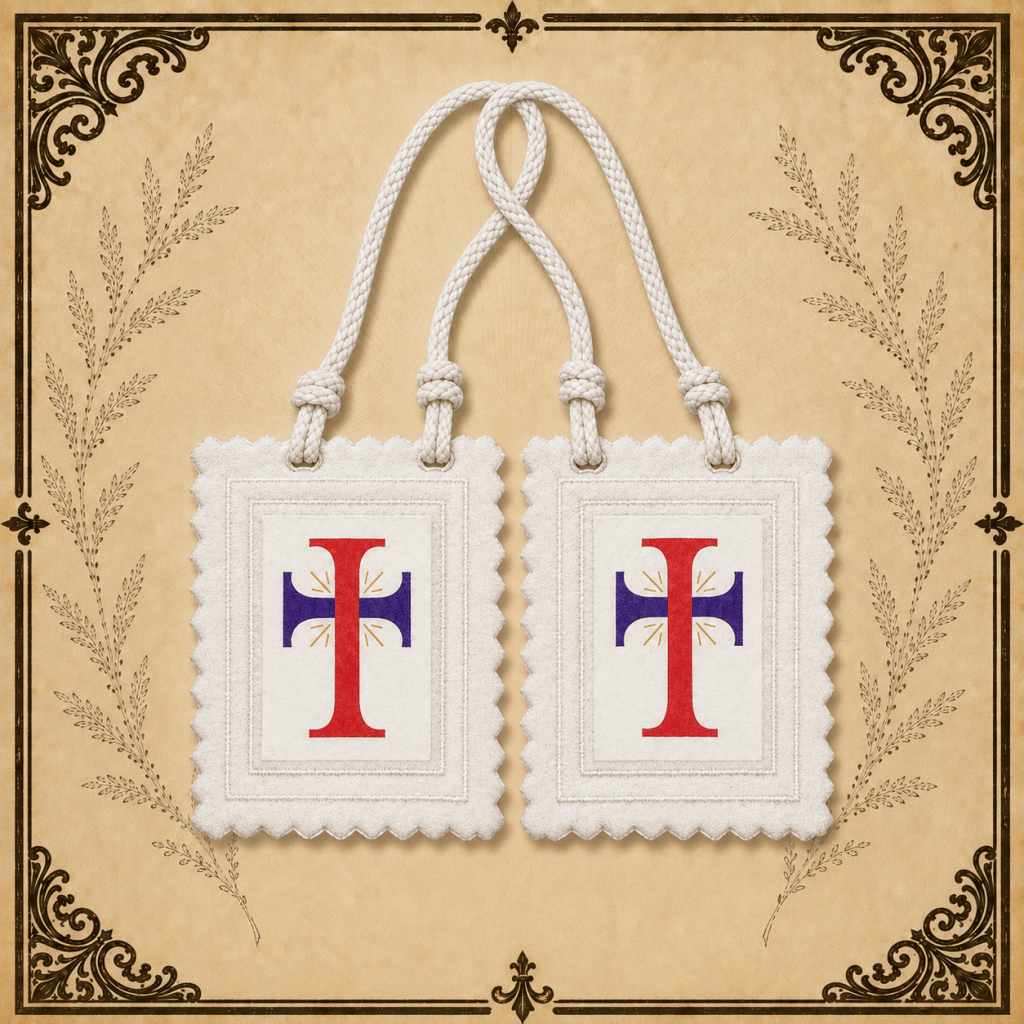
The White Scapular of the Most Blessed Trinity may be the oldest of the small devotional scapulars to be associated with a Catholic religious order. In its physical appearance, it is disarmingly simple: White cloth. A red- and blue cross. No mandated picture of a saint. No dramatic image from an apparition. No promise scrawled across the border. The wearer becomes affiliated with the Order of the Most Holy Trinity and of the Captives, better known as the Trinitarians. The Order was founded toward the end of the twelfth century by St. John de Matha. Its mission: to praise God in His Unity by working for the release of captives. That history is key. The White Scapular is designed not merely to foster meditation on a theological concept. The White Scapular evokes a way of spirituality in which belief in Father, Son and Holy Spirit is made concrete by works of mercy, efforts to liberate others, fraternity and service to those who have been deprived of their freedom or their dignity. In fact, you might say the White Scapular summarizes the traditional Trinitarian motto: Glory to the Trinity, and freedom to captives. The white cloth reminds us of the Trinitarian habit. The colored cross shows we belong to the Order’s family. And wearing the scapular as a whole presents us with a question: If I believe God is Father, Son and Holy Spirit; that God is a communion of self-giving love; then how ought that belief impact the way I treat another human being in pain?
⸻
At a Glance
| Full Name | Scapular of the Most Blessed Trinity |
| Alternative Name | White Scapular of the Most Holy Trinity |
| Traditional Color | White |
| Essential Emblem | A cross with a red upright beam and blue horizontal beam |
| Associated Tradition | Order of the Most Holy Trinity and of the Captives |
| Common Name of the Order | Trinitarians |
| Founder | St. John de Matha |
| Traditional Co-founder | St. Felix of Valois |
| Rule Approved By | Pope Innocent III |
| Date of Papal Approval | December 17, 1198 |
| Founding Mission | The redemption of captives and service to the poor |
| Devotional Focus | The Holy Trinity, Christ the Redeemer, mercy, human dignity, and liberation |
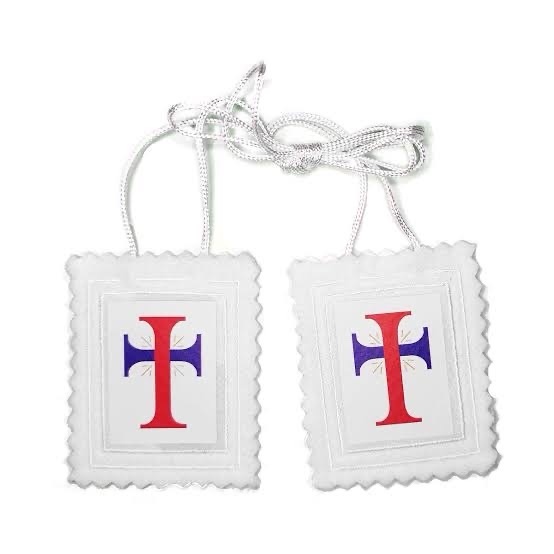
| Traditional Form | Two pieces of white cloth joined by cords |
| Essential Feature | The red-and-blue Trinitarian cross on the front panel |
| Confraternity Association | Confraternity of the Most Holy Trinity |
| Formal Investiture Historically Required for Membership? | Yes |
| Does Wearing It Guarantee Protection or Salvation? | No |
| Central Meaning | To glorify the Trinity by participating in a life of redemptive charity |
The Order’s Rule was approved by Innocent III in the papal bull Operante divinae dispositionis clementia on December 17, 1198. John Paul II described the Trinity as the source, model, and goal of Trinitarian life and connected that contemplation directly with the Order’s work for captives and the poor.
⸻
Which White Scapular?
White does not identify one universal scapular.
Several distinct devotional scapulars have historically been made from white cloth, including those associated with:
- The Most Blessed Trinity
- Our Lady of Ransom or Mercy
- The Immaculate Heart of Mary
- The Sacred Heart of Jesus
- The Sacred Hearts of Jesus and Mary
- Our Lady of Good Counsel
- St. Dominic
The White Scapular discussed here is identified specifically by the red-and-blue Trinitarian cross.
Without that cross, white cloth alone would not distinguish it from the other white scapular traditions.
⸻
What Is the Holy Trinity?
The scapular honors the central Christian mystery that there is one God in three divine Persons:
- The Father
- The Son
- The Holy Spirit
It does not teach three gods, or three parts of God, or one divine Person manifest under three temporary masks. The Trinity is one divine Being who exists as three Persons. Each Person is fully God. But the Father is not the Son. The Son is not the Spirit. The Spirit is not the Father. They share one divine Nature. Their glory is equal. Their majesty is eternal. Doctrine about the Trinity can sound abstract and remote from everyday life. Trinitarian spirituality reminds us that it is not. The Order sees the Trinity in particular as God- Love: the source and exemplar of communion, of self-giving, of unity in diversity, and of love reaching out to those who suffer. The scapular thus invites not only consideration of the number three, but participation in the divine pattern of communion and love.
⸻
St. John de Matha and the Birth of the Trinitarian Order
John de Matha was born in France in the twelfth century and entered the priesthood as a theologian. Tradition tells us that while he was offering Mass for the first time as a priest, he experienced a vision of what he was to do with his life. Some images differ slightly, but the most lasting depicts Christ the Redeemer standing between two captives; one captive wore the symbol of Christ while the other did not. The bonds around their wrists were connected. Worship became associated with freedom. John knew that God was calling him to found a community dedicated to the Holy Trinity and the redemption of captives. He went into seclusion at Cerfroid and gathered about him a community and a Rule of life. According to Trinitarian tradition, St. Felix of Valois was with him and co-founded the community. The Order recognizes, however, that while some details of Felix’ biography can be confirmed by contemporary records, other aspects are only known through tradition. John then traveled to Rome to seek official sanction. Pope Innocent III approved the Rule on December 17, 1198, and gave his official blessing to a brotherhood whose mission was to ransom Christians taken captive.
⸻
The Historical World of Captivity
The Order developed in a Mediterranean world shaped by warfare, piracy, religious conflict, and the enslavement or imprisonment of captives from opposing communities.
People seized during raids or military conflict could be:
- Sold
- Imprisoned
- Held for ransom
- Separated indefinitely from family
- Pressured to abandon their faith
- Subjected to forced labor or abuse
Trinitarians established an unarmed ministry of redemption. Redemption work was their primary focus. It involved fundraising, negotiating, serving the poor, and bringing captives back to freedom. The Order states that they were the first official unarmed institution in the Church with this specific ministry of redemption in mind. John Paul II said this work also established a sort of humanitarian contact between Christian and Muslim. Mercy would cross the barriers erected by conflict. The scapular is therefore cloth linked not just to monastery prayer but to human beings in chains.
⸻
The Trinitarian Rule
The Rule composed by John de Matha combined contemplation, communal life, poverty, hospitality and the redemption of captives. John Paul II noted that the Rule begins: “In the name of the holy and undivided Trinity”. That beginning was not merely ornamental. The whole of life and mission was meant to be shaped by the mystery of the Trinity. By serving Christ in the imprisoned, poor and oppressed, the brothers glorified the Trinity.
Trinitarian spirituality still describes this relationship through two inseparable elements:
- God the Trinity
- Redemptive charity
The Order’s motto expresses the same union:
Trinitati Gloria, Captivis Libertas.
Glory to the Trinity, freedom to captives.
This is the world from which the scapular receives its meaning.
⸻
The Trinitarian Habit
The current constitutions of the Trinitarian Order describe its religious habit as consisting of:
- A white tunic
- A black belt
- A white scapular
- A red-and-blue cross placed upon the scapular
- A white hood
The smaller devotional scapular reproduces the most distinctive portion of that habit:
White cloth bearing the Trinitarian cross.
As with the Brown and Black Scapulars already examined in this series, it is fundamentally a religious habit made small.
It represents affiliation with a spiritual family rather than an isolated object carrying independent power.
⸻
The Traditions of the Red-and-Blue Cross
Several related origin traditions developed around the Trinitarian emblem.
The First-Mass Tradition
The Order’s modern historical presentation centers upon John de Matha’s first-Mass vision of Christ the Redeemer with two captives. The red-and-blue cross became associated with that founding image and appears in the ancient Trinitarian mosaic at St. Thomas in Formis in Rome.
The St. Felix Tradition
A later tradition says that John and Felix encountered a deer carrying the red-and-blue cross between its antlers, confirming the emblem associated with John’s vocation. The official Trinitarian account preserves this as tradition rather than presenting it as independently verified contemporary history.
The Innocent III Tradition
Older scapular histories add that Pope Innocent III saw an angel wearing white with a red-and-blue cross and understood this as confirmation that he should approve the new Order.
These stories have often been combined into one continuous narrative.
Historically, they should be distinguished.
The securely documented event is the papal approval of John’s Rule in 1198.
The visions and miraculous confirmations belong to the Order’s devotional and legendary memory.
⸻
Evidence Check
Claim: Pope Innocent III certainly received a historically documented angelic vision directing him to approve the Trinitarian Order.
Assessment: The account belongs to later Trinitarian and scapular tradition; the official papal approval itself is documented, but the supernatural event is not established by the sources consulted here.
Evidence Category: Venerable foundation tradition.
Documented Fact: Innocent III approved John de Matha’s Rule on December 17, 1198, establishing the Order’s place within the Church.
The distinction does not require ridicule of the tradition.
It simply prevents devotional memory from being presented as though it were identical to surviving documentary history.
⸻
How Did the Small White Scapular Develop?
The original white scapular was the smallest component of the full Trinitarian religious habit. As lay people began affiliating themselves with religious orders through brotherhoods, fraternities, third orders and confraternities they were given smaller “signs” of the spirituality they wanted to participate in. Older Catholic reference books list the White Scapular as one of the earliest small scapulars. It is described as being the badge of the Confraternity of the Most Blessed Trinity. Lay affiliates wore the miniature white scapular with the Order’s cross on it as an external sign of their membership in the Trinitarian family. There is no exact recorded time when the miniature scapular first appeared.
It probably evolved over time from the many lay fraternities and confraternities connected with the Order rather than from one specific apparition or Papal decree. The official history of the Trinitarians states that there were lay fraternities from the earliest centuries of the Order. Statutes that are very old are attributed to the early 1200’s. The first extant written rules for the Third Order date from 1584.
⸻
Why Is It White?
The most secure historical explanation is straightforward:
It is white because the Trinitarian religious habit and scapular are white.
White may also evoke:
- Baptism
- Purity
- Resurrection
- Divine light
- Peace
- The unity of faith
Those meanings are spiritually appropriate, but they are secondary reflections.
The white cloth’s primary identity comes from the habit of the Order.
⸻
The Red-and-Blue Cross
The traditional cross has:
- A red upright beam
- A blue horizontal beam
This arrangement appears in older descriptions of the Order and scapular.
The cross is not a separate decorative accessory.
Historical scapular instructions identify it as the essential emblem on the front panel.
The rear panel may remain plain white.
⸻
Do the Three Colors Represent the Three Divine Persons?
Later devotional explanations sometimes assign:
- White to the Father
- Blue to the Son
- Red to the Holy Spirit
Other interpretations connect blue with Christ’s suffering and red with the fire of the Spirit.
These explanations may provide material for meditation.
However, the official Trinitarian sources reviewed for this article emphasize the red-and-blue cross as the ancient emblem of the Order and connect it principally with Trinitarian faith and redemptive charity. They do not make one person-by-person color code the foundation of the devotion.
The safest presentation is therefore:
- The three colors became recognizable signs of the Trinitarian habit.
- They evoke the Order’s dedication to the Holy Trinity.
- Exact assignments of individual colors to individual Persons belong to later devotional interpretation rather than the essential definition of the scapular.
⸻
What Does the White Scapular Symbolize?
The Trinity as the Source of Christian Life
The scapular begins with God.
Trinitarian spirituality understands the Father, Son, and Holy Spirit as the source, model, and final goal of life.
John Paul II called this the heart of the Order’s spirituality.
The wearer is invited to remember that Christianity is not merely belief in a distant supreme being.
It is relationship with:
- The Father who creates and calls
- The Son who redeems
- The Holy Spirit who gives life and sanctifies
⸻
Unity Without Erasing Difference
Catholic belief holds that the three divine Persons are distinct without being divided.
The Trinity therefore became a spiritual model for communion:
- Unity without uniformity
- Relationship without possession
- Difference without hostility
- Love without domination
The Order’s current spirituality describes Trinitarian community as reflecting “unity in plurality and plurality in unity.”
The scapular may therefore challenge division, rivalry, isolation, and the idea that communion requires everyone to become identical.
⸻
Christ the Redeemer
The founding image of the Order presents Christ between people in chains.
The Trinity is not contemplated apart from the redeeming mission of the Son.
Christ is the one who enters captivity, sin, suffering, and death in order to bring humanity into freedom.
The scapular’s cross therefore represents not only the doctrine of the Trinity but also the redemptive love made visible in Christ.
⸻
Freedom for Captives
The Trinitarian charism links worship to liberation.
Historically, that meant raising funds and negotiating the freedom of Christian captives.
Today, the Order extends its mission toward people suffering forms of captivity that may be:
- Physical
- Political
- Religious
- Economic
- Social
- Psychological
- Addictive
- Exploitative
Its ministries include concern for persecuted Christians, prisoners, the poor, people denied basic rights, and those whose dignity is threatened.
The scapular asks the wearer to notice chains.
Not only ancient chains.
Present ones.
⸻
Mercy
The Trinitarians describe the redemption of captives as a work of mercy in which Christ is encountered in the hungry, thirsty, naked, sick, displaced, and imprisoned.
The scapular therefore cannot be reduced to private protection.
Its spirituality moves outward.
To wear the sign of an Order founded for captives while remaining indifferent to oppression would contradict the emblem’s history.
⸻
Human Dignity
Trinitarian spirituality speaks of God as responding to the cry of enslaved and oppressed people.
The mission is not only to move a person from one physical location to another.
It is to recognize and restore dignity.
The Order’s current mission includes those:
- Persecuted for faith
- Imprisoned or exploited
- Living in poverty
- Damaged in their basic rights
- Deprived of freedom or hope
The scapular becomes a reminder that devotion to the Trinity should deepen respect for every human person.
⸻
The Confraternity of the Most Holy Trinity
The original white scapular was the smallest component of the full Trinitarian religious habit. As lay people began affiliating themselves with religious orders through brotherhoods, fraternities, third orders and confraternities they were given smaller “signs” of the spirituality they wanted to participate in. Older Catholic reference books list the White Scapular as one of the earliest small scapulars. It is described as being the badge of the Confraternity of the Most Blessed Trinity. Lay affiliates wore the miniature white scapular with the Order’s cross on it as an external sign of their membership in the Trinitarian family. There is no exact recorded time when the miniature scapular first appeared. It probably evolved over time from the many lay fraternities and confraternities connected with the Order rather than from one specific apparition or Papal decree. The official history of the Trinitarians states that there were lay fraternities from the earliest centuries of the Order. Statutes that are very old are attributed to the early 1200’s. The first extant written rules for the Third Order date from 1584.
⸻
Wearing, Investiture, and Enrollment
These acts should be distinguished.
Wearing the Scapular Devotionally
A person may wear a White Scapular to honor the Holy Trinity and remember the spirituality of mercy and redemption.
Simple possession or devotional wearing does not necessarily make the person a formal confraternity member.
Blessing
The scapular may be blessed as a sacramental according to the rites and authority of the Church.
Canon law requires approved rites and formulas to be observed when sacramentals are administered.
Investiture
Historically, investiture involved the formal imposition of the scapular by an authorized priest.
Enrollment
Enrollment admitted the person into the confraternity and its spiritual association with the Trinitarian Order.
Because the Order’s current law says that its associations operate according to approved statutes, anyone seeking formal membership should contact:
- A Trinitarian priest or community
- The relevant Trinitarian province
- The General Curia
- A recognized branch of Trinitarian laity
rather than relying solely upon historical instructions or a commercial scapular listing.
⸻
What Commitments Does the Scapular Represent?
The exact current obligations of confraternity members should come from the applicable statutes.
The broader Trinitarian commitments are clear.
They include:
- Worship and love of the Most Holy Trinity
- Prayer
- Participation in the sacramental life
- Fraternal communion
- Works of mercy
- Concern for prisoners and captives
- Defense of human dignity
- Service to persecuted Christians
- Assistance to the poor and oppressed
- Participation in Christ’s redemptive mission
The Order describes Trinitarian spirituality as glorifying the Trinity through love directed toward people who have been deprived of freedom or damaged in their dignity.
These are not fees paid to activate the scapular.
They are the life it symbolizes.
⸻
What Graces Are Associated with It?
The White Scapular is a sacramental.
The Catechism teaches that sacramentals do not confer grace in the same way as the sacraments. Through the prayer of the Church, they prepare believers to receive grace and dispose them to cooperate with it.
Its spiritual fruits may include:
- Deeper faith in the Trinity
- Growth in prayer
- Greater awareness of God’s indwelling presence
- Increased charity
- Courage in defending the oppressed
- Compassion for prisoners and persecuted people
- Stronger commitment to mercy
- A more communal and less individualistic spiritual life
None of these occurs automatically because white cloth touches the body.
The scapular disposes and reminds.
The wearer must respond.
⸻
Are There Special Promises?
Unlike some better-known scapular traditions, the White Scapular is not primarily promoted through a famous promise such as:
- Guaranteed salvation
- Automatic release from purgatory
- Protection from all physical danger
- Conversion according to a fixed formula
Its documented identity rests upon:
- The Trinitarian habit
- The Confraternity of the Most Holy Trinity
- Devotion to the Trinity
- Participation in the Order’s redemptive spirituality
This relative absence of sensational promises may actually help clarify the scapular’s purpose.
It is not mainly about what the wearer receives.
It is about the divine love the wearer is asked to reflect.
⸻
Historical Indulgences
Older sources report that indulgences associated with the confraternity were approved by the Congregation of Indulgences on August 13, 1899.
That information is historically relevant.
It should not be copied as though the nineteenth-century arrangement remained unchanged.
Pope Paul VI reformed the discipline of indulgences in 1967. The reform emphasized that indulgences are attached to the properly disposed faithful performing indulgenced works, not contained mechanically in objects. Older grants that were not confirmed under the revised system ceased to remain in force.
The modern principles are therefore:
- The scapular itself does not store an indulgence.
- The person must be properly disposed.
- Current confraternity indulgences must be verified through present statutes and Church grants.
- Devout use of a properly blessed scapular may fall within the Church’s general grant concerning blessed devotional objects.
⸻
What Does the Traditional Scapular Look Like?
The historic small scapular consists of:
- Two pieces of white cloth
- Joined by two cords or bands
- One panel worn in front
- One worn behind
- The red-and-blue Trinitarian cross placed on the front panel
Older instructions specify that:
- The upright portion of the cross is red.
- The horizontal portion is blue.
- The cross is essential on the front panel.
- The rear panel may remain plain.
Modern commercially produced versions may add:
- An image of the Trinity
- Christ the Redeemer
- Captives in chains
- St. John de Matha
- St. Felix of Valois
- The Trinitarian motto
- The Order’s mosaic emblem
These may explain the devotion.
They are not more essential than the white cloth and colored cross.
⸻
The Ancient Mosaic at St. Thomas in Formis
One of the most important visual witnesses to early Trinitarian identity is the mosaic above the entrance to St. Thomas in Formis in Rome.
The image shows Christ the Redeemer seated between two captives.
An inscription identifies it as the sign of the Order of the Holy Trinity and of the Captives. Red-and-blue crosses also appear in the design, connecting the image with the emblem worn upon the Trinitarian scapular.
The mosaic gives visual form to the Order’s complete spirituality:
- Christ
- Captivity
- Freedom
- The Trinity
- Mercy
- Human beings restored through redemptive love
For someone wearing the White Scapular, that image may provide a better interpretive key than any promise of private benefit.
⸻
The Fivefold Scapular
The White Scapular of the Most Blessed Trinity is traditionally one of the five scapulars combined in the Fivefold Scapular.
The five are:
- White Scapular of the Most Blessed Trinity
- Brown Scapular of Our Lady of Mount Carmel
- Black Scapular of the Seven Sorrows
- Blue Scapular of the Immaculate Conception
- Red Scapular of the Passion
Historical instructions customarily placed the White Scapular lowest in the combined arrangement while leaving its red-and-blue cross visible.
Being included in the Fivefold form helped preserve the White Scapular’s visibility even where an independent Trinitarian confraternity was less familiar.
But the Fivefold Scapular should not flatten its five components into one generic devotion.
Each represents a distinct history and spirituality.
⸻
Common Misunderstandings
“Every white scapular is the Scapular of the Trinity.”
It is not.
The red-and-blue cross identifies this particular scapular.
“The Trinity means three gods.”
Catholic teaching confesses one God in three distinct divine Persons.
“Each color has one officially defined divine Person.”
Later devotional explanations assign the colors in different ways. The essential historical fact is that the white habit and red-and-blue cross identify the Trinitarian Order.
“The scapular was personally handed down during a proven apparition.”
The Order’s founding visions belong to venerable tradition. Papal approval of the Rule in 1198 is historically documented.
“It was created by Pope Innocent III.”
The small scapular developed through association with the Trinitarian Order and its confraternity. Innocent III approved the Order’s Rule.
“Wearing it guarantees freedom from every kind of suffering.”
No.
Its history calls the wearer to participate in the liberation and care of others.
“The scapular is only about private devotion to the Trinity.”
Trinitarian spirituality joins contemplation of God with the redemption of captives and works of mercy.
“Buying one enrolls me in the confraternity.”
It does not.
Formal enrollment requires the process established by the responsible Trinitarian authority.
“The historical indulgences are automatically unchanged today.”
They are not.
The Church reformed indulgence practice in 1967.
“The Trinity is too abstract to affect ordinary life.”
The Trinitarian tradition responds that communion with God should become visible through fraternity, mercy, and the defense of human dignity.
⸻
The White Scapular Today
The Order of the Most Holy Trinity and of the Captives remains active internationally.
Its current ministries include:
- Service to persecuted Christians
- Prison ministry
- Assistance to the poor
- Defense of human rights and dignity
- Work among people suffering new forms of enslavement
- Education and pastoral ministry
- International Trinitarian Solidarity initiatives
The wider Trinitarian family includes friars, priests, brothers, contemplative nuns, religious sisters, secular and lay members, and associations sharing in the Order’s spirituality.
The confraternity remains named in the Order’s current law, although its public visibility and local availability vary.
The White Scapular is therefore not merely an extinct relic from medieval confraternity life.
It belongs to a living spiritual family.
Its continued relevance may be found wherever people remain:
- Imprisoned unjustly
- Persecuted for faith
- Trafficked
- Exploited
- Addicted
- Politically oppressed
- Economically trapped
- Stripped of dignity
- Forgotten behind literal or invisible walls
The vocabulary of captivity changes.
The need for liberation does not.
⸻
A Student’s Reflection
Before researching the White Scapular, I expected the article to be mostly about the Trinity.
I imagined three colors.
Three divine Persons.
Perhaps a short explanation of the symbol.
What I found was a scapular carrying the memory of chains.
The Trinitarian Order did not choose the Holy Trinity as an abstract theological specialty separated from the suffering world.
The Order understood divine communion as the source of redemptive love.
To glorify the Trinity meant freeing captives.
To contemplate God meant responding to the person whose freedom had been taken.
That changes the way I understand the scapular.
The white cloth is not merely clean or peaceful.
It comes from the habit of people who crossed borders, raised ransom, negotiated with opposing powers, cared for the poor, and risked themselves to bring prisoners home.
The red-and-blue cross is not simply a colorful theological diagram.
It marks a spirituality in which Christ sits between people in chains.
The scapular therefore asks more than:
Do I believe in the Father, Son, and Holy Spirit?
It asks:
What does that belief require of me when another person is imprisoned, persecuted, exploited, or denied dignity?
The Trinity is communion.
Captivity isolates.
The Trinity is self-giving love.
Oppression takes and controls.
The Trinity is unity without the destruction of personhood.
Slavery reduces a person to property.
The Trinitarian response is therefore not accidental.
It grows from the mystery being honored.
Perhaps that is the deepest meaning of this small white garment:
The wearer glorifies the God of communion by refusing to become indifferent to human chains.
That makes the White Scapular quieter than some of the others we have studied.
It carries no sensational promise.
But it may carry one of the most demanding questions.
⸻
Primary and Historical Sources
Pope Paul VI, Indulgentiarum Doctrina, on the modern reform of indulgences and the distinction between an indulgenced action and the devotional object used.
Pope John Paul II, Message to the Minister General of the Order of the Most Holy Trinity, June 7, 1998, on the Order’s foundation, Rule, Trinitarian spirituality, and ministry of redemption.
Order of the Most Holy Trinity and of the Captives, official history of St. John de Matha, the 1198 papal approval, and the Order’s original redemptive mission.
Order of the Most Holy Trinity and of the Captives, official constitutions and directory concerning the white habit, red-and-blue cross, Trinitarian associations, and confraternity.
Trinitarian Order, official presentations of its spirituality, motto, lay family, and contemporary redemptive ministry.
Trinitarian Order, St. Thomas in Formis and the ancient mosaic of Christ the Redeemer between two captives.
Catechism of the Catholic Church, paragraphs 232–267, on one God in three divine Persons.
Catechism of the Catholic Church, paragraphs 1667–1670, on sacramentals and cooperation with grace.
Joseph Hilgers, “Scapular,” The Catholic Encyclopedia, for the historical description of the White Scapular, confraternity, investiture, and essential red-and-blue cross.


