A “ Beneath the Veil” personal reflection… and also it’s spooky season…why not?
©MS 2026
Parts: Relics , Incorruptibles, Stigmata, Memento Mori
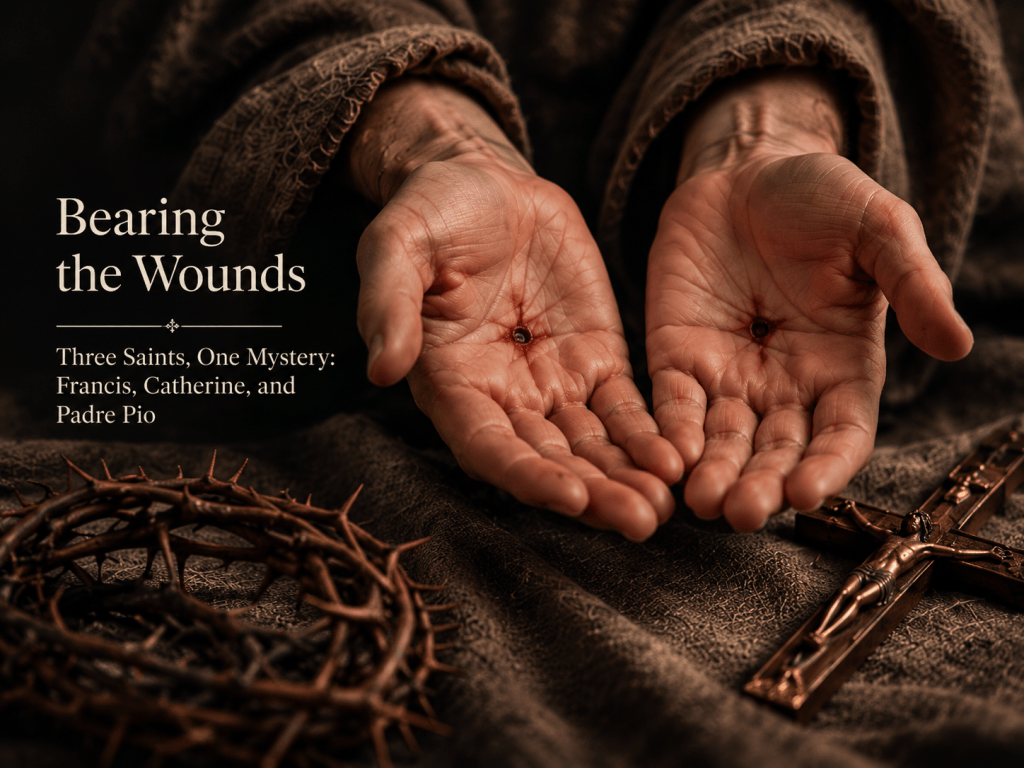
In the Christian story, the wounds belong to Christ.
Nails pierce the hands and feet. A spear opens the side. The Passion ends with a body marked by violence, and even after the Resurrection the wounds remain: in the Gospel of John, the risen Christ invites Thomas to see and touch them.
Then, centuries later, Christians began telling stories of those wounds appearing on other bodies.
Hands bled.
Feet opened.
Pain was felt in the side.
Sometimes the marks were visible. Sometimes there was pain without any wound that another person could see.
The phenomenon became known as the stigmata, from a Greek word referring to a mark or brand. In Christian mystical tradition, the term came to describe wounds, marks, or sufferings corresponding in some way to the wounds of the crucified Christ.
Stigmata are among the most dramatic phenomena associated with Catholic mysticism—and among the easiest to misunderstand.
They are not a requirement for sainthood.
Most saints have never claimed them.
The Church does not teach that every reported stigmatic experienced a supernatural event, nor does the canonization of a person automatically authenticate every extraordinary experience attributed to that saint.
And even when the Church speaks reverently about the stigmata of a particular saint, the wounds are not supposed to be the point of the person’s life.
They point somewhere else.
Toward the Crucifixion.
Toward suffering.
And, in Catholic thought, toward the unsettling possibility of becoming so identified with the suffering Christ that the Passion seems to impress itself upon the human person.
Three saints illustrate just how differently that idea has appeared across Catholic history.
One gives us the foundational story.
One bore wounds that, according to her tradition, could not be seen.
And one carried visible wounds into the age of modern medicine.
St. Francis of Assisi: When the Wounds Became Visible
If there is one name inseparable from the history of the stigmata, it is Francis of Assisi.
He is generally regarded as the first well-documented Christian stigmatic, although later traditions have occasionally attributed similar phenomena to earlier figures.
The event associated with Francis occurred in 1224, two years before his death.
Francis had withdrawn to the mountain sanctuary of La Verna in central Italy for a period of prayer and fasting. Early Franciscan sources describe a vision involving a crucified seraph. Afterward, marks corresponding to the wounds of Christ were reportedly visible on Francis’s hands, feet, and side.
Eight hundred years later, the event remains an official part of Franciscan memory. In 2024, the Vatican commemorated the eighth centenary of Francis’s stigmata, identifying La Verna and 1224 directly with the event. (Vatican News)
That long institutional memory matters.
Francis’s stigmata did not enter Christian tradition centuries after everyone who knew him was dead. Early Franciscan writers—including Thomas of Celano—described the wounds within the first generations after his death, and the tradition became deeply embedded in Franciscan spirituality and art.
Paintings of Francis receiving the stigmata became almost a genre of their own.
But theologically, the interesting thing is not simply that Francis was said to bleed.
It is why Christians interpreted the wounds as meaningful.
Francis had built his religious life around an unusually literal imitation of Christ: poverty, itinerant preaching, service to the marginalized, identification with the poor, and intense meditation upon the Passion.
Within Franciscan spirituality, the stigmata eventually came to represent the culmination of that imitation.
Not merely:
Francis looked like Christ.
But:
Francis had allowed the life of Christ to shape him so completely that the Crucified seemed to have left His marks upon him.
Modern Vatican reflections continue to interpret Francis’s wounds in precisely that direction. During the 2024 commemoration, Pope Francis described them not as spiritual spectacle but as signs pointing toward Christ’s suffering, mercy, and victory over death. (Vatican News)
A 2026 meditation from the Pontifical Household made the warning even more explicit: mystical suffering should not be interpreted as though God somehow needs human pain or as though Christ’s sacrifice were incomplete. The emphasis instead was upon the transformation of suffering through love. (Vatican News)
That distinction is important.
Because without it, stigmata can easily become a theology of pain for pain’s sake.
Christian mystical tradition intends something more complicated.
The wounds are supposed to signify conformity to Christ, not a competition over who can suffer the most.
But Francis established a pattern that later Christians would recognize immediately.
Visible wounds.
Hands.
Feet.
Side.
The Crucifixion written upon another body.
A little more than a century later, Catherine of Siena complicated that picture considerably.
Because according to her tradition, the wounds were there—
but they could not be seen.
St. Catherine of Siena: The Wounds No One Could See
Catherine of Siena was born in 1347, more than a century after Francis.
She was a Dominican tertiary, mystic, political correspondent, spiritual teacher, and eventually one of the most influential women in medieval Catholicism.
In 1375, while in Pisa during Lent, Catherine reportedly experienced the stigmata.
But her account contains an unusual detail.
According to the traditional narrative preserved by her early biographers, Catherine did not want the wounds to remain visibly displayed on her body. She prayed that the marks would become invisible.
The pain remained.
The outward wounds did not.
Her early biographical tradition therefore presents Catherine as bearing invisible stigmata—an experience of the wounds of Christ without externally visible lesions during her lifetime. (New Advent)
That immediately forces us to widen the definition.
A stigmatic is not necessarily someone bleeding publicly from five wounds.
Older Catholic discussions commonly distinguish between visible stigmata, in which bodily marks or wounds appear, and invisible stigmata, in which a person reports corresponding suffering without outward signs. (New Advent)
Catherine’s case also demonstrates how deeply mystical experiences depend upon testimony.
With visible wounds, an observer can at least say:
There is a wound.
That still leaves enormous questions about its cause—but the physical object exists for examination.
Invisible stigmata are different.
If another person cannot observe the wound, then the historical record depends much more heavily upon what the mystic reports and what those around her preserve.
That does not make the experience meaningless.
But it does change the type of evidence available.
And this is where it becomes useful to separate two questions that are often collapsed together:
Did Catherine experience something that she understood as participation in Christ’s wounds?
and
Can a modern historian establish the supernatural cause of that experience?
Those are not the same question.
Catherine’s stigmata belong primarily to the history of her mystical life and the testimony preserved by her followers.
She was canonized in 1461, but canonization is not the equivalent of a Church declaration that every vision, mystical experience, or bodily phenomenon reported during her lifetime must be accepted as supernatural fact. (New Advent)
That distinction becomes even more important when we reach the twentieth century.
Because with Padre Pio, the wounds were no longer confined to medieval hagiography.
There were doctors.
There were written reports.
There were photographs.
There were Church investigations.
And there were controversies.
Padre Pio: The Stigmata Enter the Modern World
Francesco Forgione—better known as Padre Pio of Pietrelcina—was a Capuchin friar born in 1887.
On September 20, 1918, while praying at San Giovanni Rotondo, he reported an experience after which permanent wounds associated with the Passion appeared on his body.
The timing is significant.
This was not medieval Europe.
The First World War was ending.
Modern medicine already possessed germ theory, anesthesia, radiography, laboratory pathology, professional medical institutions, and increasingly systematic diagnostic practice.
A man displaying persistent wounds could be examined by physicians in ways Francis of Assisi never could have imagined.
And Padre Pio was.
One of the earliest medical examinations occurred in 1919, when physician Luigi Romanelli examined his wounds and recorded his observations. Other physicians would follow, producing differing assessments and interpretations. The official Padre Pio archive preserves accounts of these examinations as part of the history surrounding the wounds. (Padre Pio Official Site)
The stigmata remained associated with Padre Pio for approximately fifty years, from 1918 until shortly before his death in 1968.
They became impossible to separate from his public reputation.
Pilgrims came to San Giovanni Rotondo.
Reports spread.
Photographs circulated.
Questions followed.
Were the wounds supernatural?
Could they have been self-inflicted?
Could repeated irritation, chemicals, psychological processes, or another medical mechanism explain them?
Were observers too eager to believe?
Were skeptics too eager not to?
Those questions are not hostile intrusions into the history of Padre Pio.
They are part of it.
Indeed, twentieth-century discussions of stigmatics often turned precisely upon the difficulty of moving from an observable fact—a wound exists—to a confident explanation of why the wound exists. Modern historical scholarship on stigmata has emphasized that medical examination could document physical phenomena while still leaving their underlying cause disputed. (Cambridge University Press)
The Church itself scrutinized Padre Pio repeatedly during his lifetime, and restrictions were imposed upon aspects of his public ministry at different points.
That history can sometimes disappear from devotional retellings, which jump directly from mysterious wounds to canonized saint.
But the tension is important.
Catholic authorities were not operating under a rule that said:
A friar has wounds; therefore God caused them.
Padre Pio’s holiness, ministry, obedience, prayer, pastoral work, and reputation all underwent examination over time.
He was beatified in 1999 and canonized in 2002.
And the Vatican has certainly used explicitly theological language about his stigmata. At his beatification, John Paul II spoke of his body as marked by the wounds of Christ and described the stigmata as signs of divine mercy. In 2018, Pope Francis traveled to Pietrelcina and San Giovanni Rotondo during commemorations marking the centenary of the appearance of Padre Pio’s permanent stigmata. (Vatican)
So it would be equally misleading to pretend that the Church simply ignores the phenomenon.
It does not.
Padre Pio’s wounds are embedded in official Catholic memory.
But there remains a useful distinction between the Church’s devotional and theological interpretation of the life of a saint and the kind of claim that might be made by a laboratory declaring a physical event scientifically inexplicable or proving supernatural causation.
Science can investigate tissue.
It can investigate blood.
It can look for infection, trauma, disease, chemicals, healing patterns, and mechanisms of injury.
What science cannot place into a test tube is the proposition:
God caused this wound.
That is a theological claim, not a medical measurement.
And the Catholic Church itself has become increasingly cautious about precisely this territory.
What Does the Church Actually Do With Extraordinary Claims?
In 2024, the Dicastery for the Doctrine of the Faith issued revised norms for discerning alleged supernatural phenomena.
The document applies broadly to extraordinary religious claims rather than to stigmata alone, but its principle is useful here.
When physical or psychological phenomena appear that cannot immediately be explained, the Church calls for discernment, not automatic acceptance.
The investigation can include doctrine, moral behavior, testimony, spiritual fruits, potential manipulation, financial motives, psychological concerns, fraud, and evidence against the claim.
Most significantly, the contemporary norms state that even a favorable judgment such as a nihil obstatnormally does not amount to a declaration that the phenomenon itself has been proven supernatural. (Vatican Press)
That is an important antidote to a common misunderstanding.
The Catholic Church can allow devotion surrounding an extraordinary event without requiring Catholics to believe that every supernatural explanation attached to the event has been definitively established.
Likewise:
Canonization is not certification of every extraordinary story associated with a saint.
Francis is a saint.
Catherine is a saint.
Padre Pio is a saint.
The Church holds each of them up as examples of Christian holiness.
That does not mean a Catholic must suspend critical thought about every detail transmitted in centuries of devotional literature.
Nor does skepticism automatically require dismissing the spiritual meaning the tradition has found in their experiences.
There is room between gullibility and contempt.
Catholicism, at its best, has always needed that space.
Wound, Miracle, or Mystery?
There are natural explanations that must be considered whenever someone presents with unexplained bodily wounds.
Self-infliction is possible.
Fraud is possible.
Dermatological disease is possible.
Repeated trauma is possible.
Psychological and psychosomatic processes have long been proposed in discussions of stigmatics.
And some historical cases undoubtedly deserve more skepticism than devotional literature has sometimes allowed.
But another mistake is possible in the opposite direction: assuming that naming a possible natural mechanism automatically establishes that it explains a particular historical case.
Often, especially with people who died centuries ago, the evidence simply cannot carry that much weight.
Francis cannot undergo a dermatological examination in 2026.
Catherine’s invisible wounds cannot be photographed.
Even Padre Pio’s twentieth-century documentation leaves room for disagreement over how particular observations should be interpreted.
Sometimes the most accurate historical answer is simply:
We do not know.
That does not satisfy everyone.
Believers may want certainty.
Skeptics may also want certainty.
History frequently offers neither.
What it can tell us is that Christians have spent eight centuries returning to these wounds and asking what they mean.
Bearing the Wounds
The deepest Catholic interpretation of the stigmata is not that certain saints developed supernatural injuries as proof that God liked them better.
Nor is suffering itself considered holiness.
The tradition instead understands authentic stigmata—if and when they occur—as an extraordinary form of participation in the Passion of Christ.
Francis gives us the visible image.
Catherine gives us suffering without the public wound.
Padre Pio gives us the collision between mystical tradition and modern scrutiny.
But in each case, the wounds are meant to direct attention away from themselves.
Toward Christ.
That is why one of the most important contemporary Vatican reflections on Francis’s stigmata warned against imagining a God who demands suffering simply for its own sake. Christian faith holds that Christ’s sacrifice is complete; human pain does not need to finish something He failed to accomplish. (Vatican News)
The more difficult idea is transformation.
Christianity cannot promise that human beings will avoid suffering.
It makes the stranger claim that suffering can sometimes be carried without becoming meaningless.
And perhaps that is why the stigmata have remained so disturbing.
The body refuses abstraction.
A theologian can write about the Passion.
An artist can paint it.
A preacher can describe it.
But a wound brings suffering uncomfortably close.
It says:
This happened to flesh.
Whether one interprets a particular stigmatic through theology, medicine, psychology, history, or some combination of them, the image forces the same confrontation.
Francis’s hands.
Catherine’s unseen pain.
Padre Pio’s wounds.
They return the Crucifixion from theological language to the body.
And perhaps that is where the stigmata are most powerful—not as proof, not as spectacle, and not as a demand that every strange wound be called miraculous.
But as an unsettling reminder that the central image of Christianity has always been a wounded body.
The saints who were said to bear those wounds did not make Christianity more comfortable.
They made its oldest image harder to look away from.


