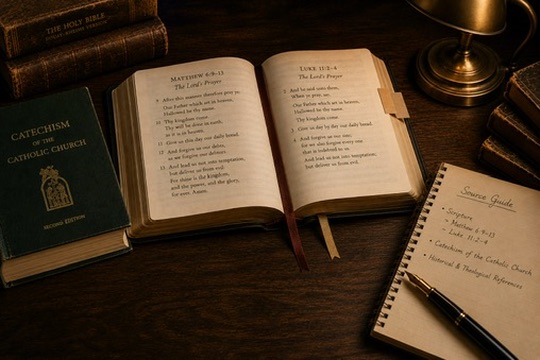
Introduction
The Our Father occupies a unique place among Christian prayers because it originates directly from the teaching of Jesus Christ as recorded in the Gospels.
As a result, the primary sources for studying the prayer differ significantly from those used to research later devotional prayers. The history of the Our Father begins with Scripture itself and continues through the writings of the early Church, liturgical tradition, theological commentary, and modern catechetical teaching.
This guide identifies the principal sources used to study the Lord’s Prayer and explains the contribution each makes to understanding its history, meaning, and development.
I. Primary Biblical Sources
All serious study of the Our Father begins with Scripture.
Matthew 6:9–13: The Sermon on the Mount
Our Father who art in heaven…
Research Significance
This is the most complete biblical version of the prayer.
It serves as the foundation for:
- Catholic liturgical use
- Most traditional Christian forms
- Historical study of the prayer
Researchers should begin here.
Luke 11:2–4: Lord, Teach Us to Pray
Father, hallowed be thy name…
Research Significance
Provides an alternative and shorter version of the prayer.
Important for:
- Textual comparison
- Historical questions about transmission
- Understanding early Christian prayer traditions
Matthew 6:5–8: Context of the Prayer
Research Significance
Explains why Jesus teaches the prayer.
Provides insight into:
- Christian prayer
- Relationship with God
- Warnings against empty prayer
⸻
Luke 11:1
The Request of the Disciples
Lord, teach us to pray.
Research Significance
Provides the immediate context for Luke’s version.
Highlights the prayer as a model given by Christ.
II. Early Christian Sources
These sources demonstrate how the earliest Christians received and practiced the Lord’s Prayer.
The Didache
c. AD 70–120
One of the oldest surviving Christian documents outside the New Testament.
Research Significance
Contains one of the earliest known references to the Lord’s Prayer outside Scripture.
Instructs Christians:
Pray thus three times each day.
Provides valuable evidence for the prayer’s early devotional use.
III. Early Church Fathers
The Fathers provide some of the earliest surviving commentaries on the Lord’s Prayer.
Tertullian: On Prayer (De Oratione)
c. AD 200
Research Significance
One of the earliest dedicated studies of the Lord’s Prayer.
Famously refers to it as:
The summary of the whole Gospel.
Origen: On Prayer
c. AD 240
Research Significance
One of the earliest extensive theological commentaries on the Lord’s Prayer.
Examines each petition in detail.
Particularly important for understanding early interpretation.
⸻
St. Cyprian of Carthage
On the Lord’s Prayer
c. AD 250
Research Significance
Demonstrates how the prayer was understood in the third-century Church.
Emphasizes the communal nature of: Our Father
St. Augustine: Sermons and Commentaries
4th–5th Century
Research Significance
Provides influential explanations of:
- Daily bread
- Forgiveness
- Temptation
- Christian discipleship
Many later Catholic interpretations draw from Augustine.
St. John Chrysostom: Homilies on Matthew
4th Century
Research Significance
Offers important commentary on the Matthean version.
Provides insight into Eastern Christian interpretation.
IV. Textual and Linguistic Sources
These sources are particularly important for understanding difficult phrases.
Greek New Testament Manuscripts
Research Significance
Essential for studying:
- Variations between Matthew and Luke
- The doxology
- Translation issues
The Word “Epiousios”
Research Significance
The Greek word is traditionally translated as: “Daily”
Occurs almost nowhere else in ancient Greek literature.
Important for studying:
- Daily bread
- Eucharistic interpretations
- Linguistic debates
Biblical Lexicons and Language Studies
Research Significance
Help researchers understand:
- Original Greek terminology
- Translation challenges
- Historical meanings
V. Liturgical Sources
These sources show how the prayer entered Christian worship.
Ancient Liturgies
Including:
- Roman Rite
- Byzantine Rite
- Other historic Christian liturgies
Research Significance
Demonstrate the widespread use of the Lord’s Prayer across Christian traditions.
Roman Missal
Research Significance
Shows the prayer’s role within the Mass.
Important for studying:
- Liturgical placement
- The embolism following the prayer
- Modern Catholic usage
Liturgy of the Hours
Research Significance
Demonstrates the prayer’s continuing role in the Church’s daily prayer.
VI. Catechetical Sources
These sources explain how the Church officially interprets the prayer.
Catechism of the Council of Trent
Research Significance
Provides a post-Reformation explanation of the Lord’s Prayer.
Important for historical Catholic teaching.
Catechism of the Catholic Church
Especially:
§§2759–2865
Research Significance
The most comprehensive modern Catholic treatment of the Lord’s Prayer.
Examines:
- Each petition
- Biblical foundations
- Spiritual meaning
- Liturgical significance
One of the most important sources for modern Catholic understanding.
VII. Papal Documents
Unlike the Rosary prayers, the Our Father is not associated with a single defining papal document.
Instead, it appears throughout broader teaching on prayer.
Catecheses on Prayer
Various popes have offered reflections on the Lord’s Prayer.
Notable examples include:
- Pope St. John Paul II
- Pope Benedict XVI
- Pope Francis
Research Significance
Provide modern pastoral and theological interpretation.
VIII. The Doxology Question
One of the most common areas of research concerns the ending of prayer.
Ancient Manuscripts of Matthew
Research Significance
Help determine whether:
For thine is the kingdom,
and the power,
and the glory forever.
formed part of the earliest biblical text.
The Didache
Research Significance
Contains an early form of the doxology.
Useful for understanding its liturgical development.
Modern Biblical Scholarship
Research Significance
Examines:
- Manuscript evidence
- Liturgical traditions
- Textual transmission
⸻
IX. Claim-to-Source Guide
If researching:
“Where did Jesus teach the Our Father?”
Consult:
- Matthew 6:9–13
- Luke 11:2–4
“How did the earliest Christians pray it?”
Consult:
- Didache
“How did the Church Fathers understand it?”
Consult:
- Tertullian
- Origen
- Cyprian
- Augustine
- Chrysostom
“What does daily bread mean?”
Consult:
- Greek New Testament
- Epiousios studies
- Patristic commentaries
“Why do Catholics and Protestants sometimes pray different endings?”
Consult:
- Matthew manuscripts
- Didache
- Liturgical history
“How does the Catholic Church explain the prayer today?”
Consult:
- Catechism of the Catholic Church §§2759–2865
X. Recommended Reading Order
For readers beginning research on the Lord’s Prayer:
Matthew 6:5–13 and Luke 11:1–4
The Didache
Tertullian’s On Prayer
Origen’s On Prayer
Catechism of the Catholic Church §§2759–2865
Conclusion
The Our Father is among the best-documented prayers in Christian history.
Its origins are preserved in Scripture.
Its early use is documented by some of Christianity’s oldest surviving texts.
Its interpretation has been explored by generations of theologians, pastors, and saints.
Its place within Christian worship has remained remarkably stable for nearly two thousand years.
For researchers, the Lord’s Prayer offers a rare opportunity to trace a prayer directly from the ministry of Christ, through the earliest Christian communities, into the life of the modern Church.
Few prayers possess such a continuous and richly documented history.


