A “ Beneath the Veil” personal reflection… and also it’s spooky season…why not?
©MS 2026
Parts: Relics , Incorruptibles, Stigmata, Memento Mori
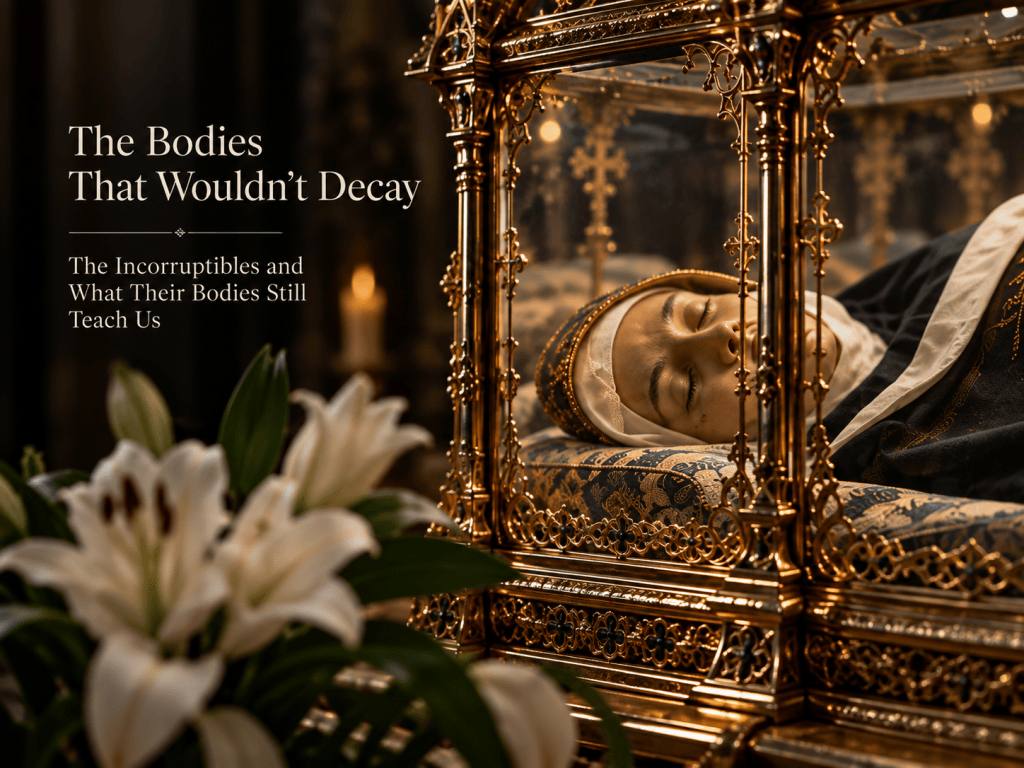
Behind glass in Bologna sits the body of a woman who died in 1463.
She is not lying down.
Saint Catherine of Bologna sits upright, dressed in the habit of a Poor Clare, her darkened face visible above folded clothing. Pilgrims can still approach the chapel where her body has been kept for centuries.
In Cascia, another medieval saint lies within a silver-and-crystal shrine. Her face, hands, and feet remain covered with dried tissue, although much of the body beneath her religious habit is now skeletal.
In Nevers, France, Saint Bernadette Soubirous appears almost peacefully asleep beneath glass—yet the serene face most visitors see includes a thin wax covering placed over her own preserved features a century ago.
And in Lebanon, the body of Saint Charbel Makhlouf was repeatedly opened and examined after his death because monks reported not merely unusual preservation but the persistent appearance of liquid resembling blood and water.
These people are frequently grouped together under one extraordinary word:
incorruptible.
It is a word capable of creating considerably more confusion than clarity.
Popular Catholic websites sometimes use incorrupt as though it means a saint died, was buried, and later emerged looking perfectly alive without decomposition, embalming, conservation, environmental preservation, or human intervention.
Reality is much more complicated.
Some bodies identified with the tradition of incorruptibility have undergone partial natural mummification.
Some have lost substantial amounts of soft tissue.
Some have been treated or conserved after exhumation.
Some have wax coverings over exposed areas.
Some remained unusually preserved for a period and later continued decomposing.
And some historical accounts describe preservation that remains difficult to reconstruct scientifically because the examinations occurred long before modern forensic medicine.
The interesting question, then, is not simply:
Did the saint rot?
It is:
What was actually found, what happened to the body afterward, and what does the Catholic Church mean when it preserves and venerates remains like these?
What Happens to a Body After Death?
Before looking at saints, it helps to begin with something considerably less mystical:
decomposition.
The human body normally begins changing almost immediately after death. Cells break down. Bacteria participate in the destruction of tissue. Environmental conditions, temperature, moisture, oxygen, clothing, the coffin, burial depth, soil chemistry, disease, body composition, and many other variables affect what happens and how quickly.
There is no universal timetable by which every human body must reach the same condition.
Under some circumstances, decomposition can be substantially slowed or altered.
A body in a sufficiently dry environment can undergo natural mummification, as moisture leaves the tissues faster than destructive processes can progress.
Under other conditions, body fat can transform into a waxy substance known as adipocere, sometimes called grave wax. Forensic research describes adipocere as a postmortem transformation capable of slowing or even arresting ordinary decomposition and preserving recognizable portions of a body for many years. (ScienceDirect)
Bodies can also be deliberately preserved.
Embalming, chemical treatments, refrigeration, sealed environments, restoration, wax coverings, and later conservation can all affect what survives and what a pilgrim eventually sees.
That distinction matters enormously.
A body can be remarkably preserved without that preservation being supernatural.
And incorruptibility, as used in Catholic devotional history, is not a forensic diagnosis.
The Church’s contemporary rules governing saints’ remains concentrate on authenticating the identity of those remains, protecting them, documenting procedures performed upon them, and preserving them with dignity. The modern canonization process does not offer a shortcut in which a surprisingly well-preserved body automatically proves sanctity. (Vatican)
Historically, however, unusual preservation could carry powerful religious meaning.
If Christians believed that a person’s body had been the instrument through which an unusually holy life was lived, finding that body unexpectedly preserved could appear to them as a physical sign of that holiness.
And few examples are more visually arresting than Catherine of Bologna.
Saint Catherine of Bologna: The Saint Who Sits
Catherine de’ Vigri was born in Bologna in 1413.
She was unusually well educated for a woman of her time. As a girl she spent years at the sophisticated Este court in Ferrara, where she learned Latin, music, poetry, drawing, manuscript illumination, and the intellectual disciplines associated with court life.
But Catherine eventually abandoned courtly life for religious life.
She became a Poor Clare, wrote spiritual works—including The Seven Spiritual Weapons—created religious art, instructed younger sisters, and in 1456 helped establish a new Poor Clare monastery in Bologna.
Pope Benedict XVI later described her as a highly educated woman whose learning existed alongside profound humility, prayer, service, and an intensely contemplative spirituality. (Vatican)
Catherine died on March 9, 1463.
According to the Corpus Domini Sanctuary, where her body remains today, she was buried according to the Poor Clare custom without a coffin. Eighteen days later she was exhumed.
The sanctuary’s tradition reports that her body was found intact, flexible, and associated with a pleasant fragrance. Accounts preserved by the community also describe unusual moisture or fluid appearing on the body in the period after exhumation. (Santuario Corpus Domini)
Those claims must be understood for what they are.
They come from a fifteenth-century religious community and the later tradition preserving its testimony.
No forensic pathologist stood beside Catherine’s grave in 1463 collecting tissue samples, recording soil temperature, measuring humidity, or conducting toxicological analysis.
We cannot transport the body backward into a modern laboratory.
What we can say is that Catherine’s community believed her preservation was extraordinary, preserved that belief for generations, and continued to safeguard her body.
And that body is still there.
Catherine is particularly memorable because she is displayed seated upright, rather than lying horizontally as most bodies in shrines are presented. The Corpus Domini Sanctuary continues to describe and display her remains as incorrupt. (Santuario Corpus Domini)
But Catherine also teaches us the first rule of this entire subject:
An old religious account is historical evidence for what people reported and believed. It is not automatically modern forensic evidence for why the body was preserved.
We should neither ridicule the witnesses nor pretend they possessed investigative tools that would not exist for centuries.
The honest answer leaves some uncertainty intact.
Our second saint gives us something different.
Her shrine can tell us quite plainly what remains today.
Saint Rita of Cascia: When “Incorrupt” Does Not Mean Unchanged
Rita of Cascia was another Italian woman of the late medieval period, born in the fourteenth century.
Unlike Catherine, Rita did not begin her adult life in a convent.
She married, became a mother, lost her husband violently, lost her sons, and eventually entered an Augustinian religious community in Cascia.
Her spirituality became deeply associated with suffering, reconciliation, and the Passion of Christ.
According to Catholic tradition, Rita prayed to participate more intimately in Christ’s suffering, and a wound resembling that caused by a thorn appeared on her forehead. The wound became one of her recognizable attributes in religious art. (vaticanstate.va)
She died in 1457.
Her reputation for holiness spread rapidly, although formal canonization did not occur until 1900, when Pope Leo XIII declared her a saint. (vaticanstate.va)
And her body remains in Cascia.
This is where things become especially useful for understanding the word incorruptible.
The official Shrine of Saint Rita does not tell visitors that her body remains perfectly preserved as if death never occurred.
It says something much more specific.
According to the shrine, Rita’s face, hands, and feet are mummified.
Beneath the Augustinian habit lies her skeleton, the remainder of the body having been reduced substantially to bone beginning centuries ago. (Santa Rita)
That is an enormously important detail.
If we look only at a photograph of Rita’s shrine, we may see a saint apparently lying intact beneath glass and conclude:
Her entire body never decomposed.
That is not what her own custodians claim.
Parts of the body retain dried, mummified tissue.
Other portions have undergone the very process every human body ordinarily undergoes.
She changed.
She decomposed.
She remains a relic.
Those statements do not contradict one another.
And Rita’s case exposes one of the biggest problems with popular lists of “incorrupt saints.”
The word can flatten radically different physical conditions into one category.
A partially mummified body and a nearly intact body may both be called incorrupt in devotional conversation, while a forensic scientist would describe them very differently.
Catholic veneration does not require pretending those differences do not exist.
Indeed, acknowledging them makes the story more interesting.
The saint is not holy because every cell escaped decay.
Rita’s bodily remains are venerated because they are Rita’s remains.
The condition of those remains is secondary.
Our third example is probably the most famous—and perhaps the most misunderstood.
Saint Bernadette Soubirous: The Face Behind the Wax
Bernadette Soubirous was born in Lourdes, France, in 1844.
She grew up in severe poverty and suffered from chronic poor health.
In 1858, at fourteen years old, she reported a series of apparitions of the Virgin Mary at a grotto near Lourdes. The apparitions were later accepted by the local Church, and Lourdes became one of the world’s major Catholic pilgrimage destinations.
Bernadette herself eventually left Lourdes.
In 1866 she entered the Sisters of Charity at Nevers, where she worked in nursing and sacristy duties while struggling with increasingly severe illness.
She died on April 16, 1879, at only thirty-five years old. (Nevers)
Decades later, as her cause for beatification advanced, her grave was opened.
Then opened again.
And again.
Formal recognitions of Bernadette’s body occurred in 1909, 1919, and 1925.
The Sisters of Charity of Nevers state that at each examination the body was found intact. Following her beatification in 1925, her remains were placed in the glass shrine where they remain today. She was canonized in 1933. (Nevers Sisters)
If you’ve ever seen a photograph of Bernadette, however, there is something essential to know.
The face you are seeing is not simply her untreated exposed face exactly as it emerged from the grave.
Archival accounts of the examinations describe changes.
By the later recognitions, the face had darkened. The eyes and nose had become sunken. The body had undergone drying and mummification.
In 1925, thin wax coverings were created for the face and hands, modeled using photographs and impressions of Bernadette’s features, and placed over the surviving tissue before her body was installed for public veneration. An account based on the Nevers convent and diocesan archives explicitly describes those wax coverings and states that Bernadette had not previously been embalmed. (EWTN Global Catholic Television Network)
That does not mean Bernadette’s body is a wax statue.
Her remains are beneath the coverings.
Nor does it mean the Church secretly created an illusion and hoped no one noticed.
Wax restoration and coverings have historically been used when bodily relics were exposed publicly, both to protect vulnerable remains and to present them in a form less distressing to pilgrims.
But it absolutely does mean that the luminous, peaceful complexion seen in photographs cannot be offered as photographic proof that Bernadette’s facial skin remained unchanged after death.
That distinction matters.
And it demonstrates why photographs of incorrupt saints can be deeply misleading when separated from conservation history.
Bernadette’s preservation was considered remarkable by the people who examined her.
That fact does not require us to pretend that nothing changed.
Her body dried.
Her features altered.
Conservation intervened.
Wax was added.
And yet there was enough preserved tissue after decades of burial that the repeated canonical examinations generated significant attention.
Both sides of that sentence belong in the story.
The remarkable and the ordinary.
The preservation and the decay.
The relic and the conservation work.
If Bernadette demonstrates how much context can be hidden behind a serene face, Saint Charbel gives us something stranger still.
Saint Charbel Makhlouf: The Body That Wept
Charbel Makhlouf was born in Lebanon in 1828.
He entered the Lebanese Maronite Order as a young man, became a priest, and eventually withdrew to a hermitage associated with the Monastery of Saint Maron at Annaya.
For more than two decades he lived an austere life centered upon prayer, silence, manual work, poverty, and the Eucharist.
During Mass in December 1898 he became gravely ill.
He died on Christmas Eve. (vaticanstate.va)
Then reports began.
People said an unusual light appeared around his grave.
Pilgrims began visiting.
The grave was opened.
Vatican and Maronite sources recount that the body was found unexpectedly preserved and flexible. Even stranger were reports that liquid resembling a mixture of blood and water emerged from the remains. (vaticanstate.va)
The monastery at Annaya itself records that Charbel’s body was transferred through several coffins and that repeated examinations were undertaken specifically because of the reported exudation of water and blood. (Deir Annaya)
Unlike Catherine of Bologna, whose earliest preservation accounts come from the fifteenth century, Charbel died at the threshold of the twentieth.
Doctors could examine him.
Records could be maintained with substantially greater detail.
The story nevertheless remains difficult to evaluate from a modern forensic perspective.
Church and monastic sources describe a body that remained unusually preserved for decades and continued producing moisture for an extended period. Vatican State’s biography of Charbel says this extraordinary bodily condition persisted until his beatification in 1965. He was canonized in 1977. (vaticanstate.va)
That last detail is revealing.
Even within the tradition surrounding Charbel, incorruptibility need not mean:
The body will remain permanently unchanged forever.
A body can undergo an unusual period of preservation and later continue decomposing.
And that leads us directly back to the question we started with.
What exactly are we calling a miracle?
Does the Church Declare Incorrupt Bodies Miraculous?
Not simply because they are preserved.
The Catholic Church has long examined the bodies of candidates for sainthood, but contemporary canonical recognition has a practical purpose: establishing that the remains are authentic, documenting their condition, securing them, extracting relics properly when authorized, and preserving them appropriately. (Vatican)
The Church already expects the normal human body to decay.
The Catechism’s own language about Christian death is strikingly straightforward: after death, the body becomes corrupt while the soul awaits resurrection. Christianity’s ultimate hope is not that sufficiently holy corpses will never decompose.
It is the resurrection of the body. (Vatican)
That makes incorruptibility an intriguing sign within Catholic tradition, not a requirement of sainthood.
Thousands of saints decomposed normally.
Their holiness is not considered lesser because their bodies returned to bone.
Conversely, a naturally preserved body does not become holy simply because chemistry and burial conditions slowed decay.
Modern forensic science gives us several entirely natural pathways toward unexpected preservation.
Desiccation can produce mummification.
Warm, moist, low-oxygen conditions can produce adipocere.
Soil chemistry, temperature, coffins, clothing, body composition, microbes, and environmental conditions can dramatically alter decomposition. (PubMed)
And then there is human intervention.
Embalming.
Cleaning.
Reclothing.
Rehousing.
Wax reconstruction.
Modern conservation.
These are not inconveniences to be hidden because they make the story less miraculous.
They are part of the object’s history.
Or in this case, the body’s history.
The Wax Face Is Not a Lie
I think this deserves to be said plainly.
Discovering that an incorrupt saint has a wax face should not be treated as some devastating revelation.
The purpose of a shrine is not to stage a forensic experiment.
It is to preserve human remains for religious veneration.
Bodies displayed for decades—or centuries—need protection. Exposed tissue is fragile. Human features collapse and darken. Damage occurs.
Conservation alters presentation because doing nothing is itself a conservation decision, and usually not a very good one.
Bernadette’s wax covering tells us something about twentieth-century attitudes toward displaying relics.
Rita’s mummified extremities tell us something about partial natural preservation.
Catherine’s seated body gives us a centuries-old devotional tradition whose earliest physical observations cannot be repeated under modern conditions.
Charbel gives us reports of preservation and bodily phenomena documented much closer to the age of modern medicine.
None of these four bodies is physically identical.
And yet all four have been drawn into the Catholic language of incorruptibility.
That should make us cautious about the word.
Not cynical.
Precise.
Why Keep the Body at All?
This brings us back to where Beneath the Veil began.
Relics.
Christianity has never been entirely comfortable with the idea that a body becomes meaningless once a person dies.
The Church venerates saints’ remains because the body participated in the person’s life.
Those hands worked.
Those feet walked.
Those mouths prayed.
Those bodies suffered illness, hunger, exhaustion, aging, and eventually death.
Catholic teaching describes the body of the saint as having been a living temple of the Holy Spirit and an instrument through which that person’s holiness was expressed. That theology underlies the Church’s continued concern for the authentication and preservation of relics. (Vatican)
An incorrupt body magnifies the confrontation.
A tiny relic can be almost abstract.
A fragment of bone sealed beneath glass may be intellectually understood without forcing the viewer to think deeply about the dead person from whom it came.
A whole body is different.
There is the face.
There are the hands.
There is the unmistakable shape of a human being who once moved through the world.
And yet the body is still.
That is why incorrupt saints can feel simultaneously holy and unsettling.
They occupy an uncomfortable space between presence and absence.
The person is dead.
The person is not there.
And something of the person remains unmistakably before us.
The Bodies That Wouldn’t Decay
Catherine of Bologna died in 1463 and, according to the religious community that preserves her, was found unexpectedly intact when her grave was opened eighteen days later.
Rita of Cascia died in 1457. Her face, hands, and feet retain mummified tissue while much of the rest of her body has become skeletal.
Bernadette Soubirous died in 1879. Her body was examined three times during her cause for sainthood and remained substantially preserved, though later changes required conservation and wax coverings over the face and hands.
Charbel Makhlouf died in 1898. His monastic and Church traditions record decades of unusual preservation accompanied by reports of liquid emerging from the body.
Four saints.
Four bodies.
Four very different physical histories.
Calling all of them simply incorruptible tells us less than we might imagine.
The more interesting story begins after we ask what happened next.
Some tissue dried.
Some disappeared.
Some was conserved.
Some was covered.
Some decomposition continued.
And none of that destroys the religious meaning Catholics have found in these remains.
Perhaps it even sharpens it.
Because Christianity does not ultimately claim that holy people escape death.
The saints died.
Their bodies changed.
Even the bodies called incorrupt remain material things subject to time.
Catholic hope lies somewhere beyond preservation.
Not in keeping the body forever untouched beneath glass.
Not in defeating bacteria.
Not in producing a corpse that looks asleep.
The Christian claim is considerably stranger than that.
The body matters even though it dies.
And one day, Christianity says, death itself will not have the final claim upon it.
Until then, these bodies remain behind glass.
Catherine sitting quietly in Bologna.
Rita lying in Cascia.
Bernadette beneath her wax-covered face in Nevers.
Charbel resting in Lebanon.
They can be examined historically.
They can be questioned scientifically.
They can be approached devotionally.
And they should never be made more mysterious by pretending we know things we do not.
Sometimes nature preserves a body.
Sometimes human beings preserve it.
Sometimes the surviving evidence leaves questions.
And sometimes the most unsettling thing about an incorrupt saint is not whether the body should have decayed faster.
It is simply that the dead person is still there to be looked at.
Which leaves the living with a much more uncomfortable subject.
Not what happened to their bodies.
But what will eventually happen to ours.


