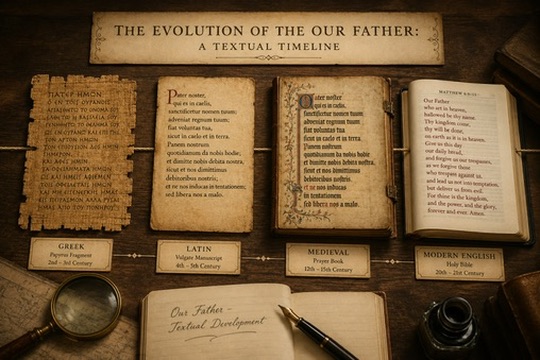
Introduction
Among the major prayers of Christianity, the Our Father occupies a unique position.
Unlike the Hail Mary, the Apostles’ Creed, or the Salve Regina, the Lord’s Prayer does not emerge gradually through centuries of devotional development. Christians believe it originates directly from the teaching of Jesus Christ.
For this reason, the history of the Our Father is not primarily the story of a prayer being composed. Instead, it is the story of how Christ’s words were preserved, transmitted, interpreted, translated, and incorporated into Christian worship.
The prayer’s remarkable stability across two thousand years testifies to its central place within Christian life. Yet beneath that stability lie fascinating historical questions involving biblical manuscripts, ancient languages, liturgical traditions, and theological interpretation.
First Century: Jesus Teaches the Prayer
c. AD 30
The origins of the Our Father trace back to the earthly ministry of Jesus.
The Gospels preserve two versions of the prayer.
Matthew 6:9–13: The Sermon on the Mount
Matthew records the longer form:
Our Father who art in heaven,
hallowed be thy name.
Thy kingdom come.
Thy will be done,
on earth as it is in heaven.
Give us this day our daily bread.
And forgive us our debts,
as we forgive our debtors.
And lead us not into temptation,
but deliver us from evil.
This version becomes the foundation for most later Christian usage.
Luke 11:2–4: Lord, Teach Us to Pray
Luke preserves a shorter version:
Father,
hallowed be thy name.
Thy kingdom come.
Give us each day our daily bread.
Forgive us our sins,
for we ourselves forgive everyone indebted to us.
And lead us not into temptation.
Several familiar phrases are absent.
The existence of two versions demonstrates that the prayer circulated within the earliest Christian communities before the New Testament canon was finalized.
Which Version Came First?
Historians continue debating this question. Two major theories exist.
Theory One
Luke preserves the earlier form.
Matthew expands it for teaching purposes.
Theory Two
Matthew preserves the original form.
Luke abbreviates it for his audience.
No scholarly consensus exists. What is clear is that both versions originate very early.
The Mystery of “Daily Bread”
One of the Most Difficult Words in the New Testament
The Greek word translated as “Daily” is epiousios.
This word is extraordinarily rare.
In fact, it appears almost nowhere else in ancient Greek literature.
Scholars remain uncertain whether Jesus intended:
Daily bread
Necessary bread
Bread for tomorrow
Future bread
Heavenly bread
The exact meaning remains debated.
Different Early Christian writers understood the phrase differently.
Physical Sustenance: Food necessary for life.
Spiritual Nourishment: God’s grace
Eucharistic Meaning: The Bread of Life.
The richness of interpretation begins almost immediately.
Late First Century: The Didache
c. AD 70–120
One of the earliest Christian documents outside the New Testament.
The Didache instructs believers: Pray thus three times each day.
The prayer given is recognizably the Lord’s Prayer.
This is among the earliest evidence that Christians had already incorporated the prayer into regular devotional life.
The Our Father moved from Christ’s teaching into communal Christian practice remarkably quickly.
Second and Third Centuries: Church Fathers Begin Commentary
Major Christian writers begin explaining the prayer.
These include:
Tertullian
Origen
Cyprian
The Our Father is among the earliest Christian texts to receive systematic theological commentary.
Tertullian
c. AD 200
Refers to the Lord’s Prayer as: The summary of the whole Gospel.
This description becomes enormously influential.
Origen
c. AD 240
Produces one of the earliest surviving extended commentaries on the prayer.
Shows that Christians were already studying each petition individually.
Fourth Century: The Golden Age of Commentary
Major Church Fathers write extensive explanations.
Notable figures include:
St. Ambrose
St. Augustine
St. John Chrysostom
St. Gregory of Nyssa
The theological interpretation of the prayer becomes highly developed.
Much later, Catholic teaching draws from these writers.
The Doxology Question: “For Thine Is the Kingdom…”
One of the most famous textual questions concerns the ending.
Many Protestants conclude:
For thine is the kingdom,
and the power,
and the glory forever.
Amen.
Most Catholics do not include these words in the prayer itself.
Why?
Earliest Manuscripts: The doxology is absent from some of the earliest and most important Matthew manuscripts. However, it appears in other ancient traditions.
The doxology appears to have originated as an early liturgical addition rather than part of the original Gospel text. It is ancient, but it was probably not originally part of Matthew’s written version.
Protestant Reformation
Many Protestant communities retained the ancient doxology as part of the prayer itself. This practice became widespread in English-speaking Christianity.
Modern Catholic Liturgy
Today Catholics hear:
Deliver us, Lord, we pray, from every evil…
followed by:
For the kingdom, the power and the glory are yours now and forever.
The doxology remains present but is separated from the prayer itself.
This arrangement reflects both historical scholarship and ancient liturgical practice.
The Prayer in the Mass
Early Church
Evidence suggests the Lord’s Prayer was incorporated into Christian worship very early.
Different rites placed it in different locations.
Roman Rite
Eventually, the prayer became firmly associated with preparation for Communion.
This placement remains today. The Our Father became both a devotional prayer and a liturgical prayer.
Medieval Period: Universal Christian Prayer
By the Middle Ages, the Our Father had become one of the most widely known texts in Europe. Children memorized it. Clergy taught it. Catechisms explained it. Monastic communities prayed it repeatedly. No Christian prayer achieved broader recognition.
The Reformation Era: Translation Becomes Important
As vernacular translations spread, the prayer appears in:
English
German
French
Spanish
Numerous other languages
The prayer’s wording becomes increasingly tied to translation choices.
Debts, Trespasses, and Sins
Different traditions begin using different translations.
Matthew uses “Debts”
Liturgical Tradition frequently uses: “Trespasses”
Luke uses language closer to: “Sins”
The underlying meaning remains similar, but wording varies.
Modern Translation Questions
“Lead Us Not into Temptation”
Modern readers often misunderstand this phrase.
The concern: God does not tempt people to sin.
Some modern translations attempt to clarify the meaning, such as “Do not let us fall into temptation” or “Do not let us enter into temptation.”
The Catechism Era: Catechism of the Catholic Church
The modern Catechism devotes an extensive section to the Lord’s Prayer.
It presents the Our Father as:
Summary of the Gospel
Model of prayer
School of Christian life
What Changed—and What Did Not
Over two millennia:
What Changed
- Language
- Translation
- Commentary
- Liturgical placement
- Use of the doxology
What Remained Stable
- Core structure
- Main petitions
- Relationship to Christ’s teaching
- Role in Christian worship
The Lord’s Prayer remains one of the most stable texts in Christian history.
Summary Timeline
c. AD 30: Jesus teaches the prayer.
AD 70–120: Didache instructs Christians to pray it three times daily.
2nd Century: Tertullian calls it the summary of the Gospel.
3rd Century: Origen writes a commentary.
4th Century: Major Church Fathers produce extensive explanations.
Early Church: Doxology appears in some liturgical traditions.
Middle Ages: Prayer becomes universal throughout Christian Europe.
16th Century: Reformation highlights translation differences.
20th Century: Modern biblical scholarship revisits textual questions.
Present Day: Most widely prayed Christian prayer in the world.
Conclusion
The history of the Our Father differs from that of most Christian prayers. Rather than being gradually composed, it was preserved. Rather than accumulating major additions, it was transmitted. Its story is therefore not one of invention but of faithful reception.
The prayer moved from the teaching of Jesus, to the pages of the Gospels, to the worship of the early Church, and ultimately into the daily lives of billions of Christians.
Over the centuries, Christians have debated translations, interpreted difficult phrases, and developed liturgical customs around it.
Yet the prayer itself remains remarkably unchanged.
For nearly two thousand years, believers have continued to pray the words that Christ taught His disciples.
Few texts in human history can claim such continuity.


