©MS 2026
The Red Scapular of the Passion
A Vincentian Sign of Christ’s Wounded Love
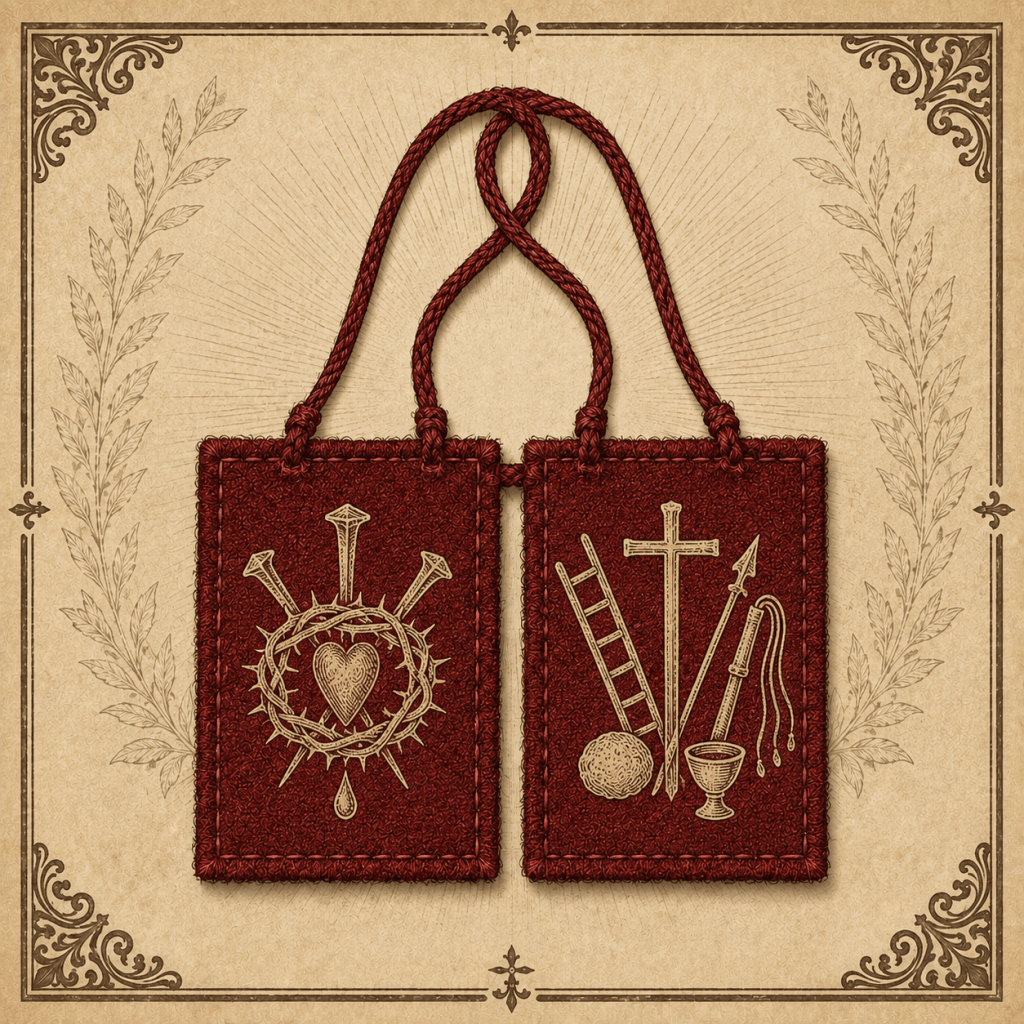
The Red Scapular of the Passion makes no attempt to masquerade as a tranquil or low-key devotion. Its fabric is red. One side depicts the Crucified Christ surrounded by the instruments of the Passion. The other highlights the Sacred Heart of Jesus together with Mary’s wounded Heart under the Cross. Every aspect of it points the wearer to suffering. Yet the scapular does not invite the wearer to glory in pain as an end in itself. Instead, it proclaims the Passion as the supreme expression of God’s love: Christ giving himself up for us, Mary standing at his side, and the Christian called to drink deeply of that love by way of faith, hope, charity, conversion, and works of service. The devotion originated with Sister Apolline Andriveau, a Daughter of Charity of St. Vincent de Paul, in nineteenth-century France. Pope Pius IX approved its promulgation in 1847 and entrusted it particularly to the priests of the Congregation of the Mission (known historically as the Vincentians or Lazarists). At its heart, its message is not: Put on this red cloth and suffering will end. Rather: Keep the Passion before your eyes. Let the love made known there transform your believing, hoping, loving, and serving.
⸻
At a Glance
| Full Name | Scapular of the Passion of Our Lord Jesus Christ and of the Sacred Hearts of Jesus and Mary |
| Common Names | Red Scapular; Red Scapular of the Passion |
| Traditional Color | Scarlet or red |
| Associated Tradition | Daughters of Charity and Congregation of the Mission—the Vincentian family |
| Devotional Focus | The Passion of Christ, the Sacred Hearts of Jesus and Mary, conversion, and the theological virtues |
| Traditional Origin | Mystical experiences reported by Sister Apolline Andriveau in Troyes, France, beginning in 1845; the scapular was shown in 1846 |
| First Scapular Vision | July 26, 1846 |
| Papal Authorization | Pope Pius IX, June 25, 1847 |
| Traditional Form | Two red cloth panels connected by red bands |
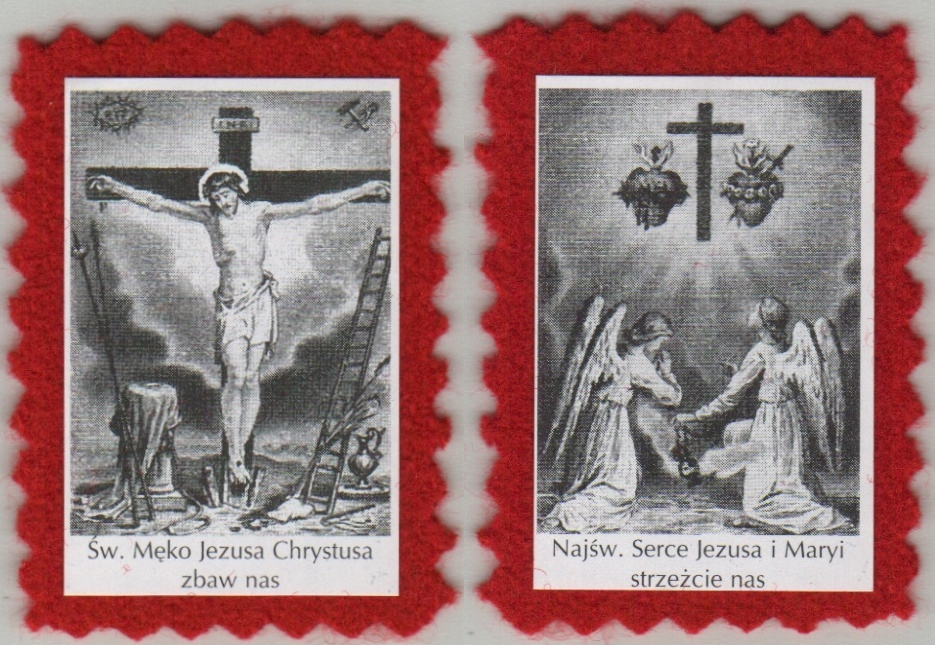
| Front Image | Christ Crucified with instruments of the Passion |
| Reverse Image | The Sacred Hearts of Jesus and Mary beneath or beside a Cross |
| Traditional Prayer Texts | “Holy Passion of Our Lord Jesus Christ, save us” and “Sacred Hearts of Jesus and Mary, protect us” |
| Particular Day of Devotion | Friday |
| Formal Investiture Historically Available? | Yes |
| Automatic Confraternity Membership? | No |
| Does It Automatically Forgive Sin or Guarantee Salvation? | No |
| Central Meaning | To contemplate Christ’s saving Passion and grow in faith, hope, charity, conversion, and compassionate service |
The historical form, prescribed images, papal authorization, and Vincentian authority to bless and invest wearers are documented in the early twentieth-century Catholic Encyclopedia.
⸻
Which Red Scapular?
The color red does not identify one universal Catholic devotion.
Several scapulars have used red cloth, including:
- The Red Scapular of the Passion
- The Scapular of the Most Precious Blood
- Other devotional scapulars incorporating red symbols or cords
The Red Scapular discussed here is specifically associated with:
- Christ’s Passion
- The Sacred Heart of Jesus
- The wounded Heart of Mary
- Sister Apolline Andriveau
- The Vincentian family
It should also not be confused with the Black Scapular of the Passion, which belongs to the Passionist tradition associated with St. Paul of the Cross.
The color may be the same.
The history is not.
⸻
The Vincentian Family
The Red Scapular arose within the spiritual family founded by St. Vincent de Paul and St. Louise de Marillac.
The Daughters of Charity were established to serve people who were poor, sick, elderly, abandoned, or otherwise vulnerable. Their spirituality did not separate contemplation of Christ from practical service to suffering humanity.
The Congregation of the Mission, founded by St. Vincent, served through evangelization, missions, priestly formation, and ministry among the poor.
The Daughters of Charity continue to describe Christ as the source of their love and service, especially among people living at the margins of society. Their current presentation of the Red Scapular similarly connects meditation upon Christ’s Passion with the “calvaries” endured by suffering people in the modern world.
This is important because it prevents the scapular from becoming a private fascination with suffering.
Within its Vincentian setting, contemplation should produce charity.
The wearer looks at the wounded Christ and then asks:
Where is Christ suffering now, and how am I being called to serve him?
⸻
Sister Apolline Andriveau
Louise- Apolline Andriveau was born in France on May 7, 18th10. She possessed artistic and intellectual abilities, studying music, art and languages. In 1833 she entered the Daughters of Charity in Paris. She was later assigned to Troyes where she ministered for about thirty- eight years. A central element of her spirituality was the Passion of Christ. Beginning around 1845 she began to experience what she referred to as mystical encounters with the suffering Jesus. She cautiously embraced these visions and confided them to Father Jean- Baptiste Étienne, superior general of the Congregation of the Mission (Vincentians) and director of the Daughters of Charity.
According to surviving Vincentian texts, she wrote many letters explaining her inner journey and formation of the devotion to the scapular. She never became widely known during her life. Louise continued her service in obscurity and died on February 23, 1895. She has never been canonized and the contemporary Vincentian biography used for this article makes no mention of a cause for canonization. Devotionally, her legacy rests with the Red Scapular.
⸻
The Vision of July 26, 1846
On July 26, 1846, in the chapel of the Daughters of Charity at Troyes, Christ appeared to Sister Apolline wearing a scarlet scapular. Christ was described as being dressed in red with a blue mantle. The image on one panel of the scapular depicted Christ upon the Cross with various instruments of the Passion nearby. Encircling the image was a prayer mentioning the saving Passion of Christ. The image on the other panel showed the Hearts of Jesus and Mary located under (versus sub = below) or next to (juxta = beside) a Cross. Jesus’ Heart was surrounded by thorns while Mary’s appeared wounded. Stars around Mary’s Heart are commonly depicted on later reproductions of the medal, but are not mentioned in Sister Apolline’s vision. The vision was reportedly repeated or expanded upon in later visions. On September 14, 1846—the Feast of the Exaltation of the Holy Cross—Sister Apolline said that she associated the scapular with devotion on Fridays and increase of faith, hope, and charity. These visions are considered private revelations, and are not considered part of the deposit of faith.
⸻
What Does Church Approval Mean Here?
Approval by the Church of a devotion based on private revelation does not normally imply that every alleged vision has been declared historically or supernaturally reliable. Vincentian formation materials state this principle clearly: ecclesiastical approval considers primarily whether the message and practice are orthodox and spiritually fruitful. It does not make doctrine of the visionary experience itself. Thus a Catholic may wear the Red Scapular without believing every detail of what Sister Apolline said she experienced.
The approved devotional message can be assessed through its own content:
- Contemplate Christ’s Passion.
- Grow in faith, hope, and charity.
- Seek conversion.
- Remember the wounded love of Christ.
- Turn contemplation into service.
None of those themes depends upon accepting private revelation as public revelation.
⸻
Papal Authorization
Father Étienne brought the devotion to Rome. Pope Pius IX approved the Red Scapular on June 25, 1847, and granted the priests of the Congregation of the Mission the faculty to bless it and to invest the faithful with it. Historically, the Vincentian superior general could delegate that faculty to other priests as well. The rapidity of the concession impressed the Vincentian family. By 1853, Father Étienne had constructed a chapel of the Passion in Paris and promoted the devotion as one through which the Vincentian apostolate would propagate the mercy and merits of Christ’ sacrifice of Redemption. The Scapular spread from France through Vincentian missions and associations devoted to the devotion.
⸻
Why Is It Red?
The color red directly evokes the Blood shed in Christ’s Passion.
Within the devotional tradition, it also represents:
- Sacrificial love
- Martyrdom
- The wounds of Christ
- The fire of charity
- The price of redemption
- Love poured out completely
Vincentian interpretations emphasize that the red cloth is not merely the color of suffering. It is the color of love expressed through sacrifice.
This distinction matters.
The Passion is not honored because pain is inherently holy.
It is honored because Christ transformed suffering through obedient, self-giving love.
The red therefore does not say:
Pain is good.
It says:
Love remained faithful even when love became costly.
⸻
The Front Panel: Christ Crucified
The first panel traditionally shows Jesus upon the Cross.
Around him appear instruments associated with his Passion, which may include:
- Nails
- Hammer
- Lance
- Scourges
- Crown of thorns
- Sponge
- Garment
- Other objects remembered from the Passion narratives
The surrounding inscription is traditionally rendered in English as:
Holy Passion of Our Lord Jesus Christ, save us.
The precise wording may vary slightly among translations and manufacturers, but the central invocation remains directed toward the saving Passion of Christ.
The panel gathers several stages of the Passion into one image.
It is not intended as a literal snapshot of Calvary.
It is a devotional summary.
⸻
The Reverse Panel: The Sacred Hearts
The second panel traditionally displays:
- The Sacred Heart of Jesus
- The Heart of Mary
- A Cross rising above or between them
The inscription is commonly translated:
Sacred Hearts of Jesus and Mary, protect us.
Christ’s Heart is shown crowned with thorns.
Mary’s Heart is shown pierced, often recalling Simeon’s prophecy that a sword would pierce her soul.
The two Hearts do not suggest that Jesus and Mary possess equal roles in redemption.
Christ is the Savior.
Mary participates as mother, disciple, and faithful companion.
Her wounded heart directs attention toward the cost of remaining beside Christ and toward the compassion of someone who does not abandon the suffering person.
⸻
Why Are Both Jesus and Mary Included?
The scapular joins the Passion of Jesus with the compassion of Mary.
The word compassion means suffering with another.
Mary does not undergo Crucifixion in the same way as Christ.
She does not redeem humanity independently.
But the Gospels place her near the Cross, where she remains present to her Son’s suffering.
The scapular therefore presents two related movements:
- Christ gives himself for the world.
- Mary remains beside the One who suffers.
The wearer is invited into both:
- To receive Christ’s saving love
- To remain faithfully beside suffering people
That combination fits the Vincentian charism particularly well.
⸻
What Does the Red Scapular Symbolize?
The Saving Passion of Christ
The scapular centers upon the death of Christ, but Christian devotion never isolates Good Friday from Easter.
Christ Crucified is also the risen Christ.
The Passion reveals:
- The gravity of sin
- The depth of divine mercy
- The cost of human redemption
- The obedience of Christ
- Love carried “to the end”
- The victory that passes through death into Resurrection
The scapular is not a celebration of defeat.
It is a sign of love that death could not overcome.
⸻
Faith
The devotion was introduced by Father Étienne from Lyons. Pope Pius IX approved the Red Scapular on June 25, 1847, and granted the priests of the Congregation of the Mission the faculty of blessing it and of investing the faithful with it. (The Vincentian superior general could historically delegate that faculty to other priests.) The speed of the concession amazed the Vincentian family. In 1853 Father Étienne built a chapel of the Passion in Paris, where he promoted the devotion as a means through which the Vincentian apostolate would spread the mercy and merits of Christ’s sacrifice of Redemption throughout the world. The Scapular spread from France by way of Vincentian missions and associations devoted to promoting the devotion.
⸻
Hope
Hope trusts that suffering, sin, and death are not the last word. Christian hope does not deny pain. It locates pain within the promise of the Resurrection. The Catechism is clear. It explicitly ties hope to the merits of Christ’ s Passion. It describes hope as that which sustains believers in trial, abandonment and discouragement. The Red Scapular does not promise a life devoid of crosses. It only asks that the wearer not give up hope within them.
⸻
Charity
Charity is the love of God above all things and love of one’ happiness for God’ love. The Passion is Catholicism’ most potent symbol of charity because Christ empties himself. We learn from the Catechism that charity breathes life into all the virtues, and that Christ”s love “until the end” should be how we love. If we wear a scapular of the Passion and deny mercy, generosity, forgiveness, or service to anyone, then we mock the very symbol over our heart. The Cross is not put on to be admired. The Cross is put on to be followed.
⸻
Conversion
The instruments of the Passion remind the wearer that human sin wounds.
Conversion means turning away from that harm and toward God.
The Red Scapular is therefore not simply intended to comfort the already convinced.
It asks for examination:
- Where have I become indifferent?
- Where do I participate in cruelty?
- Where have I refused forgiveness?
- Where do I avoid the suffering of others?
- Where do I resist the self-giving love revealed by Christ?
The devotion begins with the Passion.
It should lead toward repentance.
⸻
Compassionate Service
The present-day Daughters of Charity interpret contemplation of Christ’s Passion through the suffering of people living in neglected or vulnerable circumstances.
They describe their vocation as bringing Christ’s Passion into dialogue with the “calvaries” of people on the margins.
This gives the devotion an outward movement.
A wearer may meditate upon:
- The scourging of Christ
and then recognize people beaten or abused.
- Christ stripped of his garments
and then recognize those deprived of dignity.
- Christ abandoned
and then recognize the lonely, imprisoned, dying, or forgotten.
- Christ carrying the Cross
and then recognize burdens made heavier by poverty, illness, displacement, or injustice.
The devotion is incomplete if it never leaves the prayer corner.
⸻
Fridays and the Passion
Friday has long held a special place in Christian devotion because Christ’s Crucifixion is commemorated on Good Friday.
The private-revelation tradition connected with Sister Apolline particularly associates the scapular with Fridays and with growth in faith, hope, and charity.
A wearer might observe Friday through:
- Meditation on the Passion narratives
- The Stations of the Cross
- Prayer before a crucifix
- An act of fasting or abstinence
- Works of mercy
- Prayer for suffering people
- Examination of conscience
- Participation in Mass where possible
No single private practice should be imposed universally unless it belongs to a current approved rite or association.
The essential movement is remembrance leading to conversion and love.
⸻
The Reported Promise of Faith, Hope, and Charity
The promise most consistently associated with the Red Scapular is a “great increase” in the theological virtues of:
- Faith
- Hope
- Charity
especially in connection with Friday devotion.
This should not be understood as a guaranteed quantity of grace produced automatically by wearing cloth.
The Catechism teaches that faith, hope, and charity are theological virtues given by God and animated by the Holy Spirit. They are not magical effects controlled through an object.
The scapular may help dispose a person toward those virtues by:
- Keeping the Passion before the mind
- Encouraging prayer
- Deepening trust in Christ
- Inspiring works of charity
- Strengthening perseverance
- Calling the wearer back to conversion
The promise is most responsibly understood as an invitation to seek and cooperate with grace.
⸻
What About Claims of Forgiveness or Remission of Sin?
Some modern retellings say that wearers would receive “remission of sins” on Fridays.
That wording requires caution.
A scapular does not replace sacramental confession.
A blessed object does not independently forgive mortal or venial sin.
The historical devotion was associated with indulgences, but an indulgence concerns the temporal punishment remaining after the guilt of sin has already been forgiven. It is not permission to bypass repentance or the sacrament of Reconciliation.
Evidence Check
Claim: Wearing the Red Scapular automatically forgives a person’s sins every Friday.
Assessment: Unsupported and inconsistent with Catholic sacramental theology.
Evidence Category: Overstated popular interpretation of older devotional and indulgence language.
Supported Understanding: The devotion encourages repentance, prayer, meditation on the Passion, and cooperation with grace. Historical indulgences must be interpreted under later Church reforms.
⸻
Historical Indulgences
Pius IX granted indulgences when he authorized the scapular in 1847, and older reference works preserve historical descriptions of those privileges.
However, Pope Paul VI substantially reformed indulgence practice in 1967.
The reform abolished the older classification of indulgences as attached to objects or places and emphasized that indulgences are attached to the properly disposed person performing an indulgenced work. Historical grants that were not later confirmed ceased to remain in force.
Therefore, modern writers should not simply reproduce an old statement such as:
Wear this scapular and receive a plenary indulgence every Friday.
A historically accurate article should say:
- Pius IX granted indulgences connected with the devotion.
- The Church reformed the system in 1967.
- The object itself does not contain an indulgence.
- Current indulgences must be verified through the Church’s present norms and approved grants.
The devout use of a properly blessed scapular may still be associated with the general partial indulgence provided for the pious use of blessed devotional objects, subject to the Church’s current norms.
⸻
Sacramental, Not Talisman
The Red Scapular is a sacramental.
The Catechism explains that sacramentals are sacred signs instituted by the Church. They do not confer grace in the same manner as the sacraments; through the Church’s prayer, they prepare believers to receive grace and cooperate with it.
The scapular is therefore not:
- A charm against suffering
- A guarantee that the wearer will avoid tragedy
- Automatic forgiveness
- A substitute for confession
- A guarantee of salvation
- A mechanism that forces God to grant a result
- Permission to romanticize pain or abuse
Its proper spiritual use includes:
- Faith
- Prayer
- Repentance
- Participation in the sacramental life
- Meditation upon Christ
- Charity toward others
The object serves the relationship.
The relationship does not serve the object.
⸻
What Does the Traditional Scapular Look Like?
The historical prescriptions are unusually specific.
The traditional Red Scapular consists of:
- Two pieces of red woolen cloth
- Connected by red woolen bands
- Worn with one panel in front and one behind
One panel displays Christ Crucified, the instruments of the Passion, and the Passion invocation.
The other displays the Hearts of Jesus and Mary beneath a Cross and the prayer asking their protection. Historical sources specifically state that the images belong to the prescribed form of this scapular rather than being merely optional decoration.
This makes the Red Scapular different from several older scapulars in which plain cloth could be sufficient.
Here, the pictures carry an essential part of the devotional message.
⸻
Must It Be Wool?
The historical authorization specified red wool for both panels and bands.
Whether a modern authorized form may use alternative materials should be confirmed with the Vincentian authority or priest conducting the investiture rather than assumed from nineteenth-century rules or commercial products.
Many online scapulars are manufactured from modern fabrics.
Availability does not automatically establish conformity with the historical rite.
For an ordinary devotional wearer, the larger theological issue remains avoiding superstition.
For formal investiture, the approved form should be followed.
⸻
Blessing and Investiture
Historically, Pius IX granted the Congregation of the Mission authority to bless the Red Scapular and invest the faithful with it. The superior general could extend that faculty to other priests.
This indicates that formal investiture was not originally treated as something any person could invent privately.
Because faculties and rites can change, anyone seeking formal investiture today should contact:
- A Vincentian priest
- The Congregation of the Mission
- A recognized Vincentian shrine or community
- The Archconfraternity of the Holy Agony
- Another priest who has verified that he may use the appropriate rite
I did not locate a current universal English-language ritual or a definitive public list of contemporary faculties during this research.
That gap should be acknowledged rather than silently filled with nineteenth-century regulations.
A person may still contemplate the Passion and use a blessed devotional object without claiming formal enrollment or privileges that have not been verified.
⸻
Is There a Red Scapular Confraternity?
The Red Scapular was historically connected with Vincentian devotional associations, particularly the Archconfraternity of the Holy Agony of Our Lord Jesus Christ.
That association developed in nineteenth-century France around prayer for the Church, the dying, sinners, and Christ’s Agony in Gethsemane. Vincentian sources report that it adopted and promoted the Red Scapular as part of its devotional life.
The association and the scapular are related.
They are not identical.
A person should not assume that:
- Buying the scapular
- Having it blessed
- Receiving formal investiture
- Joining an archconfraternity
are all the same act.
Where formal membership is desired, current statutes and enrollment procedures should be obtained directly from the responsible association.
⸻
What Commitments Does the Wearer Make?
The historical devotion centers most clearly upon:
- Wearing the scapular faithfully
- Remembering Christ’s Passion
- Honoring the Sacred Hearts of Jesus and Mary
- Observing Friday with particular devotion
- Seeking growth in faith, hope, and charity
- Living a converted Christian life
Within a Vincentian interpretation, these naturally expand into:
- Service to people who suffer
- Attention to the poor and abandoned
- Prayer for sinners and the dying
- Compassion rather than avoidance
- Works of mercy
- Sacrificial love
These are not tasks performed to activate a supernatural guarantee.
They are the life represented by the scapular.
⸻
The Fivefold Scapular
The Red Scapular of the Passion is one of the five scapulars traditionally combined into the Fivefold Scapular.
The five are:
- White Scapular of the Most Blessed Trinity
- Brown Scapular of Our Lady of Mount Carmel
- Black Scapular of the Seven Sorrows
- Blue Scapular of the Immaculate Conception
- Red Scapular of the Passion
Historical rules required the combined cords to be red because of the requirements attached to the Red Scapular. The Red Scapular was commonly placed uppermost so that its prescribed images remained visible.
The Fivefold form does not erase the distinct history of each devotion.
Each component still requires individual understanding.
⸻
Common Misunderstandings
“The Red Scapular belongs to the Passionists.”
The Red Scapular belongs historically to the Vincentian tradition.
The Passionists have a distinct Black Scapular of the Passion.
“Red means Precious Blood, so these are the same scapular.”
They are not.
The Scapular of the Most Precious Blood has a separate history and symbolism.
“The Church declared Sister Apolline’s visions unquestionably supernatural.”
Papal authorization approved the devotion’s use and propagation. It did not transform the private revelation into Catholic dogma.
“Wearing it forgives sins every Friday.”
No.
Forgiveness requires repentance, and sacramental confession is necessary in the circumstances established by Catholic teaching. Historical indulgence language should not be confused with forgiveness of guilt.
“It guarantees an increase in virtue whether I pray or not.”
Theological virtues are gifts of grace. The scapular assists devotion; it does not operate mechanically.
“The Passion means Catholics should seek suffering.”
Christianity does not teach that pain is good in itself. The Passion reveals faithful love within suffering and calls believers to relieve the suffering of others.
“The Sacred Hearts are equal sources of salvation.”
Christ alone is the Savior. Mary’s wounded heart reflects her participation, discipleship, and compassion.
“The images are optional decorations.”
Historically, this scapular’s two prescribed images formed part of its approved design.
“Buying one makes me a member of a confraternity.”
It does not.
Formal association requires whatever admission and enrollment the responsible body currently establishes.
⸻
The Red Scapular Today
The Red Scapular is much less known than the Brown Scapular. Nevertheless, Vincentian devotional memory preserves it. The global Daughters of Charity continue to offer Sister Apolline and the devotion to the Passion in their prayer resources. In their presentation, meditation on Christ Crucified calls Christians to the passion that suffers in the forgotten and in vulnerable populations. Vincentian texts also preserve memory of the July 26 appearance tradition, the 1847 approval, and connection between the scapular and the Archconfraternity of the Holy Agony.
The devotion therefore survives.
Its challenge is the same challenge faced by nearly every sacramental:
To preserve the symbol without reducing it to superstition.
To remember the Passion without romanticizing suffering.
To speak of grace without promising automatic results.
To honor the wounded Christ while refusing to ignore wounded people.
⸻
A Student’s Reflection
Before researching the Red Scapular, I expected an article primarily about the color red and the Passion of Christ.
What I found was a devotion built around three words:
Faith.
Hope.
Charity.
That surprised me.
The images are intense.
A Cross.
Nails.
A lance.
Wounded Hearts.
Scarlet cloth.
Yet the promised spiritual movement is not toward fear.
It is toward the theological virtues.
Faith asks me to trust the love revealed through the Cross.
Hope asks me to believe that suffering and death do not have the final word.
Charity asks me to love as Christ loved—completely, faithfully, and at personal cost.
The Vincentian setting deepens that meaning.
The Passion cannot remain safely printed upon a small piece of cloth.
It must become recognizable in the people whose suffering is easier to avoid.
The abandoned.
The poor.
The sick.
The dying.
The abused.
The person whose grief cannot be fixed.
The person whose need makes me uncomfortable.
The Red Scapular does not permit me to look at Christ’s wounds while refusing to look at theirs.
Perhaps that is why this devotion feels demanding.
It does not merely ask:
Do you believe that Christ suffered?
It asks:
What has his suffering taught you about love?
And then:
Whose suffering are you willing to enter because of it?
That feels like the true weight of the red cloth.
Not pain for its own sake.
Love that remains when love becomes costly.
⸻
Primary and Historical Sources
Vincentian sources on the Archconfraternity of the Holy Agony and its promotion of the Red Scapular.
Daughters of Charity of St. Vincent de Paul, current reflection on Sister Apolline Andriveau and the spirituality of the Scapular of the Passion.
FAMVIN, historical account of Sister Apolline, the 1846 visions, the traditional design, and Pius IX’s 1847 authorization.
Vincentian historical reflection on the Red and Green Scapulars and the distinction between ecclesiastical recognition and proof of private revelation.
Joseph Hilgers, “Scapular,” The Catholic Encyclopedia, on the traditional materials, images, investiture, and historical papal authorization of the Red Scapular.
Catechism of the Catholic Church, paragraphs 1667–1670, on sacramentals and cooperation with grace.
Catechism of the Catholic Church, paragraphs 1812–1829, on faith, hope, and charity.
Pope Paul VI, Indulgentiarum Doctrina, on the modern reform of indulgences and the distinction between indulgenced actions and devotional objects.


