A “ Beneath the Veil” personal reflection… and also it’s spooky season…why not?
©MS 2026
Parts: Relics , Incorruptibles, Stigmata, Memento Mori
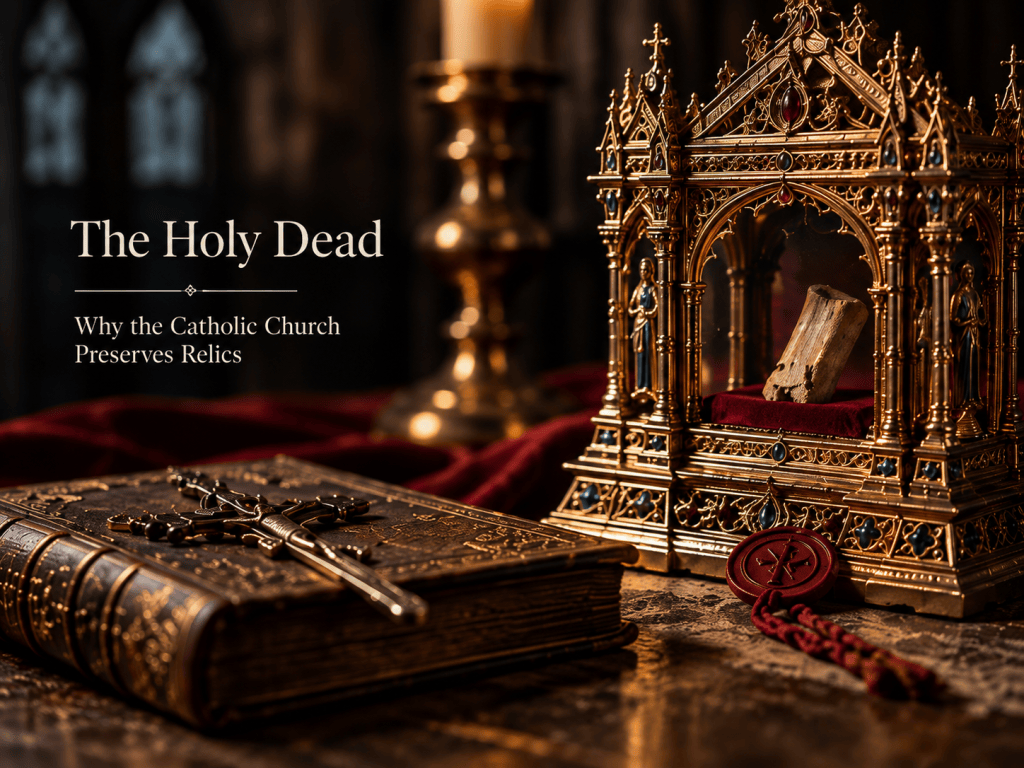
A human tongue rests behind glass in Padua.
In Spain, the heart of Teresa of Ávila is preserved separately from her body.
In Italy, the remains of Padre Pio have been exhumed, examined, conserved, and placed where pilgrims can approach them. A portion of the membrane that once surrounded the heart of Carlo Acutis travels internationally in a reliquary. And in September 2026, at the beatification of Fulton J. Sheen, the jawbone of the famous American preacher was carried forward during the liturgy.
To someone encountering Catholic relics for the first time, there is an entirely reasonable question:
Why are Catholics keeping pieces of dead people?
It can look macabre. Sometimes it is visually macabre. Bones, blood, organs, teeth, hair, fragments of skin, pieces of clothing, and objects once handled by the dead have been preserved in churches and monasteries for centuries.
Yet within Catholicism, the relic is not meant to be a curiosity detached from the person to whom it belonged. Nor is the relic itself worshiped. Relics are venerated: treated with reverence because of their association with someone whom the Church recognizes as holy.
The distinction matters.
Catholic Christianity has always made unusually physical claims. God did not merely appear human; Christianity teaches that Christ truly became flesh. Jesus touched bodies, healed bodies, suffered in a body, died in a body, and rose bodily from the dead. Christian belief also anticipates the resurrection of the body.
That gives the body a significance extending beyond death.
The Vatican’s current instruction governing relics explains the logic explicitly: the bodies of Blesseds and Saints receive special veneration because during life those bodies were “the living temple of the Holy Spirit” and the instruments through which their holiness was lived. The same instruction establishes procedures for identifying, examining, preserving, dividing, transferring, sealing, documenting, and displaying relics. (vatican.va)
In other words, Catholic relic culture is strange.
But it is not casual.
What Is a Relic?
The familiar devotional language divides relics into three general categories.
A first-class relic is part of the saint’s body: bone, hair, tissue, blood, or another physical remain.
A second-class relic is something personally used or worn by the saint: clothing, a devotional object, a book, or another possession closely associated with the person’s life.
A third-class relic is generally an object that has been brought into contact with a first-class relic or, in some devotional traditions, with a significant place associated with the saint.
Contemporary Vatican regulations use somewhat different legal language. The 2017 instruction distinguishes particularly between significant relics—such as an entire body, a notable part of one, or the totality of cremated remains—and non-significant relics, such as small bodily fragments or objects that had direct contact with the person. Publicly venerated relics require appropriate ecclesiastical documentation, and the sale or commercial exchange of relics is prohibited. (vatican.va)
The result is a devotional practice that can range from almost invisible—a tiny fragment sealed within a reliquary—to startlingly physical.
And few examples are more startling than a tongue.
St. Anthony of Padua: The Tongue of a Preacher
Anthony of Padua died in 1231.
Thirty-two years later, in 1263, his remains were examined and transferred as part of the completion of the basilica built in his honor. According to the Basilica of Saint Anthony in Padua, the Franciscan minister general Bonaventure of Bagnoregio presided over the recognition of the remains.
During that examination, Anthony’s tongue was found preserved.
The basilica still commemorates the event, traditionally known as the Feast of the Tongue. (San Antonio)
The significance was immediately connected with Anthony’s life.
He had been an extraordinary preacher.
The body part associated most directly with the work for which he was remembered—the tongue that had preached, instructed, argued, prayed, and proclaimed the Gospel—became itself an object of devotion.
That connection is important because it helps explain something that otherwise risks looking grotesque.
The relic is not simply a tongue.
Within the devotional imagination surrounding Anthony, it is the physical instrument through which a human life of preaching occurred.
For centuries, Catholics have approached that relic not because a preserved human organ is inherently magical, but because the material object points back toward a person.
That same instinct appears again several centuries later in the body of another Doctor of the Church.
St. Teresa of Ávila: The Heart of a Mystic
Teresa of Ávila died in 1582 and was buried at the Carmelite monastery in Alba de Tormes, Spain.
Her remains did not remain entirely together.
The Discalced Carmelite monastery at Alba records that Teresa’s left arm was removed in 1585 when her body was being moved toward Ávila, allowing Alba to retain a substantial relic. Her heart was removed separately in 1591 so that it could be examined by physicians.
Today both the arm and the heart remain near her tomb. (Carmelitas Alba)
For modern readers, this can produce another collision between reverence and discomfort.
A heart has been taken from a dead woman’s body, enclosed in a reliquary, and preserved for generations.
But here again, the symbolism surrounding the particular organ became inseparable from the saint’s life.
Teresa’s writings are saturated with the language of interior transformation, intimacy with God, desire, suffering, and love. Her famous mystical experience known as the transverberation describes the piercing of the heart by divine love, traditionally represented in art by an angel holding a fiery spear.
Placed within that devotional world, the preservation of Teresa’s physical heart acquires a symbolic force far beyond anatomy.
And yet it remains anatomy.
That tension is one of the defining characteristics of relics.
Catholicism does not require the believer to pretend that bone is not bone or that a preserved organ is somehow less physical because it belonged to a saint.
The physicality is precisely the point.
Holiness, in Christian thought, does not happen to an abstract soul floating independently from ordinary existence.
It happens while eating, walking, becoming ill, aging, speaking, bleeding, praying, working, and inhabiting a body.
Padre Pio: Relics Under Modern Examination
By the twentieth century, relics had not disappeared.
What changed was the documentation surrounding them.
Padre Pio of Pietrelcina died in 1968 and was canonized by Pope John Paul II in 2002. In 2008, forty years after his death, his tomb was opened for a formal canonical recognition of his remains.
This was not simply someone opening a grave.
The procedure involved ecclesiastical authorization, a tribunal, medical experts, witnesses, documentation, examination of the body, and preservation work. The official Padre Pio portal records that specialists observed areas that had been relatively well preserved alongside other areas affected by the humid conditions within the tomb. Some parts were partially skeletonized, while other features remained recognizable.
After appropriate conservation procedures, his remains were placed in an urn for public veneration. (Padre Pio Official Site)
Padre Pio therefore gives us something extraordinarily valuable when talking about relics:
a modern paper trail.
The language of canonical recognition can sound archaic, but the process itself is surprisingly methodical.
The Church’s contemporary rules require records to be reviewed, seals inspected, anatomical experts appointed, remains identified and described, conservation needs assessed, and written reports produced. If fragments are legitimately extracted for the creation of relics, that too is regulated and documented. (Vatican)
That does not mean every ancient relic can therefore be scientifically proven to be exactly what tradition claims.
It means something more limited.
Ecclesiastical authentication concerns the documented identity and custody of the relic within the Church’s procedures. It is not automatically the same thing as archaeological proof of an ancient object’s complete history.
That distinction becomes increasingly important the further backward in time we travel.
With modern saints, however, the documentary chain can be remarkably close to the person’s actual lifetime.
And then we reach a saint whose lifetime many living Catholics can remember.
St. Carlo Acutis: A Relic From the Twenty-First Century
Carlo Acutis died of leukemia in 2006 at the age of fifteen.
He lived with computers, websites, video games, sneakers, school friends, and the internet.
He was beatified in 2020.
On September 7, 2025, Pope Leo XIV canonized Carlo Acutis alongside Pier Giorgio Frassati in St. Peter’s Square. (Vatican)
Carlo’s relics therefore provide perhaps the clearest answer to anyone tempted to imagine relic devotion as something Catholics once practiced in a distant medieval world.
Among the first-class relics associated with Carlo is a portion of his pericardium, the membrane surrounding the heart.
The Diocese of Assisi has used a section of the pericardium as an official pilgrim relic. In 2022, while Carlo was still a Blessed, Archbishop Domenico Sorrentino brought such a relic to the United States in connection with the National Eucharistic Revival. The United States Conference of Catholic Bishops identified it specifically as a first-class relic. (Diocesi Assisi)
The official Carlo Acutis association now directs requests for first-class relics through the Bishop of Assisi following Carlo’s canonization. (Carlo Acutis)
There is something almost disorienting about that.
Carlo did not live in a world of illuminated manuscripts and medieval pilgrimage roads.
He lived in ours.
Photographs of him look contemporary because they are contemporary.
His mother is alive. His generation is alive. The websites associated with his life and cause exist online.
And yet the Church is doing something recognizable to Christians of centuries past:
preserving his bodily remains, placing portions within reliquaries, carrying them in pilgrimage, and inviting the faithful to pray near them.
The practice survived modern medicine.
It survived modern science.
It survived photography, television, aviation, and the internet.
And then, in September 2026, it happened again.
Blessed Fulton J. Sheen: A Jawbone in the Age of Television
Archbishop Fulton J. Sheen died in 1979.
Millions of Americans had seen his face.
They had watched that jaw move as he spoke directly into television cameras, teaching Catholic theology in a medium still novel enough that a bishop with a blackboard could become a national celebrity.
On September 24, 2026, Fulton Sheen was beatified in St. Louis.
During the beatification liturgy, James Fulton Engstrom—the young man whose medically unexplained recovery as an infant had been accepted by the Church as the miracle required for Sheen’s beatification—carried forward a first-class relic.
It was Sheen’s mandible: his lower jawbone. (National Catholic Register)
The choice was deliberate.
Bishop Louis Tylka of Peoria explained that the jaw was significant because of Sheen’s extraordinary ability to communicate, teach, preach, and proclaim the faith. (National Catholic Register)
Nearly eight centuries after Anthony of Padua’s preserved tongue became associated with the preaching that had defined his ministry, another celebrated Catholic preacher was represented by the physical instrument of speech.
The parallel is difficult to miss.
Anthony’s tongue.
Sheen’s jaw.
One belongs unmistakably to the medieval world.
The other belonged to a man whose sermons survive on film.
And that may be the most useful place to end our short journey through relics.
Because relics did not disappear when Catholics became modern.
The Body Is Not an Accident
Relics can be beautiful.
They can also be uncomfortable.
A reliquary may be made from silver, gold, crystal, enamel, carving, and precious stones, while the thing protected inside it is unmistakably a fragment of mortality.
Bone.
Blood.
Skin.
Hair.
A heart.
A tongue.
A jaw.
The ornate container does not erase the reality of death. It places that reality directly in front of the living.
That is part of what makes relics so foreign to a culture accustomed to keeping death carefully out of sight.
Yet within Christianity, the saint’s body tells a story that did not end when the heart stopped beating.
The Church’s theology of relics rests upon the conviction that the human body participated in the person’s life of holiness and remains destined, ultimately, for resurrection. That is why the Vatican’s instructions speak not only about authenticity but about preservation, dignity, security, and protection from superstition and commerce. (vatican.va)
Relics are not proof that every devotional tradition surrounding every old object is historically correct.
They are not magical objects.
And ecclesiastical authentication should not be confused with a scientific declaration that every question of provenance has been settled.
They are something stranger and, perhaps, more human.
They are the physical remains of lives Catholics believe were changed by grace.
Anthony preached with that tongue.
Teresa loved, suffered, and prayed within that body.
Padre Pio’s remains survived into an era when doctors and conservation specialists could stand beside the Church officials opening his tomb.
Carlo lived in the digital world and became a saint in 2025.
And Fulton Sheen’s jaw—the same jaw millions once watched moving across television screens—was placed in a reliquary and carried before the Church in September 2026.
There is something almost stubborn about the practice.
Again and again, Catholicism refuses to reduce holiness to an idea.
It insists upon the person.
And the person had a body.
Perhaps that is why the relic can remain unsettling even when its theology is explained. It collapses the comfortable distance between sainthood and ordinary human mortality.
The saints were not symbols.
They had bones.
So do we.


