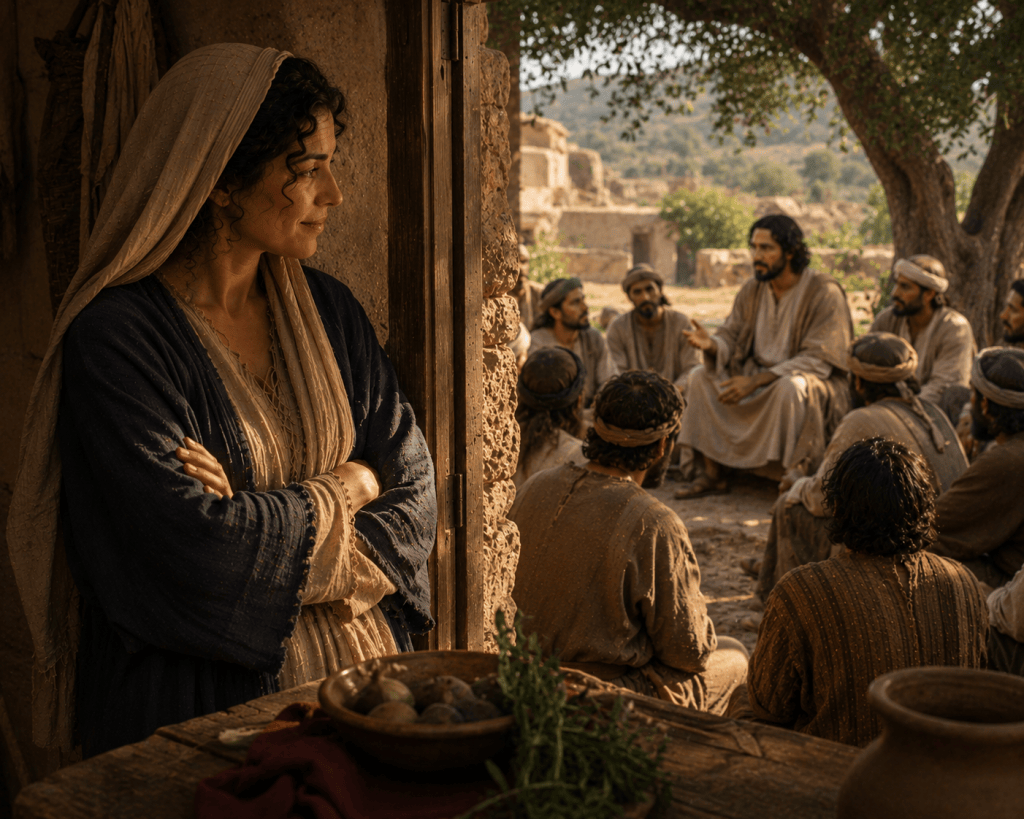
The Invitations of Mary Series
©MS 2026
For most of his life, Mary had only needed to call his name. Then one day, there were always other people between them.
At first, perhaps it was charming.
Jesus had friends.
Actual friends who traveled with him.
Disciples.
People who wanted to listen to him.
People who sought his advice.
People who seemed genuinely excited simply because Jesus had arrived.
Mary had watched him leave Nazareth alone.
Now, increasingly—
he was never alone.
Maybe the first time Jesus returned to somewhere Mary happened to be, she saw him before he saw her.
There.
Her son.
She smiled immediately.
Started toward him.
Then someone stopped him.
“Teacher.”
Jesus turned.
Mary slowed.
The man needed something.
Of course.
Mary waited.
It wouldn’t take long.
Then another person approached.
Then another.
Someone had a question.
Someone wanted prayer.
Someone had brought a sick relative.
Someone simply wanted to hear him speak.
Mary stood twenty feet away.
Waiting.
Jesus looked up once.
Saw her.
His face changed.
Mama.
Maybe he smiled.
Mary smiled back.
He started toward her.
Then someone caught his sleeve.
Mary watched him stop.
Again.
Maybe she gestured:
Go ahead.
It’s fine.
Because it was.
At first.
Perhaps half an hour later, Mary was still waiting.
That would have been new.
For thirty years, access to Jesus had been one of the most ordinary facts of Mary’s life.
She didn’t need an introduction.
She didn’t need to wait until he finished teaching.
She didn’t need to push through a crowd.
If she wanted Jesus—
she called him.
“Jesus?”
“Yes?”
That simple.
Even after he became an adult.
She could walk into the workshop.
Sit beside him at dinner.
Ask him something while he worked.
Interrupt him.
Hand him something.
Tell him about a neighbor.
Ask whether he would be home tomorrow.
Exist beside him without appointment or explanation.
Then the ministry began.
And suddenly—
everybody wanted him.
Maybe Mary was proud of that.
How could she not be?
People came because Jesus helped them.
They weren’t merely taking his attention frivolously.
Some were desperate.
A sick child.
A dying parent.
A body that had hurt for years.
A mind tormented.
A life collapsing.
A question that would not leave someone alone.
How could Mary look at those people and think:
Please go away. I want my son.
Perhaps sometimes—
she did.
And then felt terrible.
That’s the part I want to allow her.
Because sainthood does not require the extinction of ordinary attachment.
Mary could understand perfectly well that Jesus’ ministry mattered and still miss having uninterrupted access to him.
Both can be true.
Maybe one evening they were finally sitting together.
Just the two of them.
Or nearly.
Jesus had eaten.
He looked exhausted.
Mary had been waiting all day to ask him something.
Nothing important.
Maybe something about a relative.
Something at the house.
Something she had heard.
Perhaps she simply wanted to talk.
“So—”
“Teacher?”
Mary closed her mouth.
A disciple appeared at the doorway.
“There’s someone asking for you.”
Jesus looked toward Mary.
Mary looked at Jesus.
“Go.”
Maybe she said it before he could.
“I can tell them to wait.”
“No.”
“Mama—”
“Go.”
Jesus hesitated.
Mary smiled.
“I’m not going anywhere.”
So he went.
Maybe Mary sat alone with two cups.
One still warm.
She waited.
Five minutes.
Ten.
Twenty.
Eventually she got up.
Washed both cups.
Perhaps Jesus came looking for her later.
“Where did you go?”
“Home.”
“I came back.”
“I know.”
Maybe there was something slightly sharp in her voice.
Jesus noticed.
Of course he noticed.
“I’m sorry.”
That might have made it worse.
Because Mary wasn’t sure she wanted him to apologize.
“No.”
She sighed.
“Don’t apologize.”
“I left you waiting.”
“Someone needed you.”
“So did you.”
Mary looked at him.
That was the problem, wasn’t it?
She did.
Not like the people outside.
She wasn’t sick.
She wasn’t starving.
She wasn’t desperate.
She didn’t need healing.
She didn’t need a teacher.
She didn’t need the Messiah.
At least not in that moment.
She just wanted her son.
How do you compete with suffering when all you have is love?
Maybe Mary learned not to.
Perhaps she began saving things.
Stories.
Questions.
Small observations.
Things she would once have told Jesus immediately.
She saw something funny.
I’ll tell Jesus when I see him.
Someone in Nazareth did something ridiculous.
Jesus will enjoy this.
A relative sent news.
I need to remember to tell him.
Something in the house finally broke.
He’ll know what—
No.
He wasn’t there.
Mary collected pieces of her life for him.
Then when she finally saw him—
there wasn’t enough time.
“What were you going to tell me?”
Jesus asked once.
Mary stared.
She had forgotten.
There had been six things.
Now she couldn’t remember any of them.
“Nothing.”
“It wasn’t nothing.”
“It clearly was. I can’t remember.”
Jesus smiled.
Mary did not.
Maybe later, after he left, she remembered all six.
Naturally.
Perhaps that’s when she began understanding that their relationship had changed in a way Cana had only hinted at.
At Cana, Mary had brought Jesus a problem.
He responded.
There had still been something almost private between them.
A glance across the wedding.
A cup raised.
A smile.
Now privacy itself was disappearing.
Jesus’ days belonged to crowds.
His evenings belonged to disciples.
His meals sometimes became teaching.
His journeys became ministry.
Even his attempts to withdraw could be interrupted.
The Gospels repeatedly show people pressing around him.
Following him.
Searching for him.
Bringing others to him.
Crowds so thick that ordinary movement became difficult.
At one point Mark describes so many people gathering that Jesus and his disciples could not even eat.
Mary would have understood the practical meaning of that immediately.
He hasn’t eaten.
Of course that would be her concern.
Not:
The eschatological significance of the gathering multitudes is becoming apparent.
No.
When did he last eat?
Maybe someone told her:
“There are hundreds of people around him.”
Mary’s first question:
“Has he eaten?”
“I don’t know.”
Useless.
Perhaps she sent food.
Maybe it came back untouched.
Or didn’t come back at all.
Maybe she became angry.
Not at Jesus.
At everyone.
Just for a moment.
Do none of you understand that he needs to sit down?
Does nobody think the teacher needs water?
Does everyone believe because he can heal people he apparently no longer requires sleep?
Then Mary caught herself.
These people were hurting.
Of course they came.
If your child were dying and someone told you Jesus could help—
would you care whether his mother wanted twenty minutes with him?
No.
You would run.
Mary knew that.
That may have been what made the feeling so difficult.
There was nobody to blame.
Jesus wasn’t neglecting her because he stopped loving her.
The crowds weren’t cruel for needing him.
The disciples weren’t stealing him.
Mary wasn’t selfish for missing him.
There was no villain.
Only change.
Sometimes those are the hardest losses.
Maybe she watched him heal someone once.
Not at Cana.
Something more intimate.
A person who had been suffering.
A family desperate.
Jesus gave them his full attention.
That look Mary knew.
The one that made a person feel as though nobody else existed for a moment.
Mary watched.
And perhaps something inside her softened.
Because she understood.
That’s what they’re coming for.
She had received that attention for years.
Not continuously.
Jesus had been a normal human member of a household, not a permanently attentive devotional figure.
But Mary knew what it felt like to be seen by him.
Now strangers were experiencing it.
Maybe that made sharing him easier.
And harder.
Because she recognized what they were receiving.
Perhaps one woman emerged from the crowd crying.
Not grief.
Relief.
She grabbed Mary’s hands without knowing who Mary was.
“He healed me.”
Mary stared.
The woman laughed through tears.
“I’ve been sick for twelve years.”
Twelve years.
Mary thought of twelve years.
Jesus at twelve.
The Temple.
Joseph still alive.
An entirely different lifetime.
This woman had been suffering through all of it.
Mary squeezed her hands.
“I’m glad.”
Then the woman disappeared into the crowd.
Mary looked toward Jesus.
He was already speaking to someone else.
Maybe Mary thought:
All right.
Take him.
Not forever.
But right now.
You needed him more than I did.
And perhaps that became a practice.
Not one enormous act of surrender.
Hundreds of tiny ones.
Someone needs him.
Step back.
Someone is asking him something.
Wait.
Someone brought a child.
Move aside.
Someone is crying.
Later.
Someone traveled three days to see him.
You can talk to him another time.
Again.
Again.
Again.
Motherhood had always involved surrender.
Birth itself had been the first.
Jesus’ first steps.
His independence.
The Temple.
Adulthood.
Joseph’s death changing the family.
Jesus leaving Nazareth.
His public ministry.
But this was different.
Mary wasn’t surrendering Jesus to adulthood.
She was surrendering access.
That hurts in a particular way.
Because the person still exists.
The relationship still exists.
Love still exists.
But availability changes.
Maybe modern parents know this feeling.
The adult child whose work consumes them.
The child who marries and now holidays must be divided.
The child who moves away.
The child whose phone calls become shorter because somebody else needs something.
The parent who understands every reason—
and still misses when the child simply wandered into the kitchen.
Mary’s version was extraordinary.
But perhaps the ache was not.
Maybe she resented the disciples sometimes.
There.
Let’s say it.
Not hated.
Not disliked.
Just—
occasionally resented.
They got mornings with him.
They walked beside him.
They heard the conversations between villages.
They knew the jokes Mary didn’t.
They knew what he liked to eat on the road.
They knew when he was tired.
They knew which places he preferred to sleep.
They were collecting everyday knowledge of Jesus—
the kind Mary used to possess.
That might have hurt.
Maybe Peter said something once.
“Jesus always does that.”
Mary looked at him.
Always?
A strange word.
Peter had known Jesus for what?
Months?
A year?
Mary had known him since his first breath.
And yet Peter knew an always she didn’t.
Jesus always walks ahead here.
Jesus always asks that.
Jesus always sits there.
Jesus always—
Mary smiled politely.
Inside:
You have no idea how many “alwayses” came before you.
But then perhaps Peter told her something funny Jesus had done.
Mary laughed.
And suddenly she was grateful.
Because there were parts of Jesus’ life she could only know through them now.
The disciples were not taking her place.
They were occupying a place that had never been hers.
Companions.
Students.
Friends in the work he had chosen.
Mary could not be everything to Jesus.
No mother can.
Maybe that realization came with relief too.
Perhaps she began liking them.
Some immediately.
Some slowly.
Some tested the boundaries of sanctity.
Peter probably tested them.
Maybe Mary watched him argue with Jesus once.
Her eyebrows rose.
You speak to him like that?
Then Jesus answered.
Peter argued again.
Mary looked away.
Not my ministry.
Not my disciple.
Not my problem.
Growth.
Maybe later Peter asked:
“Was he always like this?”
Mary smiled.
“Like what?”
Peter gestured helplessly toward Jesus.
“That.”
Mary considered.
“Yes.”
Maybe that was how Mary became part of their world.
Not as Jesus’ gatekeeper.
Not as the person with privileged theological answers.
But as someone who knew him differently.
They knew the teacher.
Mary knew the boy.
They knew the road.
Mary knew Nazareth.
They knew parables.
Mary knew the carpenter’s bench.
They knew what Jesus looked like surrounded by thousands.
Mary knew what he looked like asleep with fever.
Nobody possessed the whole person.
Perhaps Mary learned to appreciate that.
But there is a Gospel scene we cannot avoid when asking this question.
Mark tells us that Jesus’ mother and brothers came looking for him.
A crowd was sitting around him.
They sent word.
“Look, your mother, your brothers, and your sisters are outside asking for you.”
And Jesus answered:
“Who are my mother and my brothers?”
Then, looking at those seated around him:
“Here are my mother and my brothers! Whoever does the will of God is my brother and sister and mother.”
Matthew and Luke preserve versions of the same episode.
That must have landed somewhere inside Mary.
We should not pretend otherwise.
Whatever the theological meaning—
Jesus expanding family beyond blood into discipleship—
Mary was still standing outside.
Waiting.
Maybe someone came back to tell her what he’d said.
Imagine that.
“He said…”
The messenger hesitated.
Mary waited.
Maybe the messenger softened it.
Maybe not.
Mary heard.
Silence.
What do you do with that?
Perhaps part of her understood immediately.
Jesus had been doing this throughout his ministry.
Expanding.
Reframing.
The Kingdom was creating a family larger than household and blood.
Mary herself belonged to God before she belonged to Jesus biologically.
She had said yes long before Bethlehem.
Wonderful theology.
Still—
she was his mother.
Maybe she stood there and thought:
I changed your diapers.
Obviously not in those exact modern terms, but spiritually:
Excuse me?
We are allowed to find the humanity inside Scripture.
Understanding a teaching does not make its emotional edge disappear.
Perhaps Mary was hurt.
Not destroyed.
Not offended into unbelief.
Hurt.
Maybe she went home angry.
That possibility doesn’t frighten me.
Love can survive anger.
Faith can survive:
I did not like that.
Perhaps the next time she saw Jesus, she didn’t mention it.
Or perhaps she absolutely did.
“You could have come outside.”
Jesus looked at her.
“I know.”
“I was waiting.”
“I know.”
Mary crossed her arms.
Maybe Jesus knew better than to begin explaining theology immediately.
“I understand what you meant.”
“I know.”
“I still didn’t like it.”
Pause.
“I know.”
Maybe that was enough.
Because Mary didn’t need Jesus to retract the teaching.
She needed him to recognize that the woman standing outside was a person too.
Perhaps he did.
We don’t know.
Scripture does not give us the private conversation afterward.
But Mary’s continued presence within the Gospel story tells us the relationship endured.
She did not disappear.
She remained.
Eventually—
she would be at the Cross.
And perhaps the painful lesson of those ministry years prepared both of them for something neither could yet say.
Jesus could not remain Mary’s private son.
The world needed him.
That phrase sounds beautiful until you imagine what it costs the person who loved him first.
Everyone needed something.
Heal me.
Teach me.
Explain this.
Come here.
Help my child.
Settle this question.
Feed us.
Show us a sign.
Be our king.
Save us.
Mary’s need was quieter.
Sit with me.
And quiet needs are easily displaced by emergencies.
Maybe Jesus knew.
Perhaps sometimes he found her.
That’s important too.
I don’t want to imagine their relationship as one long sequence of Mary waiting while Jesus forgot she existed.
The Gospels give us only fragments.
There may have been meals.
Visits.
Walks.
Conversations.
Hours nobody recorded because nothing happened that belonged in a Gospel.
Maybe after an exhausting day Jesus came to wherever Mary was staying.
No disciples.
No crowd.
Just him.
Mary opened the door.
“What happened?”
“Nothing.”
He looked exhausted.
“Have you eaten?”
A pause.
Mary’s eyes narrowed.
“Sit.”
Jesus sat.
Mary put food in front of him.
For ten minutes neither spoke.
Perhaps that was the gift Mary could still give him.
A place where he did not have to be needed.
Everyone else approached Jesus because they wanted something.
Healing.
Teaching.
Answers.
Hope.
Mary could simply let him sit.
Maybe she learned not to ask questions immediately.
Imagine how much restraint that required.
Jesus ate.
Mary worked nearby.
No theology.
No miracle.
No crowd.
After a while:
“How are you?”
Not:
What happened today?
Not:
What are people saying?
Not:
Where are you going tomorrow?
Just:
How are you?
Maybe Jesus looked at her.
And for a moment—
he was her son again.
Not because he ever stopped being.
Because there was finally enough quiet for both of them to feel it.
“Tired.”
Mary nodded.
“I know.”
Perhaps he slept there that night.
Maybe not.
But if he did, Mary might have woken once and heard his breathing.
That old sound.
The one that had filled her house from Bethlehem onward.
And maybe she smiled in the darkness.
Morning would come.
Someone would knock.
Someone always did now.
Jesus would leave.
Mary would let him.
Again.
That became the rhythm.
Not possession.
Not abandonment.
Release and return.
And perhaps over time Mary stopped measuring love by access.
That may have been the deeper transformation.
Jesus did not love her less because other people could reach him.
His attention expanding did not diminish what had existed between them.
Their relationship was changing from something maintained by proximity—
to something capable of surviving distance.
That is difficult love.
Adult love.
Maybe one day Mary stood at the edge of another crowd.
She could barely see him.
Years earlier, this would have hurt.
Now she watched.
Someone pressed forward.
Jesus stopped.
Listened.
Touched the person’s shoulder.
The crowd shifted.
For a second Mary saw his face.
He looked happy.
Tired.
But alive in the work.
Mary smiled.
She did not try to reach him.
Someone beside her said:
“Do you know him?”
Mary looked at the stranger.
Then back toward Jesus.
“Yes.”
The stranger laughed.
“So does everyone.”
Mary smiled.
Not quite.
“No.”
Maybe she didn’t say it aloud.
Because everyone knew something.
Teacher.
Healer.
Prophet.
Rabbi.
Friend.
Hope.
Threat.
Messiah.
Mary knew something else.
She knew the man in the crowd had once fit beneath her chin.
She knew the hands reaching toward strangers had once closed around her finger.
She knew the voice teaching hundreds had once cried for her in the night.
She knew the man everyone was trying to touch had once fallen asleep against her.
And now—
those hands belonged to the work.
That voice belonged to the road.
That life belonged increasingly to people she would never meet.
Maybe Mary finally understood what Gabriel’s announcement had always contained.
She had been asked to receive Jesus.
Never to keep him.
Those are not the same vocation.
Perhaps that was the ache beneath his public ministry.
Mary had been given thirty hidden years.
Thirty years of breakfasts.
Workshops.
Illness.
Arguments.
Laughter.
Ordinary evenings.
Joseph.
Home.
She had known Jesus before anyone stood in line to reach him.
Now everyone was calling his name.
“Jesus!”
“Teacher!”
“Rabbi!”
“Lord!”
Mary stood somewhere behind them.
She didn’t call.
Then perhaps, for just a second—
Jesus looked up.
Across shoulders.
Between people.
Through all those reaching hands.
He found her.
Mary smiled.
Jesus smiled.
Then someone needed him.
His attention moved away.
And this time—
Mary didn’t feel forgotten.
She knew better now.
She turned and walked home.
Not because she mattered less.
Because she no longer needed constant access to know she was loved.
And perhaps that was one of the quietest sacrifices Mary ever made:
Not giving Jesus to the world once.
She had done that when he left Nazareth.
But giving him away again and again, every time someone else’s need interrupted the small piece of him she wanted for herself.
A conversation.
A meal.
An afternoon.
A moment.
Again.
Again.
Again.
Until perhaps Mary could stand at the edge of a crowd and watch hundreds of people reach for her son—
and understand that his being needed by them did not erase the thirty years in which he had come home to her.
It did not erase the private name.
The workshop.
The table.
The fever.
The laughter.
The road out of Nazareth.
The cup raised across Cana.
Those things were hers to remember.
Jesus himself was never hers to possess.
So maybe that was what it felt like.
Pride.
Loneliness.
Irritation.
Understanding.
Occasional resentment.
A great deal of waiting.
And eventually—
release.
Not the serene, effortless release of devotional art.
The ordinary kind.
The kind where you sometimes think:
I miss you.
And still move aside so someone else can reach him.
Because Mary had spent thirty years teaching Jesus how to leave her.
Perhaps his ministry became the years when she learned—
slowly, painfully, beautifully—
how to let him belong to everyone else too.


