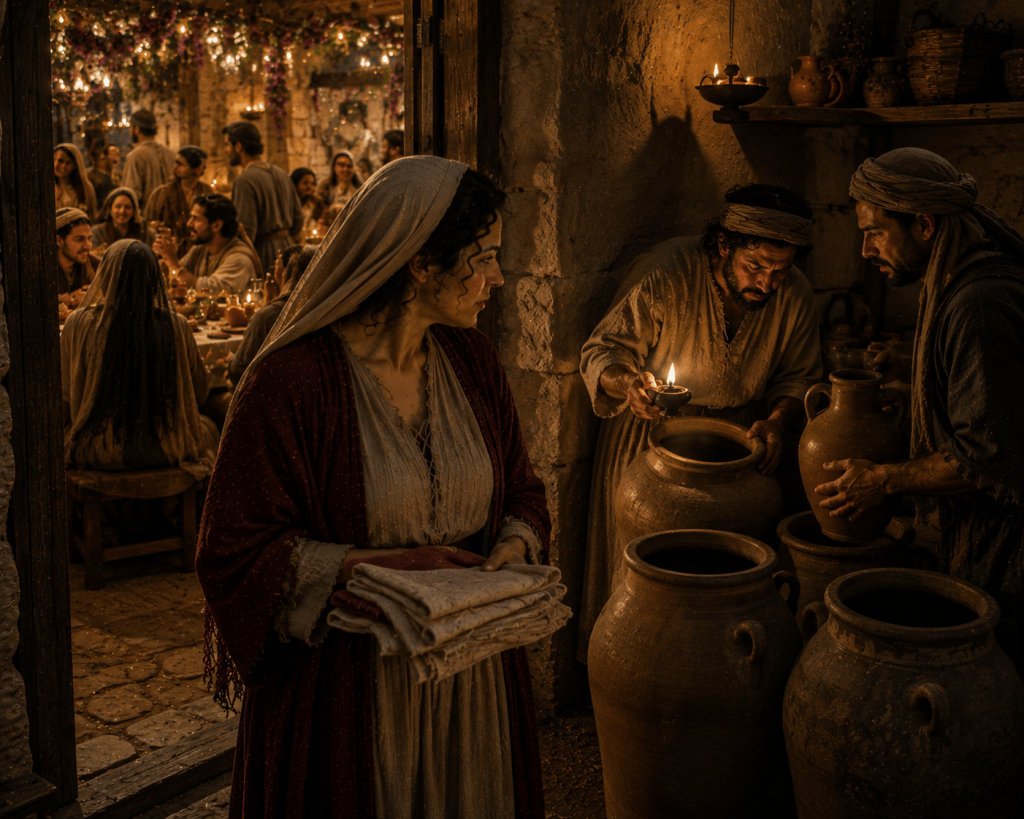
The Invitations of Mary Series
©MS 2026
Before there was a sign, there was a woman at a wedding who realized the hosts were in trouble.
The wine was running out.
Maybe nobody had said it yet.
That might be the important part.
The wedding was still happening.
People were still talking.
Someone was laughing.
Food was being passed.
Music perhaps continued.
Guests were drinking.
From the outside, nothing had gone wrong.
But somewhere behind all of that celebration—
Mary noticed.
John’s Gospel gives us remarkably little explanation.
There was a wedding at Cana in Galilee.
Mary was there.
Jesus and his disciples had also been invited.
And then:
“When the wine ran out, Jesus’s mother told him, ‘They don’t have any wine.’”
That’s it.
John does not tell us who informed Mary.
He does not tell us whether she was related to the family.
He does not tell us whether she was helping with the wedding.
He does not tell us whether she discovered the shortage herself.
He simply places the problem in Mary’s awareness.
Before Jesus does anything publicly about it—
Mary knows.
That is interesting.
Maybe Mary was helping.
That seems entirely plausible, even if we cannot state it as fact.
Weddings were communal affairs, and hospitality mattered enormously in the ancient Mediterranean world. A wedding celebration could continue for days. Feeding and providing drink for one’s guests was not a minor logistical detail.
Running out of wine was not:
Oh no, we’ll switch to water.
It was a failure of hospitality.
Potentially a humiliating one.
People would notice.
People would talk.
And as we have already established—
people are extremely good at talking.
Maybe Mary knew the family well.
Perhaps that explains why she was already there before John mentions Jesus and the disciples being invited.
Maybe relatives.
Maybe friends.
Maybe simply people within the interconnected communities of Galilee.
We don’t know.
But perhaps Mary wasn’t sitting among the guests waiting to be served.
Perhaps she was doing what experienced women at family gatherings have done for thousands of years:
helping whether anyone officially asked her to or not.
Maybe she had already carried three things that weren’t hers.
Answered two questions.
Found a missing child.
Moved a dish.
Told someone where something was.
Helped an overwhelmed younger woman.
Been asked:
“Mary, have you seen—”
“Yes.”
Of course she had.
Maybe someone came to her quietly.
“Mary.”
That tone.
Mary looked up.
“What?”
The woman leaned closer.
“We’re running low.”
Mary glanced toward the serving area.
“How low?”
The woman hesitated.
Oh.
Mary stood.
Perhaps she went to look.
One vessel.
Nearly empty.
Another.
Empty.
Someone tipped another farther than necessary.
Nothing.
“How much is left?”
“That’s it.”
Mary stared.
“How many people are still here?”
Too many.
Maybe the young bride didn’t know yet.
That would matter to Mary.
Perhaps the bride was laughing somewhere with her new husband.
Happy.
Unaware that behind the scenes several members of her family were rapidly approaching panic.
Mary looked toward her.
Then back at the empty vessel.
“No.”
Maybe softly.
Not:
No, this cannot physically be happening.
More:
We are not letting her discover this in front of everyone.
Perhaps that’s why Mary noticed.
Because Mary had spent a lifetime noticing what other people needed before they said it.
Think about the woman we have been imagining.
Not an ethereal figure floating through thirty years of domestic life.
Mary had managed a household.
She had fed people.
Measured food.
Prepared for journeys.
Raised a child.
Hosted neighbors.
Received neighbors.
Lived through scarcity.
Known how much grain remained.
Known whether there was enough oil.
Known when someone had eaten and when someone was pretending they had.
She had spent decades developing the kind of practical awareness that notices:
There isn’t enough.
Maybe Cana did not require supernatural perception from Mary.
Maybe it required experience.
There are people at gatherings who never notice anything.
They arrive.
Eat.
Drink.
Talk.
Leave.
Everything required to make the event happen remains invisible to them.
Then there are people who notice the tray is empty.
Someone hasn’t eaten.
The elderly guest needs somewhere to sit.
The child is overwhelmed.
The host hasn’t stopped moving for four hours.
The food is disappearing faster than expected.
Something is wrong in the kitchen.
Mary feels like she might have been one of those people.
Not because women are naturally responsible for everyone.
Not because Mary existed to perform invisible labor.
Because attention had become one of the ways she loved.
Joseph’s death may have sharpened it.
Loneliness may have sharpened it.
Years of community life may have sharpened it.
Mary knew what it felt like when someone noticed her.
Bread arriving after Joseph died.
Someone sitting beside her.
Someone inviting her to dinner after Jesus left.
Perhaps Mary had learned that sometimes love looks like recognizing a need before the person suffering it has to announce it publicly.
And now—
a family was about to be humiliated.
Mary noticed.
Maybe other people knew too.
Surely the servants knew.
Someone responsible for the provisions knew.
Perhaps several relatives were already whispering.
Mary was probably not the only human being with access to the inventory.
So the better question may not be:
Why was Mary the only person who noticed?
Scripture never says she was.
The more interesting question is:
Why was Mary the person who did something about it?
She went to Jesus.
That is where the story becomes extraordinary.
Imagine the moment before she approached him.
Jesus was there with his disciples.
That alone must have been strange.
He had left Nazareth.
Now he had followers.
Actual followers.
Men accompanying him.
Listening to him.
Calling him teacher.
Perhaps Mary was still adjusting to this.
Maybe she had heard strangers discussing him.
Now here he was at a wedding—
her son,
and also increasingly someone other people believed belonged to them too.
Mary looked at him.
Then at the empty wine.
Then back at him.
What exactly did she expect?
That question has occupied theologians for centuries.
John does not tell us.
Mary does not explicitly say:
Perform a miracle.
She says:
“They don’t have any wine.”
That’s all.
Which is somehow the most maternal sentence imaginable.
She presents the problem.
Nothing else.
Maybe Jesus looked at her.
Mary looked back.
“They don’t have any wine.”
Jesus probably knew immediately that this sentence contained significantly more than information.
Maybe there was a pause.
The kind only possible between two people who have known each other for thirty years.
Jesus answers:
“What has this concern of yours to do with me, woman? My hour has not yet come.”
That sounds harsh in English.
It need not be understood as contemptuous. The address translated “woman” was not inherently insulting in its ancient context, and John will place the same form of address on Jesus’ lips toward Mary at the Cross.
But the response establishes distance.
Something is changing.
Mary has brought him a domestic problem.
Jesus answers in the language of his hour.
Perhaps Mary did not fully understand.
That would hardly be unprecedented.
But she understood enough.
She turned to the servants.
And said:
“Do whatever he tells you.”
Then apparently—
she left Jesus with the problem.
Extraordinary.
No argument.
No:
Jesus, please.
No explanation.
No negotiation.
No telling him what to do.
No hovering to make sure he did it correctly.
“They don’t have any wine.”
“What has this concern of yours to do with me? My hour has not yet come.”
Mary:
Fine.
She turns to the servants.
Do whatever he tells you.
There is something almost funny about the confidence of it.
Not entitlement.
Confidence.
Maybe Jesus watched her walk away.
Thirty years.
He knew that woman.
Perhaps he sighed.
We are allowed to imagine the humanity of the moment without reducing its theology.
And then there were six stone water jars.
Large ones.
Used for Jewish purification.
Jesus told the servants:
Fill them.
They filled them to the brim.
Then:
Draw some out.
Take it to the headwaiter.
Imagine being one of those servants.
Mary has just told you:
Do whatever he tells you.
Fine.
The man tells you to fill enormous purification jars with water.
This is not obviously helping the wine situation.
Maybe one servant looked at another.
The other shrugged.
Mary said do it.
Apparently Mary had credibility.
That itself is interesting.
They filled them.
A lot of water.
John describes the jars as holding two or three measures each, often estimated in modern terms as roughly twenty to thirty gallons apiece.
Six jars.
This is not Jesus producing one emergency pitcher of wine.
It is abundance.
An almost absurd abundance.
And somehow—
water became wine.
John does not describe the instant.
No gesture.
No spoken formula.
No dramatic light.
The servants draw.
The steward tastes.
Wine.
And not mediocre wine.
Good wine.
Good enough that the steward calls the bridegroom over and essentially says:
What are you doing?
People serve the good wine first.
Then, after everyone has been drinking, the lesser wine.
You saved the good wine until now.
The bridegroom apparently has no idea what he’s talking about.
Imagine his face.
“Yes.”
Absolutely.
Definitely intentional.
Thank you.
The servants know.
Jesus knows.
Mary presumably knows.
The steward doesn’t.
The guests don’t.
The bride and groom may not initially know.
And that matters.
Because the first sign in John’s Gospel does not begin with someone begging Jesus publicly for help.
It begins quietly.
Behind the celebration.
With a shortage.
With potential embarrassment.
With Mary noticing.
Nobody is dying.
Nobody is possessed.
Nobody is blind.
Nobody is paralyzed.
The world will continue if the wedding runs out of wine.
This is not catastrophe.
It is humiliation.
Disappointment.
A celebration going wrong.
A young family’s joy acquiring an embarrassing story people might repeat for years.
And apparently—
that matters.
Mary sees a problem that is small by the standards of human suffering.
And brings it to Jesus anyway.
There is something profoundly tender about that.
Maybe Mary knew exactly how devastating small humiliations can feel when they happen to you.
People often dismiss suffering according to scale.
Nobody died.
You’re fine.
It could be worse.
Yes.
It could.
And the bride can still cry because the wine ran out at her wedding.
Both things can be true.
Mary does not say:
This is trivial.
She does not say:
They should have planned better.
She does not say:
Perhaps this will teach them responsibility.
She notices.
Then she acts.
Maybe that’s why it was Mary.
Because Mary knew what it was like to have other people talk.
She had once been a pregnant young woman in circumstances other people could easily misunderstand.
She had lived in a small community.
She knew reputation.
She knew embarrassment.
She knew how quickly private difficulty becomes public conversation.
Perhaps she saw what was about to happen to this family and thought:
Not if it can be helped.
There is also something almost beautifully mundane about Mary’s concern.
Jesus has begun gathering disciples.
John the Baptist has identified him in extraordinary terms.
Something enormous is beginning.
Mary could be contemplating prophecy.
Messiah.
Israel.
Kingdom.
Instead:
They’re out of wine.
Because theology does not eliminate dinner.
The Kingdom of God apparently arrives in a world where somebody still has to notice when the drinks run out.
Perhaps Mary had learned that from thirty hidden years.
God had been living in her house.
And socks—or their ancient equivalent—still needed washing.
Bread still burned.
Things broke.
Joseph died.
Jesus got hungry.
Neighbors needed help.
The sacred had never required Mary to stop noticing the ordinary.
Maybe she understood something the disciples were only beginning to learn:
If God is here, then ordinary human need is not beneath His attention.
But I don’t want to make Mary omniscient.
Perhaps she had no idea what Jesus would do.
That’s entirely possible.
Maybe she expected him to solve the problem practically.
Find wine.
Send someone.
Speak to someone.
Help the family manage the embarrassment.
Perhaps she simply trusted:
He will know what to do.
That is different from knowing what he will do.
And maybe that is precisely why her instruction to the servants is so powerful.
She doesn’t say:
He’ll make wine.
She doesn’t know that.
She says:
Do whatever he tells you.
Not:
Do what I think he should tell you.
Not:
Here’s the solution.
Just:
Listen to him.
Mary identifies the need.
Then relinquishes control over the answer.
That is a surprisingly mature form of trust.
Especially for a mother.
Because mothers are very good at identifying the need and designing the solution and explaining the solution and standing nearby to make sure everyone implements the solution correctly.
Mary doesn’t.
She brings Jesus the shortage.
Then steps aside.
Perhaps that reflects what she had already learned when he left Nazareth.
She could no longer manage Jesus.
She could trust him.
Different skill.
And imagine watching afterward.
Maybe Mary was somewhere among the women when the steward tasted the wine.
She saw his expression.
Confusion.
Surprise.
Then the bridegroom being summoned.
Maybe she understood immediately.
Perhaps she looked across the celebration.
Jesus was somewhere among his disciples.
Their eyes met.
No grand smile.
No triumphant:
I told you so.
Maybe the faintest expression.
Mary knew.
Jesus knew she knew.
That was enough.
And perhaps for one brief moment Mary saw something she had never seen before.
Not Jesus doing something miraculous privately.
We have no canonical childhood miracles to rely upon, and we should resist inventing them as though they happened.
John explicitly calls Cana the first of his signs.
So within the Gospel’s presentation, this is a beginning.
Mary had raised Jesus for approximately thirty years.
And now—
for the first time—
she watched the hidden mystery become visible.
Water.
Wine.
A wedding.
A secret known initially by servants.
Maybe Mary’s breath caught.
Because Gabriel’s words were thirty years old.
Simeon’s prophecy was decades old.
The twelve-year-old Temple incident was eighteen years behind them.
For most of Mary’s life, the extraordinary things said about Jesus had been followed by astonishingly ordinary years.
Carpentry.
Meals.
Growing.
Joseph dying.
Work.
Neighbors.
Then suddenly—
wine.
Oh.
Maybe that was the moment.
Not:
I knew it.
But:
It’s beginning.
That might have frightened her.
Because beginnings contain endings.
His hour had not yet come.
Mary may not have understood what that meant.
But John does.
And eventually, so will she.
At Cana, the wine appears.
Later in John’s Gospel, the hour will arrive.
And Mary will again be there.
Not beside stone jars at a wedding.
Beside a Cross.
John places Mary at both.
That is not a small literary detail.
At Cana:
“Woman.”
At Calvary:
“Woman.”
At Cana, a celebration threatened by absence becomes abundance.
At Calvary, Mary will confront an absence no abundance seems capable of repairing.
But she does not know that yet.
Please let her not know that yet.
Let Cana be a wedding.
Let her laugh.
Let her eat.
Let her watch people drink wine they have no idea should not exist.
Let the bride remain unhumiliated.
Let the groom receive credit for wine he apparently had absolutely nothing to do with.
Let the servants exchange looks because they know.
Let Jesus’ new disciples stare at him differently.
And let Mary—
for just a little while—
experience what it feels like to see her son become extraordinary in someone else’s eyes.
Perhaps the bride eventually found Mary.
“Thank you for helping today.”
Maybe she had no idea what Mary had actually done.
Mary smiled.
“You’re welcome.”
“Did you get enough to eat?”
Mary laughed.
Of course.
Even at the wedding where Jesus performed his first sign, someone was probably still worried whether Mary had eaten.
Maybe Mary left Cana carrying something home.
Leftover bread.
Fabric.
Flowers.
Whatever people carried away from celebrations.
Jesus perhaps continued with his disciples.
Their paths might already have been separating again.
Mary walked home.
Thoughtful.
She had noticed there was no wine.
That was all.
A domestic problem.
A quiet sentence to her son.
And somehow—
six stone jars had become filled with extraordinary wine.
Perhaps she replayed the exchange.
“They don’t have any wine.”
“My hour has not yet come.”
“Do whatever he tells you.”
Had she pushed him?
Trusted him?
Misunderstood him?
Participated in something she didn’t yet comprehend?
Maybe all of those questions stayed with her.
John doesn’t answer them for us.
Perhaps Mary couldn’t either.
But maybe she understood one thing.
The world was beginning to discover what she had carried privately for decades:
There was more to Jesus than anyone could see by looking at the carpenter from Nazareth.
And somehow the first people to glimpse that glory were not kings.
Not priests.
Not Roman officials.
Not scholars.
They were disciples.
Servants.
A mother.
At a wedding.
Because someone ran out of wine.
So why did Mary notice?
Maybe because she was helping.
Maybe someone told her.
Maybe she knew the family.
Maybe she happened to be near the servants when panic began.
Scripture does not say.
We should leave that uncertainty intact.
But Mary’s response tells us something more interesting than the logistics.
She cared enough to notice a problem that wasn’t hers.
She cared enough to protect someone from embarrassment.
She trusted Jesus enough to bring the problem to him.
And she trusted him enough not to dictate what happened next.
Perhaps that is the most Mary-like thing about Cana.
Not that she somehow knew there would be a miracle.
Maybe she didn’t.
Maybe she simply knew her son.
There is a need.
There is Jesus.
So she puts the two together.
Then tells everyone else:
Listen to him.
And perhaps that’s what thirty years of mothering Jesus had finally become.
Not holding him.
Not feeding him.
Not protecting him.
Not telling him what to do.
Not calling him home.
Mary’s motherhood had changed again.
Now she could notice something broken—
bring it to him—
and step aside.
Somewhere behind her, servants lifted jars.
Someone poured.
The steward tasted.
The bride kept laughing.
The groom’s reputation survived.
The celebration continued.
Most of the room never knew how close the joy had come to embarrassment.
Mary did.
Maybe she picked up her own cup sometime later.
Looked at the wine.
Took a sip.
Stopped.
Looked across the room at Jesus.
He saw her.
Perhaps one eyebrow lifted.
Mary looked at the cup again.
Then back at him.
Thirty years of knowing each other passed silently between them.
Maybe the corner of Mary’s mouth turned upward.
Just slightly.
Because apparently her son had not merely solved the problem.
He had made very good wine.
Of course he had.
Mary took another sip.
And the wedding continued.


