The Invitations of Mary Series
©MS 2026
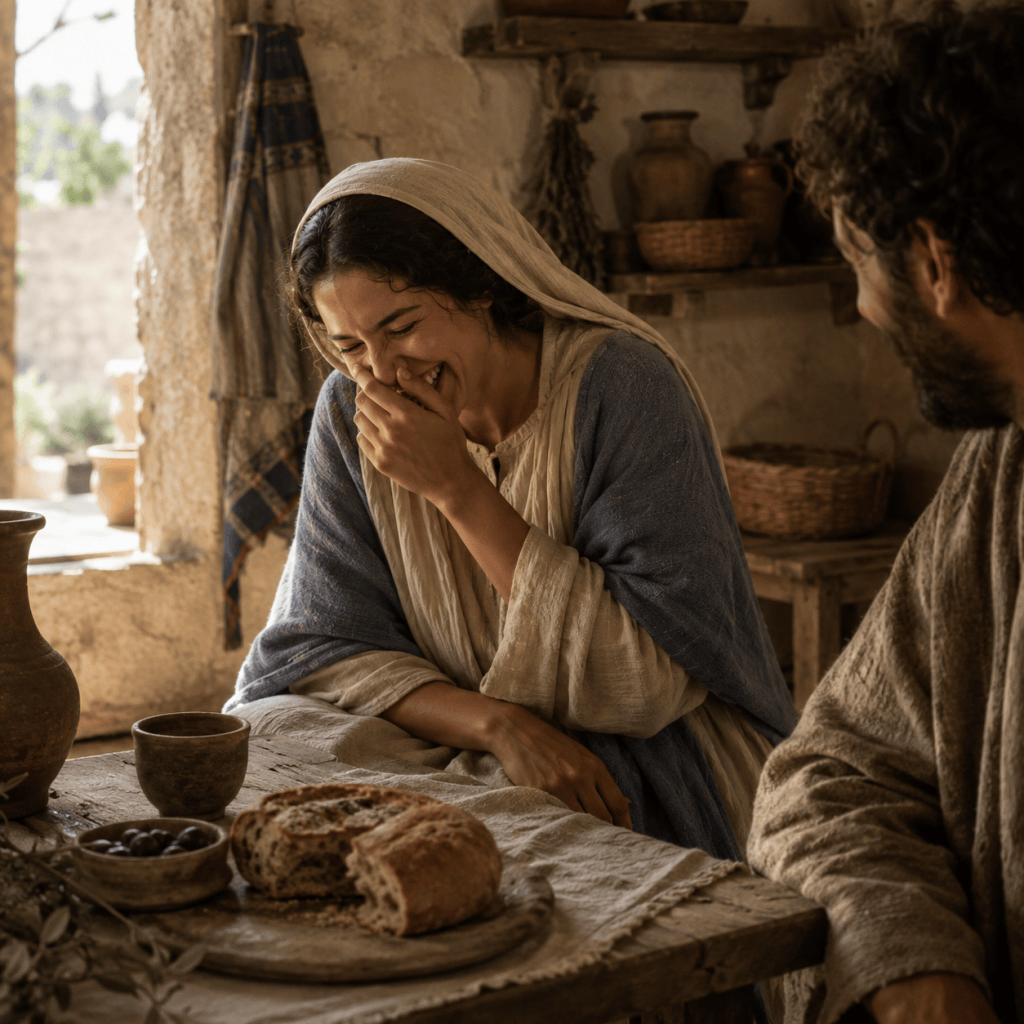
Somewhere along the way, we seem to have misplaced Mary’s laugh.
I don’t think I have ever seen Mary laughing.
Smiling, yes.
There are paintings where the corners of her mouth turn gently upward as she looks at Jesus. There are statues where her expression is peaceful and tender. Occasionally, an artist gives us something approaching delight.
But laughing?
Head tipped back.
Eyes squeezed shut.
Trying to catch her breath.
The kind of laughter where you desperately attempt to stop, make eye contact with the person who started it, and immediately lose control all over again.
I don’t think I’ve ever seen that Mary.
And surely she existed.
Mary lived a human life.
She grew up among family and neighbors. She married. She raised a child. She attended a wedding feast at Cana. She traveled with people. She lived within communities where stories were told, meals were shared, children played, relatives visited, and people undoubtedly teased one another.
There must have been laughter.
So I wonder:
What could make Mary laugh until she couldn’t stop?
Maybe Joseph.
I like that possibility.
We know remarkably little about the private relationship between Mary and Joseph. Scripture gives us glimpses of his character—his righteousness, compassion, obedience, courage—but almost nothing about the man who existed when there wasn’t a crisis requiring divine intervention.
Was Joseph funny?
Maybe not intentionally.
Maybe that was worse.
Perhaps Joseph occasionally said something so unexpectedly dry that Mary stared at him for a second before realizing he’d made a joke.
Maybe he was terrible at telling stories because he kept wandering into unnecessary details.
Maybe he had one particular expression he made whenever someone annoyed him, and Mary knew exactly what it meant.
Maybe they developed the kind of private language that grows between people who share years together.
A glance across a room.
A raised eyebrow.
A phrase that meant something entirely different because of a ridiculous thing that happened six years ago.
We rarely imagine Mary and Joseph having inside jokes.
Why not?
Holiness does not eliminate humor.
Love almost inevitably creates it.
And then there was Jesus.
We have somehow managed to portray the childhood of Jesus as though the Incarnate Word emerged from infancy already behaving like a tiny theologian.
But Jesus was a child.
A real one.
Before he preached parables, he learned words.
Before crowds followed him, he followed his mother around the house.
Before he multiplied bread, he probably dropped some.
Before he walked on water, he learned to walk on the ground.
And children are ridiculous.
Did toddler Jesus ever become enormously pleased with himself over something that made absolutely no sense?
Did he mispronounce a word in a way Mary and Joseph found so funny they secretly continued using the mispronunciation years after he’d learned to say it correctly?
Did he dance?
Did he make faces?
Did he discover that doing one particular thing made his mother laugh and then repeat it seventeen thousand times because toddlers understand comedy primarily as again?
Maybe Mary tried not to encourage him.
Maybe she failed spectacularly.
I can imagine her turning away because she knew if Jesus saw her laughing, he would absolutely do it again.
Joseph notices.
“Don’t.”
Mary presses her lips together.
Jesus does the thing again.
And that’s it.
She’s gone.
Maybe that’s the Mary I want to find.
Not because I want to make her less sacred.
Because I think we’ve accidentally decided sacred people must always be serious.
Look at so many images of saints.
Everyone appears to be having an absolutely terrible time.
Eyes raised toward heaven.
Hands folded.
Faces solemn.
Occasionally someone holds a skull.
There are an alarming number of skulls.
And suffering is certainly part of the Christian story.
Mary herself would eventually know grief so profound that Christian tradition describes her heart as pierced by swords.
But the woman capable of experiencing devastating sorrow was also capable of experiencing joy.
Not merely Joy with a capital J—the theological kind we’re comfortable putting into devotional books.
I mean the stupid kind.
The undignified kind.
The kind that makes your stomach hurt.
The kind where someone says, “Stop, stop, I can’t breathe,” which naturally makes everyone laugh harder.
Maybe it happened while cooking.
Someone dropped something.
Maybe Mary did.
Perhaps she was trying to carry too much at once, insisted she had it perfectly under control, and then watched the entire arrangement collapse.
There is a very particular kind of laughter that happens when you’ve been trying desperately to keep everything together and one final, ridiculous thing goes wrong.
Sometimes you laugh because the alternative is screaming.
I suspect that kind of laughter is ancient.
Maybe she laughed with other women.
That possibility gets overlooked too.
Mary’s life wasn’t populated exclusively by Joseph, Jesus, apostles, angels, and important men from Scripture.
There were women.
Neighbors.
Relatives.
Friends.
Women grinding grain beside one another.
Women carrying water.
Women preparing food.
Women tending children.
Women who knew which husband snored, whose child had thrown a spectacular tantrum that morning, whose bread had failed to rise, and exactly which neighbor had done something ridiculous.
Surely they laughed.
Maybe Mary had a friend who could make her lose composure with nothing more than a look.
You know that friend.
The dangerous one.
The person you absolutely cannot sit beside when you’re supposed to behave.
Something happens.
Nobody else notices.
You look at each other.
And it’s over.
Now you’re both desperately avoiding eye contact because one glance will destroy whatever dignity remains.
Could Mary have had someone like that?
I hope so.
Maybe Elizabeth was one.
There is something wonderful about imagining the Visitation containing not only prophetic recognition and the Magnificat, but two pregnant women eventually sitting together and laughing about pregnancy.
Elizabeth, older and probably thoroughly acquainted with the indignities of it by then.
Mary, experiencing everything for the first time.
There were holy things happening inside their bodies.
There were also probably swollen feet.
Those realities can coexist.
Perhaps Elizabeth told Mary something nobody bothers telling young women beforehand.
Mary stared at her.
“No.”
Elizabeth nodded.
“No.”
Another nod.
And somewhere in the Judean hills, the Mother of God completely lost it.
We don’t know.
That’s the point.
Scripture wasn’t written to preserve Mary’s funniest afternoon.
Nobody recorded the joke that made her snort.
Nobody thought future generations would want to know whether Joseph could make her laugh.
The Gospel writers were telling us something much larger.
But sometimes, in concentrating on the larger story, I think we accidentally flatten the people living inside it.
Mary becomes serenity.
Joseph becomes obedience.
Jesus becomes divinity.
And the house in Nazareth becomes strangely quiet.
I don’t believe it was.
I think there were conversations and disagreements and teasing and noises from the workshop and meals that went wrong and neighbors arriving unexpectedly and children underfoot and moments when somebody said precisely the wrong thing at precisely the right time.
And laughter.
Lots of it, I hope.
There is something else I love about imagining Mary’s laughter.
Jesus knew the sound of it.
Think about that.
Before crowds shouted his name, Jesus knew his mother’s laugh.
He knew what made it begin.
He knew the difference between her polite laugh and the real one.
He knew what her face looked like when she was trying not to laugh.
He probably knew exactly how to cause it.
And Mary knew his.
The God Christians believe created human joy experienced it inside a family.
He heard laughter around a table.
He caused it.
He joined it.
Maybe that’s sacred too.
Maybe holiness isn’t always found in solemnity.
Maybe sometimes holiness is a woman bent over a table, unable to speak, while her husband watches her with that extremely satisfied expression of someone who knows he has just said something hilarious.
Maybe it’s a child discovering that his mother is particularly vulnerable to one ridiculous noise.
Maybe it’s two women carrying impossible pregnancies laughing about something completely ordinary.
Maybe Mary laughed loudly.
Maybe she snorted.
Maybe she hated that she snorted, which only made Joseph laugh, which made her laugh harder.
We will never know.
But I find myself wanting to make room for the possibility.
Because Mary would eventually stand beneath a cross.
She would know grief.
She would know absence.
She would know the strange ache of remembering a home that once contained people who were no longer there.
And if we allow ourselves to imagine her sorrow, surely we can allow ourselves to imagine the other half of being human.
There must have been memories that made her smile years later.
Things Joseph once said.
Things Jesus did when he was five.
Stories nobody else would understand because you had to have been there.
Perhaps, as an older woman, someone once asked Mary what Jesus had been like as a child.
And perhaps she began telling a story.
Halfway through, she started smiling.
Then laughing.
And suddenly she couldn’t finish it.
For just a moment, he wasn’t the teacher everyone remembered.
He wasn’t the man surrounded by crowds.
He wasn’t the crucified Christ depicted in whispered stories.
He wasn’t even the risen Lord.
He was her little boy doing something completely ridiculous in Nazareth.
And Mary was laughing again.
I think I like her there.
Not on a pedestal.
Not beneath a crown.
Not even wearing blue.
Just Mary.
Eyes watering.
Hand pressed against her stomach.
Trying unsuccessfully to say: “Stop. I can’t laugh anymore.”


