The Invitations of Mary Series
©MS 2026
Before the angel, there was breakfast.
There was a morning before Gabriel.
That thought has been sitting with me.
Before the angel appeared.
Before Hail, full of grace.
Before Do not be afraid.
Before Mary asked how such a thing could possibly happen.
Before her yes.
Before Christianity would spend two thousand years painting that moment in gold.
Mary woke up.
And she had absolutely no idea what was coming.
I wonder what that morning looked like.
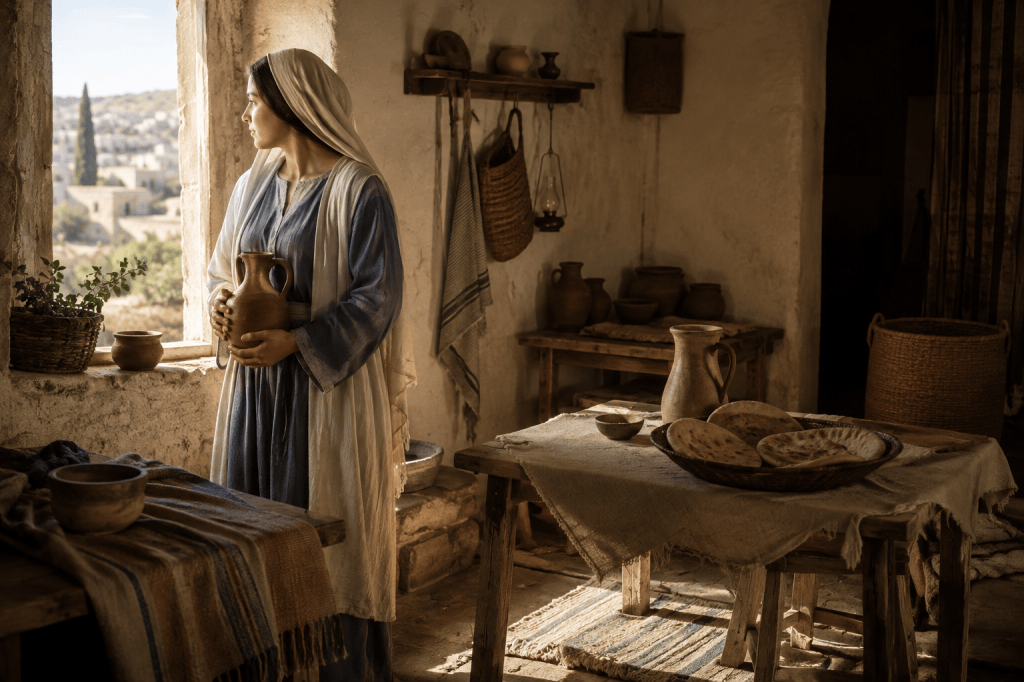
Not the morning imagined by painters, where Mary seems to spend her days kneeling beside a perfectly positioned prayer book while shafts of heavenly light conveniently illuminate the room.
An actual morning.
Perhaps someone nearby was already awake.
Perhaps she heard footsteps outside.
A door opening.
An animal complaining because it wanted feeding.
Someone beginning the day’s work.
Perhaps she lay there for another moment because she was warm and getting up meant beginning everything that needed to be done.
That possibility makes me smile.
We know so little about Mary’s life before the Annunciation. Even the details we commonly imagine about her childhood often come from later Christian tradition rather than Scripture itself. The Gospels do not tell us what time she woke, what she ate for breakfast, which chores belonged to her, whether she was naturally cheerful in the morning, or whether she preferred not to speak until she had been awake for a while.
But she lived.
That much we know.
And living required ordinary things.
She had to eat.
She had to dress.
She had to wash.
Things became dirty and needed cleaning.
Food had to be prepared.
Water did not arrive through a faucet simply because the future Mother of God needed some.
There were no refrigerators quietly preserving yesterday’s food. No electric lamps waiting at the touch of a switch. No washing machines. No grocery delivery. No coffee maker blinking impatiently from the kitchen counter.
Morning arrived with light.
And work arrived with morning.
Maybe Mary wrapped herself against the cool air before the day’s heat settled over Nazareth.
Maybe she tied back her hair.
Maybe she washed her face with water that felt unpleasantly cold.
Maybe breakfast was simple—bread from the previous day’s baking, perhaps something dipped or spread or eaten alongside whatever the household had available.
Maybe she ate while already thinking about what needed doing next.
And maybe she was tired.
That is something I rarely see in paintings of Mary.
Tired Mary.
Nobody paints her waking badly because she hadn’t slept well.
Nobody paints her staring blankly at something while her mind catches up with her body.
Nobody paints her discovering that something she needed had broken.
Or realizing there wasn’t enough of something.
Or hearing someone call her name from another room when she had only just sat down.
We tend to imagine holiness as perpetual serenity.
I wonder if Mary would recognize herself in that.
Perhaps she was serene.
Perhaps she was also occasionally irritated before breakfast.
Those things do not have to contradict one another.
Holiness does not require a person to stop having a nervous system.
Maybe someone in the household had a habit that drove her insane.
Maybe she had a chore she particularly disliked.
Maybe she woke one morning with sore muscles.
Maybe she spilled something.
Maybe she dropped a piece of bread on the ground and stared at it for one defeated second before picking it up.
Maybe she had been worried about something the night before and discovered, as we often do, that the worry had patiently waited beside her bed until morning.
And somewhere in that ordinary life was Joseph.
We don’t know exactly what their relationship looked like at the moment Gabriel came. Matthew and Luke give us the essential framework: Mary was betrothed to Joseph when she conceived Jesus.
But betrothal is such a clinical word when we read it two thousand years later.
Joseph was a person.
There must have been conversations.
Expectations.
Practical arrangements.
A future taking shape.
Maybe Mary wondered what kind of husband he would be.
Maybe she already knew precisely how he laughed.
Maybe something he had said the previous day was still on her mind.
Maybe she was thinking about marriage.
Maybe she was thinking about dinner.
Maybe she was thinking about absolutely nothing important.
That might be my favorite possibility.
Because we know something Mary did not.
Gabriel was coming.
We know the dividing line exists.
There is Mary’s life before, and there is Mary’s life after.
She didn’t.
There was no little countdown hovering above Nazareth.
No narrator whispered that today would be different.
She couldn’t look at the calendar and see:
Annunciation — today.
She simply lived the morning that had been given to her.
Perhaps she prayed.
Mary was a Jewish woman, and prayer belonged to the religious world in which she lived. Scripture would later reveal how deeply biblical language inhabited her imagination when her Magnificat poured out in Elizabeth’s presence.
But even here, I wonder whether we make the ordinary extraordinary too quickly.
Prayer doesn’t always feel extraordinary.
Sometimes prayer is familiar words spoken because this is when you speak them.
Sometimes attention wanders.
Sometimes you are deeply moved.
Sometimes you aren’t.
Sometimes God seems extraordinarily close.
Sometimes you finish praying and remember that bread still needs making.
Mary’s morning did not need to glow for it to be holy.
Maybe that is what I find so beautiful about imagining it.
Because somewhere there was a last ordinary morning.
The last morning Mary woke without knowing she would carry Jesus.
The last time she looked at her body without knowing what it would soon do.
The last time she thought about her future without having to account for an angel’s impossible announcement.
The last morning Joseph’s place in that future seemed relatively understandable.
The last morning before words like Messiah and Son of the Most High became terrifyingly personal.
And she didn’t know to treasure it.
We almost never do.
We recognize thresholds after crossing them.
There was a last ordinary morning before meeting the person who changed your life.
A last breakfast before receiving terrible news.
A last commute before accepting another job.
A last evening in a house before moving away.
A last conversation before a relationship changed.
A last ordinary day before someone died.
A last moment before discovering something wonderful.
We rarely recognize them while they’re happening.
Neither, perhaps, did Mary.
Maybe she stepped outside.
Maybe morning light had begun touching the stone and earth around Nazareth.
Someone was working nearby.
Someone was arguing.
A child was crying.
Food was cooking.
An animal was making noise.
Life was happening.
And Mary entered it.
She didn’t know that painters would someday cover her in blue.
She didn’t know churches would bear her name.
She didn’t know generations would repeat words spoken to her until Hail Mary became one of Christianity’s most recognizable prayers.
She didn’t know anyone would call her the Mother of God.
She was simply Mary.
Miriam.
A young woman in Nazareth with a day ahead of her.
There were things to do.
People to speak with.
Meals to prepare.
Water to carry.
Plans she assumed would unfold more or less as plans usually do.
And sometime later, perhaps in the middle of something completely mundane, God interrupted.
That may be what I want to remember about the morning before Gabriel.
Mary did not wake up inside a holy card.
She woke up inside an ordinary life.
And God came there.
Not after she had made everything sacred enough.
Not after she had escaped domestic life.
Not after she had entered some place where ordinary things could no longer reach her.
There.
Somewhere among the bread and water and unfinished work.
Somewhere inside a life that still needed living.
Perhaps that’s why imagining Mary’s ordinary morning matters.
Because most mornings, no angel appears in mine.
There is coffee.
There is laundry.
There are dishes.
There is work.
There are things I don’t particularly want to do.
There are thoughts left over from yesterday.
There are plans for tomorrow.
Most mornings do not announce themselves as the beginning of anything.
Mary’s didn’t either.
Until it was.
And maybe the lesson isn’t that I should spend every morning anxiously waiting for God to interrupt it.
Maybe it’s much gentler than that.
Maybe an ordinary life does not have to become extraordinary before God can enter it.
Mary’s didn’t.
She just woke up.
And began her day.


