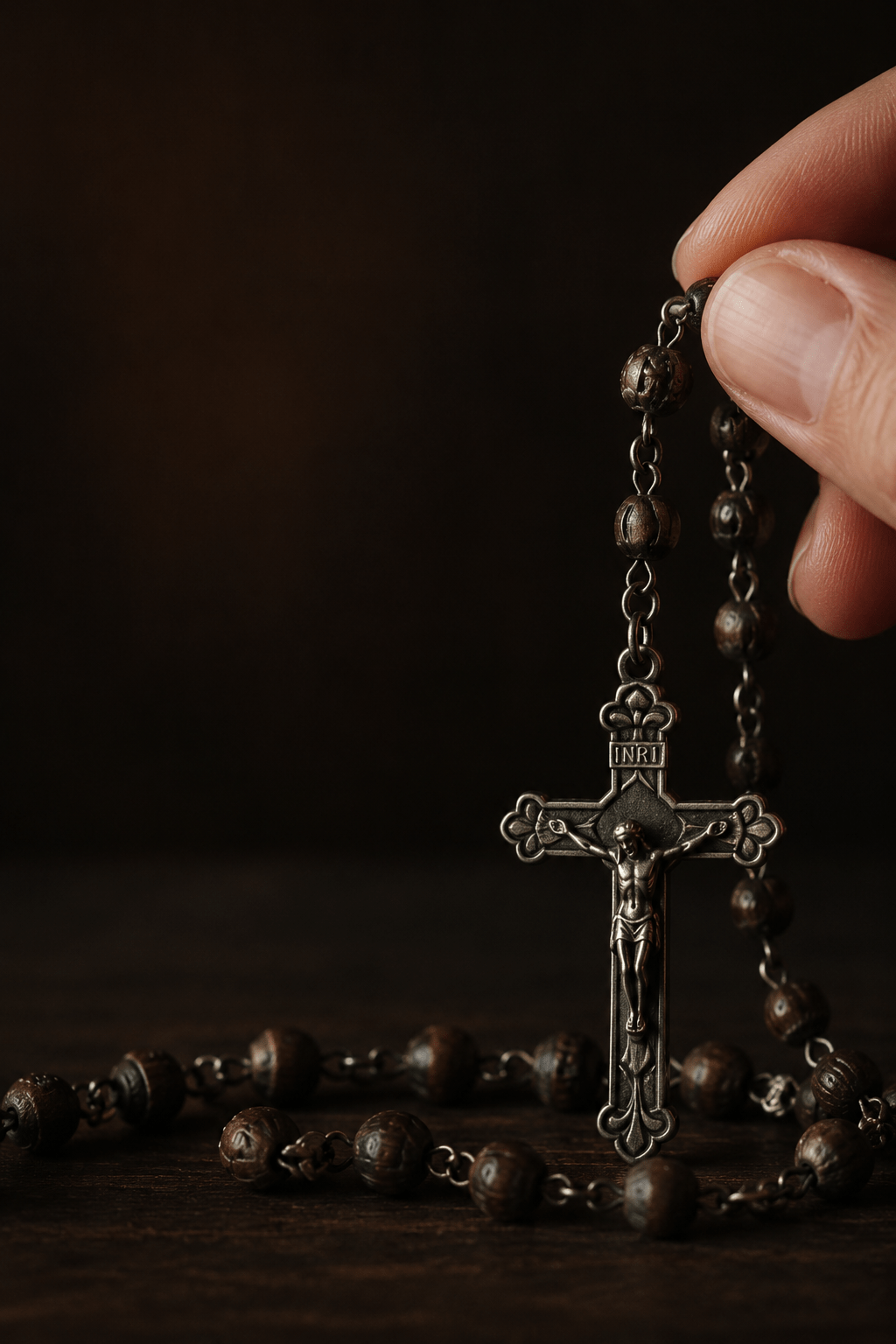
Rosaries do not exist outside of history.
The materials used to make them—the wood, seeds, glass, metals, stones, fibers, chain, medals, and crucifixes—changed as the world changed.
Empires rose and fell. Trade routes opened and disappeared. Pilgrims traveled. Wars disrupted economies. Forests were harvested. Workshops emerged. Factories industrialized devotion. Families migrated across oceans carrying familiar objects into unfamiliar lives.
A rosary held by a medieval monk, an Irish immigrant, a Mexican pilgrim, a wartime soldier, a Victorian widow, or a twentieth-century schoolchild may all serve the same devotional purpose while looking remarkably different.
Prayer remained.
Materials changed.
To understand rosaries historically, then, is to recognize something quietly important:
devotional objects evolve alongside human history.
Before Trade: Prayer Made from What Was Nearby
For much of history, rosaries reflected local life.
Before industrial manufacturing and global trade networks expanded access to materials, devotional objects were often shaped by geography and necessity.
People used what surrounded them.
Wood from nearby forests. Bone and horn from domestic animals or hunting traditions. Seeds gathered after harvest. Cord made from available fibers. Stones found locally or traded through nearby communities.
A rosary carved in one village might look entirely different from one crafted hundreds of miles away—not because theology differed, but because daily life differed.
Forested regions favored wood.
Agricultural communities used pits, seeds, or natural fibers.
Coastal regions sometimes incorporated shell or coral.
Monastic communities often developed carving traditions based on nearby resources and available skill.
Prayer reflected place.
In this period, rosaries were deeply regional objects.
Their materials carried the quiet imprint of landscape.
Pilgrimage, Trade, and Expanding Devotion
As trade routes expanded and pilgrimage culture flourished, rosary materials began to travel farther than many of the people who held them.
Pilgrims returning from sacred sites frequently brought devotional objects home, including rosaries made from locally significant materials.
Olive wood rosaries became associated with the Holy Land because olive trees carried biblical symbolism and geographical meaning. A pilgrim who visited Jerusalem might return carrying something tangible—a devotional object tied physically to sacred memory.
Elsewhere, trade broadened material possibilities.
Glass workshops in Venice and later Bohemia transformed beadmaking. Precious and semi-precious stones circulated through merchant systems. Imported woods, including ebony and rosewood, entered European devotional craftsmanship through expanding trade networks.
Even humble rosaries sometimes reflected global movement.
A person praying quietly in a village chapel may have held materials sourced from places they would never see.
Trade altered devotion not by changing prayer itself, but by expanding what prayer could be made from.
Empire, Colonialism, and Cultural Exchange
Rosaries also changed through systems of empire and colonization.
As Catholicism spread through missionary work, political expansion, migration, and imperial systems, devotional objects moved with it.
In Latin America, the Philippines, parts of Africa, and elsewhere, local craftsmanship began interacting with imported devotional traditions.
Sometimes local materials were incorporated into familiar European rosary forms.
Seeds, regional hardwoods, shell, carved natural materials, silverwork, and indigenous craftsmanship blended with Catholic devotional symbolism in ways that reflected both adaptation and cultural encounter.
The story here is rarely simple.
Cultural exchange sometimes emerged through mutual adaptation and local devotion. At other times, it unfolded within systems of coercion, forced conversion, unequal power, or displacement.
Rosaries, like many historical objects, quietly carry traces of complicated histories.
Yet they also reveal something deeply human:
faith adapts to place.
A devotional practice may remain recognizable while its material expression shifts according to geography, culture, and available resources.
Industrialization: When Devotion Became More Accessible
Perhaps no historical shift transformed rosary materials more dramatically than industrialization.
Before large-scale manufacturing, rosaries were often handmade or produced in relatively small quantities by artisans, monasteries, workshops, or family labor.
Industrial production changed this.
Machine-made chain replaced hand assembly. Pressed glass beads became more affordable. Cast medals and crucifixes could be reproduced quickly and consistently. Catalog sales, devotional shops, and mass manufacturing expanded availability.
For many families, rosaries became easier to obtain.
This mattered.
Prayer that once required handmade labor or costly materials became materially accessible to ordinary households.
Schoolchildren received rosaries. Families owned several. Pilgrims purchased devotional objects more affordably. Religious communities distributed rosaries at scale.
Accessibility increased.
But something else changed too:
uniformity.
Where earlier rosaries often carried regional irregularities, hand-carved variation, or localized craftsmanship, industrial production introduced repetition.
Rosaries became more standardized.
Yet even mass-produced rosaries eventually developed individuality.
The same object, prayed for decades, darkened with skin oils, repaired after breakage, tucked into pockets, stored beside prayer cards, inherited, gifted, and mourned.
History re-entered the object through use.
War, Scarcity, and Improvised Faith
History is rarely stable.
Wars, famine, migration, persecution, imprisonment, and economic hardship repeatedly altered what materials people could access.
In moments of instability, rosaries adapted.
Cheap metals replaced precious ones. Cord replaced chain. Salvaged parts were repurposed. Knots stood in for beads. Seeds, wood, or improvised materials appeared where supply collapsed.
Military rosaries and trench rosaries emerged from necessity as much as devotion.
A soldier might carry a small rosary tucked into a pocket before battle. A refugee crossing borders might cling to something small enough to travel. Families facing famine or displacement often preserved devotional objects even when much else was lost.
Faith persisted because adaptation persisted.
The rosary survived not because materials remained stable, but because devotion learned flexibility.
When one material disappeared, another replaced it.
The prayer continued.
Migration and Memory
Migration changed rosaries in quieter ways as well.
Immigrants carried devotional objects into unfamiliar countries, preserving memory through repetition.
An Irish family arriving in America during famine might carry a dark wooden rosary already worn smooth by years of prayer. Mexican families brought devotional traditions shaped by Marian identity and regional craftsmanship. European immigrants carried heirloom rosaries across oceans, passing them to children raised far from ancestral homelands.
Materials became emotional anchors.
A rosary did not merely symbolize faith.
It symbolized continuity.
Home.
Family.
Language remembered.
A person might lose land, employment, certainty, or familiar community—yet still carry beads recognizable to the hand.
The object remained when much else changed.
What Antique Rosaries Quietly Hold
When we encounter antique rosaries today, we often see only materials.
Wood.
Metal.
Stone.
Glass.
Chain.
But history lingers beneath the surface.
A repaired connector may hint at poverty or persistence.
An unusual bead material may reveal trade networks or regional craft traditions.
A worn medal may suggest decades of habitual touch.
A simple corded rosary may speak of scarcity, pilgrimage, or deliberate simplicity.
Every material arrived through historical circumstance.
And every rosary eventually became personal.
To study rosary materials through history, then, is to study something much larger than craftsmanship alone.
It is to watch human history become tangible.
Trade routes.
Industrialization.
Empire.
Migration.
War.
Scarcity.
Pilgrimage.
Family inheritance.
All eventually arrive somewhere very small:
in the palm of a hand reaching, once again, for prayer.
Because history does not only survive in monuments or books.
Sometimes, it survives bead by bead.

 The Living Rosary Archives