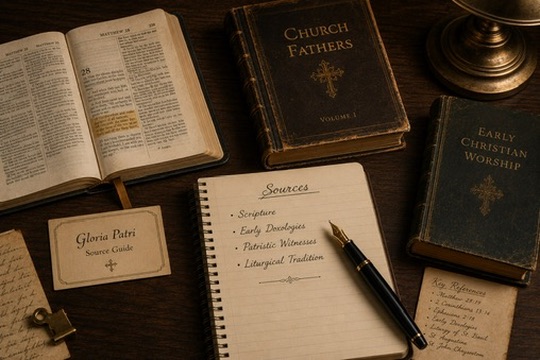
Primary Biblical Sources
Matthew 28:19
The baptismal command:
“In the name of the Father and of the Son and of the Holy Spirit.”
Provides the foundational Trinitarian formula.
Romans 11:36
“To him be glory forever.”
One of the earliest biblical doxologies.
Philippians 4:20
“To our God and Father be glory forever and ever.”
Another foundational doxology.
Ephesians 3:21
“To him be glory in the Church and in Christ Jesus throughout all generations.”
An important example of New Testament praise language.
Ecumenical Councils
Council of Nicaea (325)
Affirmed the full divinity of the Son.
Provides theological context for Trinitarian doxologies.
First Council of Constantinople (381)
Clarified doctrine concerning the Holy Spirit.
Strengthened the Trinitarian framework reflected in the Gloria Patri.
Patristic Sources
St. Basil the Great
On the Holy Spirit
Important discussion of Trinitarian doxologies and their wording.
One of the most important primary sources for understanding fourth-century usage.
St. Athanasius
Anti-Arian writings.
Demonstrates why equal praise to Father, Son, and Holy Spirit became significant.
Liturgical Sources
Divine Office / Liturgy of the Hours
The Gloria Patri concludes the Psalms.
Provides centuries of continuous liturgical usage.
Roman Breviary
Preserves the traditional Latin form.
Catechisms
Catechism of the Catholic Church
Paragraphs discussing:
The Trinity
Christian prayer
Doxologies
Liturgical worship
Especially useful for theological interpretation.
Key Historical Claims Supported by These Sources
Claim: The prayer developed from biblical doxologies.
Sources: Romans, Philippians, Ephesians.
Claim: The prayer reflects Trinitarian doctrine.
Sources: Matthew 28:19, Nicaea, Constantinople.
Claim: The wording became important during anti-Arian controversies.
Sources: St. Basil, St. Athanasius, fourth-century liturgical evidence.
Claim: The prayer became attached to the Psalms.
Sources: Divine Office and Breviary traditions.
Claim: The Rosary inherited an already ancient prayer.
Sources: Medieval liturgical and devotional practice.


