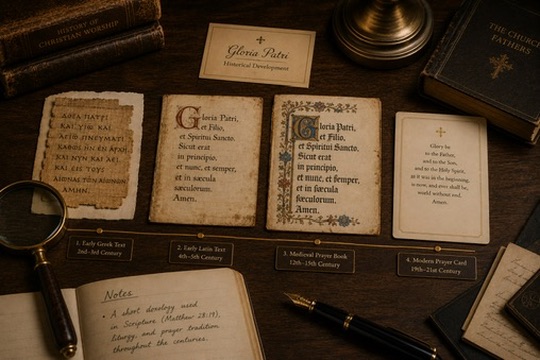
Unlike the Hail Mary, which grew with new phrases over time, the Glory Be came from a group of early Christian prayers. Its story shows how Christians figured out how to talk about the Trinity and stand up for their beliefs.
First Century: New Testament Doxologies
The New Testament contains many expressions of praise.
Examples include:
“To whom be glory forever. Amen.”
“To our God and Father be glory forever and ever. Amen.”
These passages established the pattern of concluding prayer with praise and glory.
At this stage, there was no fixed Gloria Patri.
Second and Third Centuries
Christians increasingly used Trinitarian formulas.
Examples included:
“Glory to the Father through the Son in the Holy Spirit,” and “Glory be to the Father and to the Son and to the Holy Spirit.”
Different regions preserved different wording. No universal version yet existed.
Fourth Century: The Arian Controversy
The Church faced disputes concerning the divinity of Christ.
As a result, doxologies became theological statements.
The wording:
“Glory be to the Father and to the Son and to the Holy Spirit”
affirmed equality among the divine Persons. This was not merely devotional language.
It was a profession of orthodox faith.
Fourth and Fifth Centuries
The Western Church increasingly embraced the phrase: “As it was in the beginning, is now, and ever shall be.” This phrase underscored the following:
– The eternal nature of God
– The unchanging nature of divine glory
– The eternal divinity of Christ
Some historians suggest that its popularity may be linked to anti-Arian teachings.
Eastern Christian Forms
Eastern Christians retained a slightly different wording:
“Glory to the Father, and to the Son, and to the Holy Spirit, now and ever and unto ages of ages. Amen.”
This remains common in Eastern Orthodox and Eastern Catholic traditions.
Medieval Period
The prayer became associated with every Psalm in the Divine Office. This practice reinforced the Christian belief that all Scripture ultimately points to the Trinity. The Gloria Patri became one of the most frequently recited prayers in Christendom.
Rosary Usage
As the Rosary developed between the twelfth and fifteenth centuries, the Glory Be became the customary conclusion of each decade.
The prayer served as a brief act of praise after meditation upon each mystery.
Modern Catholic Form
Glory be to the Father,
and to the Son,
and to the Holy Spirit.
As it was in the beginning,
is now,
and ever shall be,
world without end.
Amen.
Unique Features
Unlike the Our Father, which wasn’t directly taught by Christ.
Summary Timeline
1st Century: Biblical doxologies appear.
2nd–3rd Centuries: Trinitarian praise formulas emerge.
325: Council of Nicaea.
381: Council of Constantinople.
4th–5th Centuries: Western Gloria Patri takes on a recognizable form.
Middle Ages: Attached to Psalms and widespread devotion.
Rosary Era: Adopted after each decade.
Present Day: Used throughout Catholic, Orthodox, Anglican, and many Protestant traditions.


