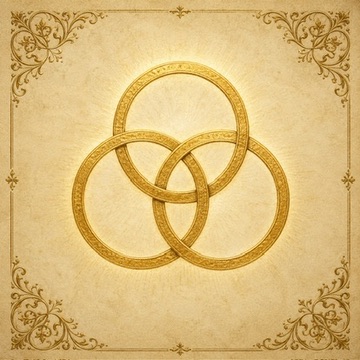
A history of the Glory Be prayer of the Rosary is a story worth telling. The Glory Be in Latin is called the Gloria Patri or “Glory to the Father.” It is a short hymn of praise we say to God.
The Glory Be was not taught to us by Christ like the Our Father prayer. Neither did it evolve from Scripture and devotional prayer over time like the Hail Mary prayer did. The Glory Be prayer grew out of the worship life of the early Church.
See how the understanding of Trinity in Christianity developed and how they tried to pray it.
The earliest Christians inherited the Jewish practice of blessing and praising God. The New Testament contains numerous doxologies, including passages such as:
“To him be glory forever. Amen.” (Romans 11:36)
“To our God and Father be glory forever and ever. Amen.” (Philippians 4:20)
As Christianity developed, believers increasingly expressed praise to the Father through the Son in the Holy Spirit. By the second and third centuries, Trinitarian formulas became common in Christian worship, especially following baptism, which Christ had commanded to be performed “in the name of the Father and of the Son and of the Holy Spirit” (Matthew 28:19).
Back in the fourth century, Christianity had a tough time figuring out its beliefs with Arianism. Arians didn’t believe Christ was fully divine, saying the Son was just made, not eternally the same as the Father.
In response, the Church clarified its beliefs through the Council of Nicaea in 325 and the Council of Constantinople in 381. During this time, Trinitarian doxologies became even more important. To declare glory equally to the Father, Son, and Holy Spirit wasn’t just a show of devotion; it was a clear statement of faith.
It seems the phrase “as it was in the beginning, is now, and ever shall be” started popping up in the Latin West around this time. People say it became super popular because it stood up to Arianism. The way it’s put together really highlights that the glory of the Trinity is always the same, no matter what.
By the Middle Ages, the Glory Be had become one of the most common prayers in Christian worship. It concluded psalms in the Divine Office, appeared in private devotions, and eventually became part of the Rosary.
In the Rosary, the Glory Be is a lovely pause to give thanks after we’ve been thinking about each mystery. After we’ve been soaking in the stories of Christ and His Mother, this prayer gently brings us back to the big picture of Christian devotion: making the Triune God shine even brighter.
Today, the Glory Be is still a prayer that many people know and love in Catholicism. Even though it’s short, it really captures the Church’s main idea that the Father, Son, and Holy Spirit are all united in one eternal, divine glory.
Key Historical Milestones
1st Century: New Testament doxologies establish a culture of praising God.
2nd–3rd Centuries: Trinitarian praise formulas become widespread.
325: Council of Nicaea affirms the divinity of Christ.
381: Council of Constantinople clarifies Trinitarian doctrine.
4th–5th Centuries: The fuller Western form of the Gloria Patri develops.
Middle Ages: incorporated into the Divine Office and popular devotion.
Rosary Tradition: Adopted as the concluding prayer of each decade.
Present Day: Continues as one of the most frequently prayed Trinitarian prayers in Christianity.


