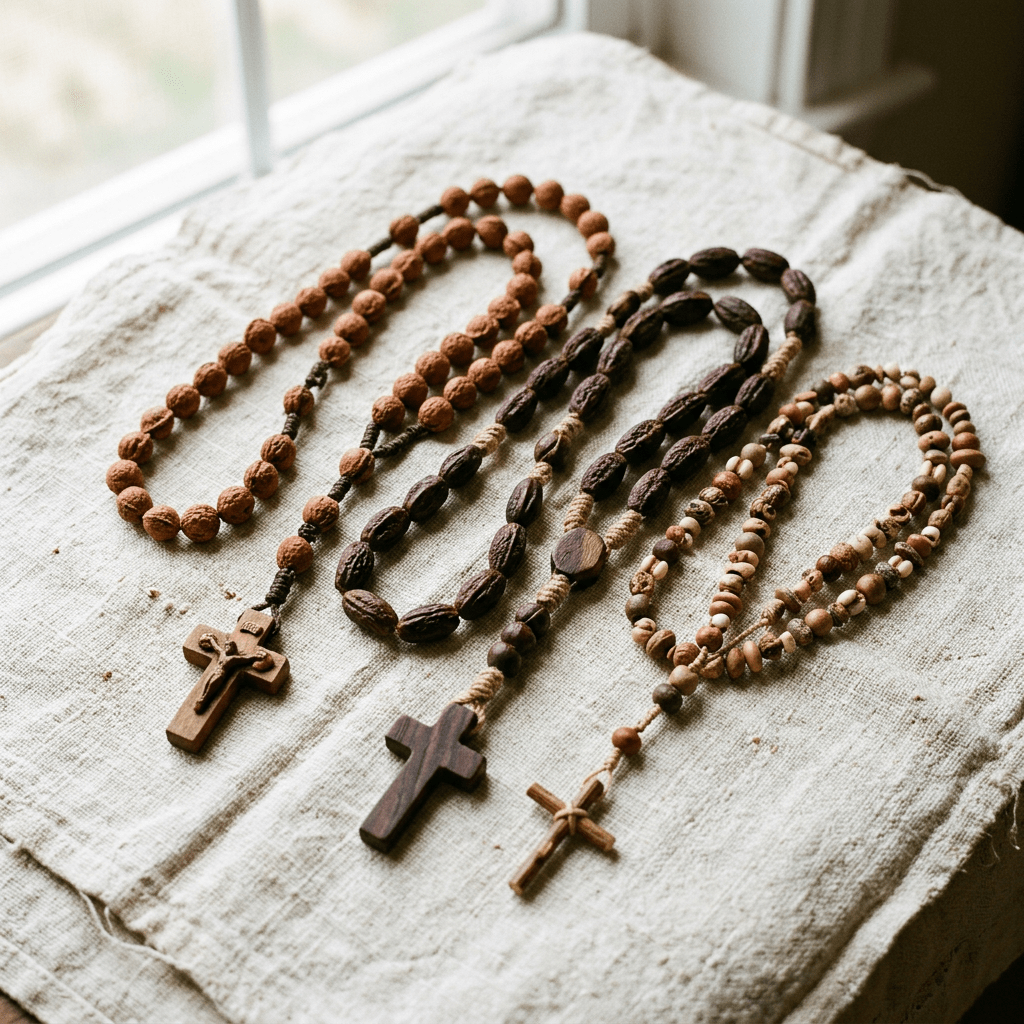
Before the advent of factories, catalogs, and mass production, rosaries were crafted from natural materials.
Wood from nearby forests. Seeds gathered after harvest. Fruit pits saved from kitchens and orchards. Bone, horn, plant fibers, pressed flower petals, and simple cord tied by hand.
For much of history, rosary materials were not selected simply for beauty. They reflected geography, availability, craftsmanship, economics, devotional practice, and necessity. What could be gathered, carved, traded, repaired, or afforded often became what was prayed with.
Organic rosary beads—those made from living or once-living materials—offer a particularly intimate view into the history of devotion because they preserve traces of landscape, labor, and ordinary human life.
To study them is to ask not only what was used, but why this material, here, in this place, at this time?
Wood: Prayer Carved from the Landscape
Wood is among the most familiar and enduring rosary materials, and perhaps the easiest to understand. Trees surrounded daily life.
A village near olive groves carved olive wood. Forested regions worked with walnut, boxwood, ebony, rosewood, bog oak, or local hardwoods. Monastic communities often carved what grew nearby or what trade networks made available.
Some woods carried symbolic meaning.
Holy Land olive wood took on associations with biblical scenery, peace, perseverance, pilgrimage, and holy places. Ebony was dense, dark, smooth – durable and impressive looking. Imported woods may represent connections to global trade systems instead of regional wood availability.
Rosaries made of darker hardwoods may have travelled through Ireland, across seas with immigrants and refugees during migration and diaspora.
Wood shows wear too. Hands stain it brown. Skin oils round out edges. Constant rubbing shines with years of grip. A coarse rosary sands itself down to silence, slipping more comfortably in your hand. Wear has a history of its own.
Seeds, Nuts, and Fruit Pits: Prayer from the Harvest
Not all rosaries were carved from hardwood or precious materials. After all, devout peoples around the world already had shells and stones. Where accessibility was a factor, cherry pits, olive pits, date pits, carved seeds, Job’’s tears, nuts, and plant-based materials became mediums of devotion simply because they were available. Some were fashioned out of sheer necessity. Others developed into regional traditions. Whatever the case may be, these rosaries often held intimacy that more extravagant goods did not. Perhaps your cherry pit rosary was crafted out of patience and homemaker diligence: fruit consumed, pits rescued, washed, dried, carved, pierced, and strung by hand. Maybe your seed rosary quietly attests to the season and the harvest because those seeds were gathered. Prayer was formed not in spite of day-to-day life, but from it. During periods of poverty, immigration, scarcity, or uncertainty such materials were important because they were accessible. Devotion found a way.
Bone and Horn: Durable, Practical, and Often Misunderstood
Modern audiences sometimes react with surprise to rosaries made from bone or horn, yet historically these materials were practical, durable, and familiar.
In communities shaped by agriculture, hunting, animal husbandry, or scarcity, bone and horn were not unusual materials. They were workable, strong, and often locally available.
Their appearance varies naturally.
Some are creamy and pale. Others darken with age. Grain, texture, and subtle irregularities make hand-carved examples feel distinctly different from industrial production.
Bone and horn also remind us of something historically important:
Many devotional objects emerged from cultures that wasted little.
Materials were reused. Repurposed. Preserved.
Faith often worked with what survival allowed.
Fiber, Rope, and Knotted Simplicity
Sometimes prayer required almost no material at all.
Corded rosaries, hemp rope rosaries, linen fibers, wool, cotton, silk thread, and knotted prayer cords appear repeatedly throughout history.
Some reflected poverty and practicality.
Others reflected intentional simplicity.
Monastic communities, missionaries, traveling clergy, soldiers, and lay believers alike sometimes favored rosaries made of cord because they were portable, inexpensive, quiet, durable, and easy to repair.
Knotted rosaries also reveal something spiritually significant:
Prayer does not require ornament.
When beads were unavailable, knots counted.
When craftsmanship was limited, repetition remained.
Even stripped to simplicity, devotion endured.
Flower Petals and Domestic Devotion
Among the most delicate organic rosaries are those made from flower petals—particularly rose petals.
Rose petal rosaries often occupy a place somewhere between devotional object, family craft, and remembrance.
Recipes varied.
Petals were dried, crushed, sometimes mixed with water or binding agents, rolled into beads, pierced, dried again, and strung into rosaries intended for use or gift-giving.
Some traditions connected them to Marian devotion through the symbolism of roses. Others reflected domestic faith practiced quietly in kitchens, convents, gardens, or family homes.
Because organic materials age, flower petal rosaries often soften, darken, or become fragile over time.
Their delicacy feels fitting.
They remind us that devotion itself is often tender.
Faith Shaped by the Living World
Organic rosary materials reveal something essential about devotional history:
Faith has always been shaped by what people could touch.
The forest, the orchard, the harvest, the family hearth, the monastery workshop, the hunting field, the market stall, the sewing basket—all became places where prayer quietly entered ordinary life.
A person did not need wealth to pray.
Only repetition. Presence. Persistence.
And sometimes, something small enough to hold in the hand.
A carved pit. A worn cord. A smooth piece of wood darkened by years of touch.
In this way, organic rosaries become more than devotional tools.
They become reminders that history was lived by ordinary hands—and that faith, more often than not, traveled through the materials life placed within reach.

 The Living Rosary Archives